On the Loveliness of my Wonderful Friend Maria Leivaditis
/When they exiled us from Paradise, Maria was crying. I then took her to the hotel opposite because we had to get on with life. When we came out it was getting dark. Mara caressed her stomach. “There is hope, she said.” / Hope which makes the world even more uncertain. (T.L., The Manuscripts of Autumn)
His name Jacob, hers the more serene: Maria. They stood upright beneath the trees, with hands clasped … (T.L., Violets for a Season)
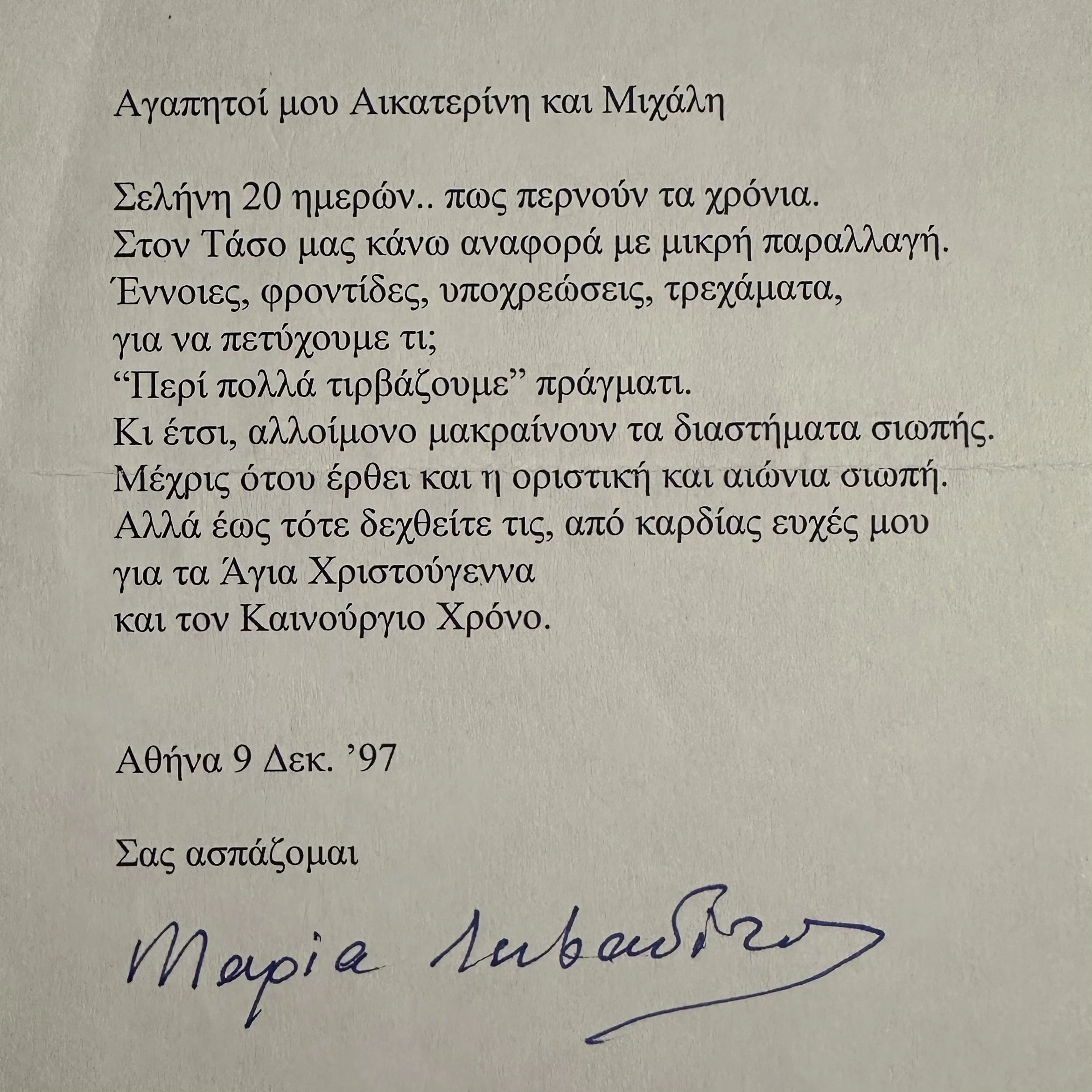
“My dearest Aikaterine and Michael
Moon of twenty days… how the years pass. / For our Tasos I make this reference with slight variation. / Stresses, concerns, running about, / To what end? / “Troubled about many things” indeed. / And so, alas the intervals of silence are prolonged. / Till that time when the final and eternal silence arrives. / However till then receive heartfelt blessings / for Holy Christmas / and the New Year.
Athens 9 Dec. ‘97
I embrace you
Maria Leivaditis”
I have counted it among the great blessings of my life that I have been able to form friendships of a depth and affection that have endured in every season. These strong bonds have oftentimes taken root in places that I could never have imagined for a little boy who grew up in his parents’ milk bar in Sydney’s inner west. Even now, later in life, I have been equally blessed to make new friends whose benevolence has renewed my faith in the goodness of people. The sadness, of course, is that a number of those dear friends are no longer with us. Even as a younger man, I found myself drawn to those souls who were older and wiser. I sought their company, their friendship and their mentoring, and went after them as a bee seeks the good floral oils. One of these beloved friends was a woman of much kindness, great generosity, and possessed of a rich life experience garnered in some of the most testing arenas of life. In her later years she became increasingly fragile but she never lost her wit nor the sharpness of her intuition. You would make a serious mistake to underestimate my friend Maria Leivaditis—(it was exactly the same with Gwen Harwood with whom I had a much briefer correspondence but was also the recipient of her strengthening grace). Maria was the wife of one of Greece’s most beloved and admired poets, Tasos Leivaditis.
This time, the focus is not on Tasos, about whom books and dissertations have been written, but precisely on Maria. Nor is this about how I first entered Maria’s orbit some years after Tasos’s passing, as that is another story altogether. Later, I plan to share some of those prized insights that she shared with me to do with the poet’s life, and how it was that we were to become friends. Instead, I want to ensure she is recognised for much more than being Tasos’s faithful and lifelong loyal companion. As I continue to read biographies, I find that the partners of many of our greatest creators, across the humanities and sciences, have too often been dismissed, forgotten, or sidelined. Sophia Tolstaya’s contribution to Tolstoy’s epic War and Peace alone bordered on the superhuman. Then there is Zelda Fitzgerald, whose fingerprints are everywhere to be found in F. Scott Fitzgerald’s novels. Vladimir Nabokov was also very much dependent on his wife, Véra Nabokov, for support and encouragement which he readily acknowledged. Mozart, Bach, and Schumann might not have completed their respective catalogues if not for Constanze, Anna Magdalena, and Clara. It is a long list that touches every discipline. Lee Krasner famously marginalised her own art to support Jackson Pollock, and it was the same with Jo Nivison and Edward Hopper.
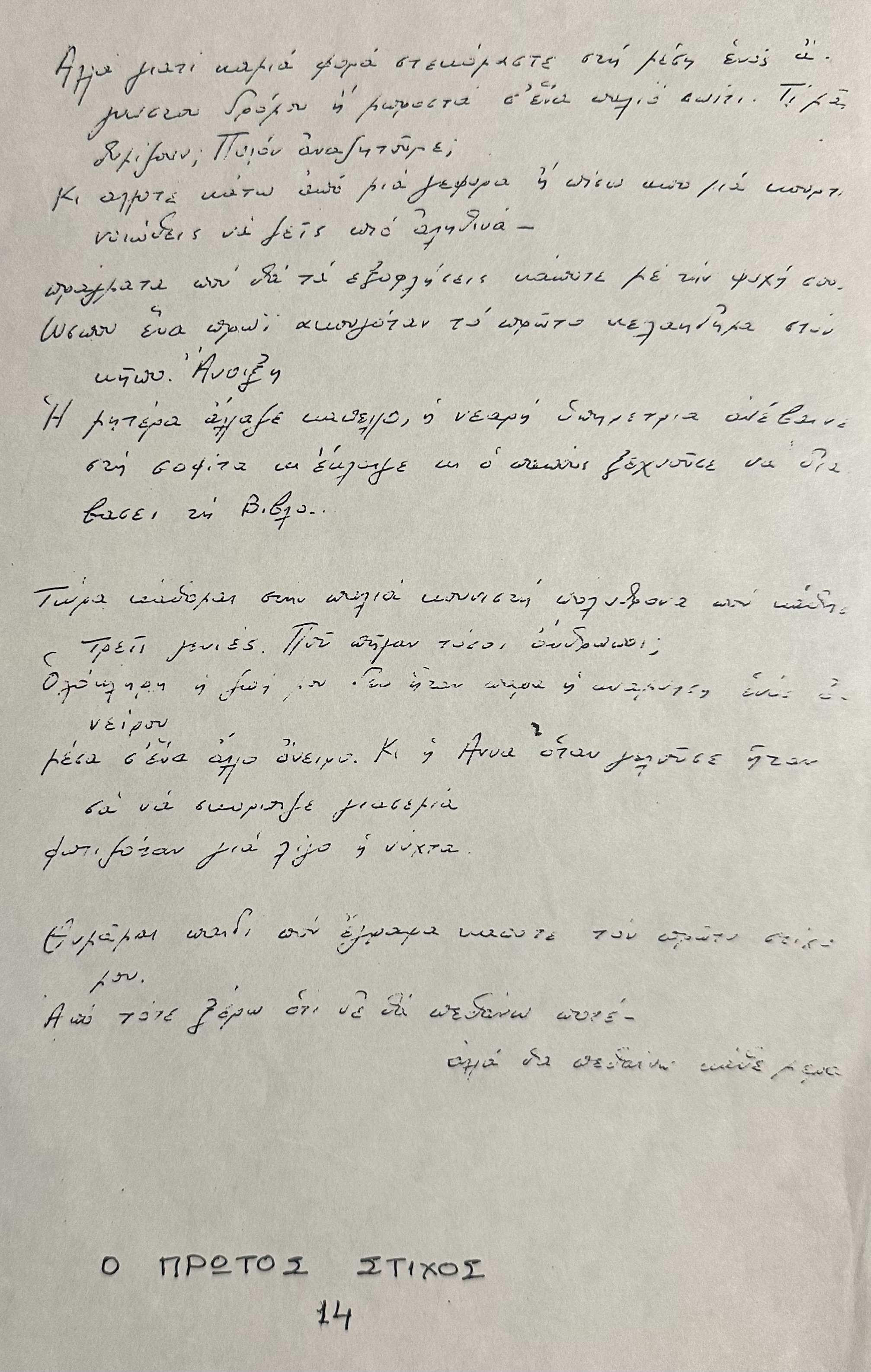
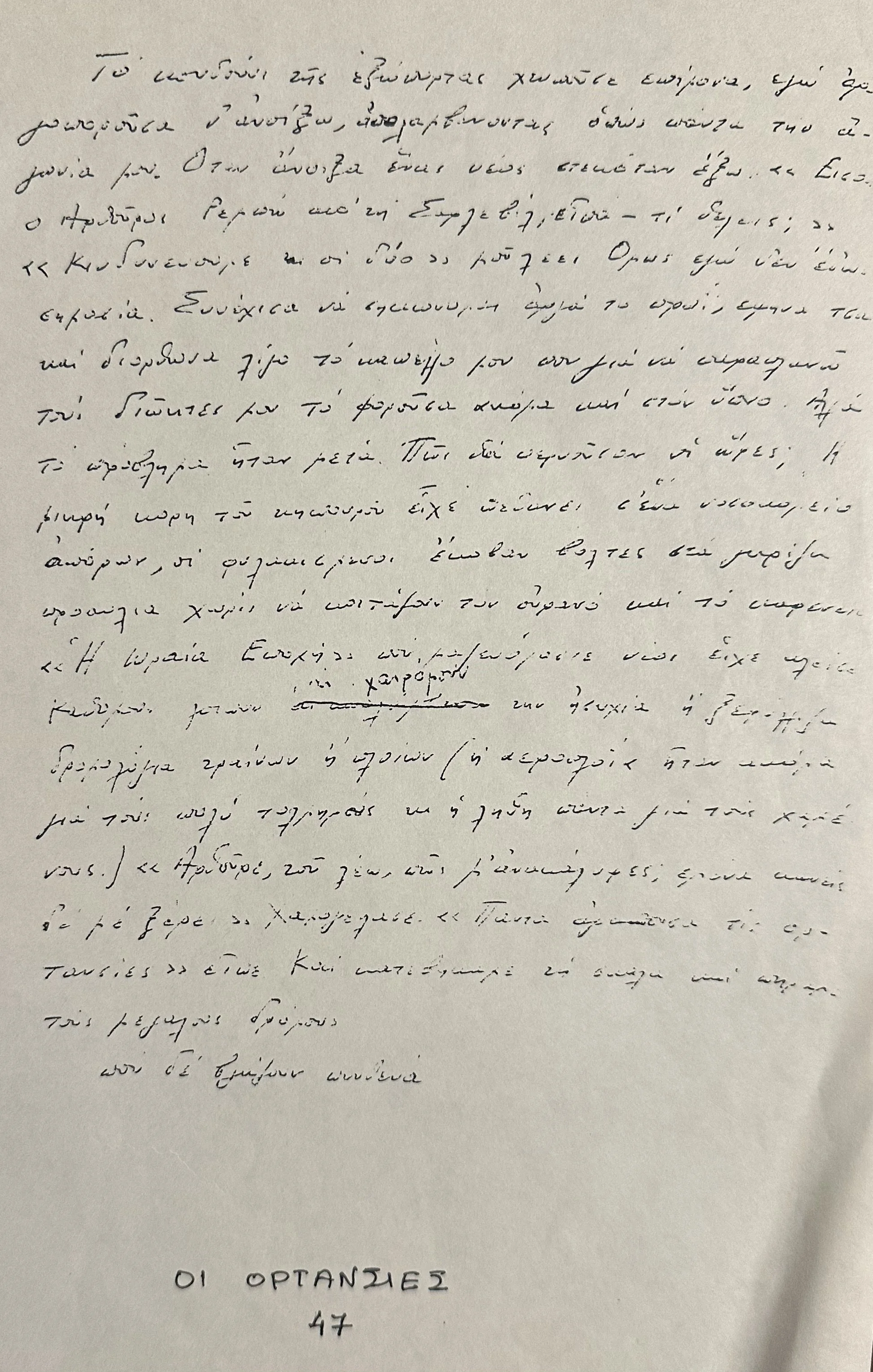
Maria would surprise us with copies of Tasos Leivaditis's hand copied drafts. (MG Michael Family Archives)
So now I return to my friend, Maria. These few reminiscences cannot do justice to her life, or to her presence in mine, but I share them nonetheless, to introduce her to those who did not know her. They reflect our years of correspondence and the many phone calls that were exchanged between us. Maria née Stoupa, the second daughter of George and Alexandra, was born sometime in the late 1920s in an inner suburb of Athens. She met the poet when they were both in their teens. They married in 1946 after she had initially resisted as she was still mourning the death of her father who had passed away during the Occupation.[1] The marriage resulted in one child, their beloved daughter, Vaso. Maria and Tasos had one grandchild that they both adored, Stelios-Petros, and presently the curator of an excellent webpage dedicated to his grandfather’s legacy.[2] Tasos was very much in love with Maria and she was in many instances his muse and inspiration. Not rarely, and for no particular reason, she told me, he would surprise her with flowers—and this to the very end of his life. He trusted Maria’s judgement. If she expressed a strong doubt about something that Tasos would write, for he would read his first drafts to her, he would normally not continue with that piece. But always she would listen, absorbed by his magical stories and only rarely interrupting. So her reflective responses would make a serious impression on the poet. These readings would customarily take place in the evenings, typically in Tasos’s study. In the background there could be music of a diverse genre ranging from the classics (they both held an enduring affinity for Chopin), Greek laïka, of course, and down to contemporary jazz. I know that Maria loved the Greek poets, and especially Angelos Sikelianos and Yiannis Ritsos. She would also speak most warmly to me of Irene Papas, and of Grigoris Bithikotsis—who famously sang Tasos’s Drapetsona and Vrehi sti Ftohogitonia set to music by Mikis Theodorakis.[3]
From Left to right, Vaso, Maria, Tasos, and Stelios-Petros. (MG Michael Family Archives)
Maria stood strong and unbreakable during the years of Tasos’s political exile, supporting her husband in every way she could, while at the same time dealing with her own pressures and making sure their young daughter was not too much affected. I early on noticed that she did not too much want to speak of those desolate years of persecution and poverty, though at times I tried to press her that I could learn more. But I soon realised that she considered this political upheaval a closed chapter not only in her own life, but also on the national scale. On the phone she would sometimes use the expression áγρια θúελλα [wild storm] for that period of Greece’s period. However, this experience did have a perceptible influence on her thinking and on the way she observed people. Despite her fragile appearance in her later years she did not lose her sharpness and was quick to discern any motives that were not healthy in those who would approach her. Often she would tell me, and how I would have wanted to have more regularly taken her counsel: “Michael, do be careful of the ‘black hats’.” Her observations on some literary stars and political heavyweights were in most instances proven correct. She was an unaffected and discerning soul.
Back in the 1990s many households still communicated by way of the old rotary phones, and making an overseas call was no simple matter. It took some effort to get through and reach a loved one on the other side of the world. And yet, outside our regular correspondence, we would speak on the phone quite regularly. At one time, when as a much younger man I found myself in a life-defining crisis, Maria was one of my great supports, and provided me with the stability and wise counsel as would a mother her own child. Indeed, at the time I was young enough to be her son. She pointed to the tribulations she and Tasos had to face and to surmount, both before and after the exile, and how with perseverance, self-belief, and the company of like-minded friends, all was endured and overcome. One of the keys she would often tell, in that very same context of the “black hats” was to be very careful of all power institutions, including the church establishment. All the same, Maria as well as Vaso, were clearly faithful souls who strongly believed that in the end it was the Creator who organized the divine providence in our lives. They both held a deep love for the Holy Mother and delighted in the Great Feasts of the Church. Their letters and postcards are testimony to this belief, and even under the most testing duress when they were nearing the end of their lives, they would turn to the Theotokos to ask for her intercessions. I remained intrigued that after Maria learnt of my expertise in Apocalypticism she became fascinated by the Book of Revelation. There were telephone calls that were spent on dissecting the book to my friend’s satisfaction—and not necessarily the more well-known pericopes such as those referencing 666 and the plagues, but more so those places that spoke of Christ as the Saviour and the evidences to the general resurrection. “Ah! Mihalis” she would say, “really[?]… that is very good.” Even now, remembering these words, and hearing her voice, brings a joy to my spirit. I can literally speak of hearing her voice as I have recordings of Maria speaking to us on tapes, they are treasured by my family. These recordings were brought back by Helen at the behest of Maria herself. I will speak of Helen, who is still with us at ninety years old, in another place below.
Maria and Vaso had their own artistic leanings. Maria enjoyed writing and this was evident in her marvellous letters, and Vaso was a designer by training, having designed covers for her father’s books. In one of her letters which often arrived as packages with copies of Tasos’s older drafts, anthologies, photographs, and various articles, she had also included a sensitive poem. She had composed the verse for the poet’s ninth anniversary since his passing, written for me and Katina, I would later learn. Maria kept writing, even though she suffered greatly with arthritic fingers towards the end of her life. This correspondence cannot be lost, and so I hope one day to send to Stelios-Petros, or to the Kapodistrian University in Greece. Maria was much loved and embraced by Tasos’s illustrious friends who adored her. She was notably close to Yiannis Ritsos, Titus Patrikios, Mikis Theodorakis, George Tsagaris, and of course, other writers and poets, too, many of whom I did not know at the time. An occasion I am particularly fond of recalling was when Mikis had only just arrived to take Maria to a literary memorial in honour of Leivaditis. We were already speaking when the larger-than-life figure arrived, and almost immediately, Maria put him on the phone to speak with me. He spoke of the poet in the most endearing of terms, referring to him by the affectionate diminutive used by his friends, “Tasoulis”. Maria was never enamoured of celebrity. The legendary figures who were regular visitors in her life, both before and after the passing of her beloved husband, came without the fanfare. They were simply friends who happened to be recognised for their craft.
An example of how Maria viewed friendship can be seen in the close bond she formed with my eldest son’s godmother, Helen Constanti. Helen (Eleni / ‘Lella’) is also deserving of her own story. Her friendship with Maria, who regarded her as a sister—Maria herself had an older sister called Eleni—and with Vaso, who held Lella in the same affection, is a long and remarkable one. If only to say, that after Tasos’s passing, Maria would not let anyone sit in his office chair—but she made an exception for Lella who had especially travelled to Greece from Australia to meet with her two dear friends. Maria loved trying to say to us on the phone: “kanggaroo” and “kooala” and we would have a great big laugh over it! I was preparing a little collection of poetry with the tentative title “Metaphysical Umbrellas” and she was delighted by it. She told me Tasos would have been quite impressed. Needless to say that, too, stuck in my memory. She enjoyed these types of plays on words. Her letters hide her humour and this playful side of her personality that was much more evident when she was speaking with you. Perhaps, I thought, when it came to writing, she would have learnt from Tasos that words put down on paper took upon themselves another materialisation that needed a stricter precision, and a more deliberate placement. There existed a marvellous balance to her that would arrive naturally in all of her communications.
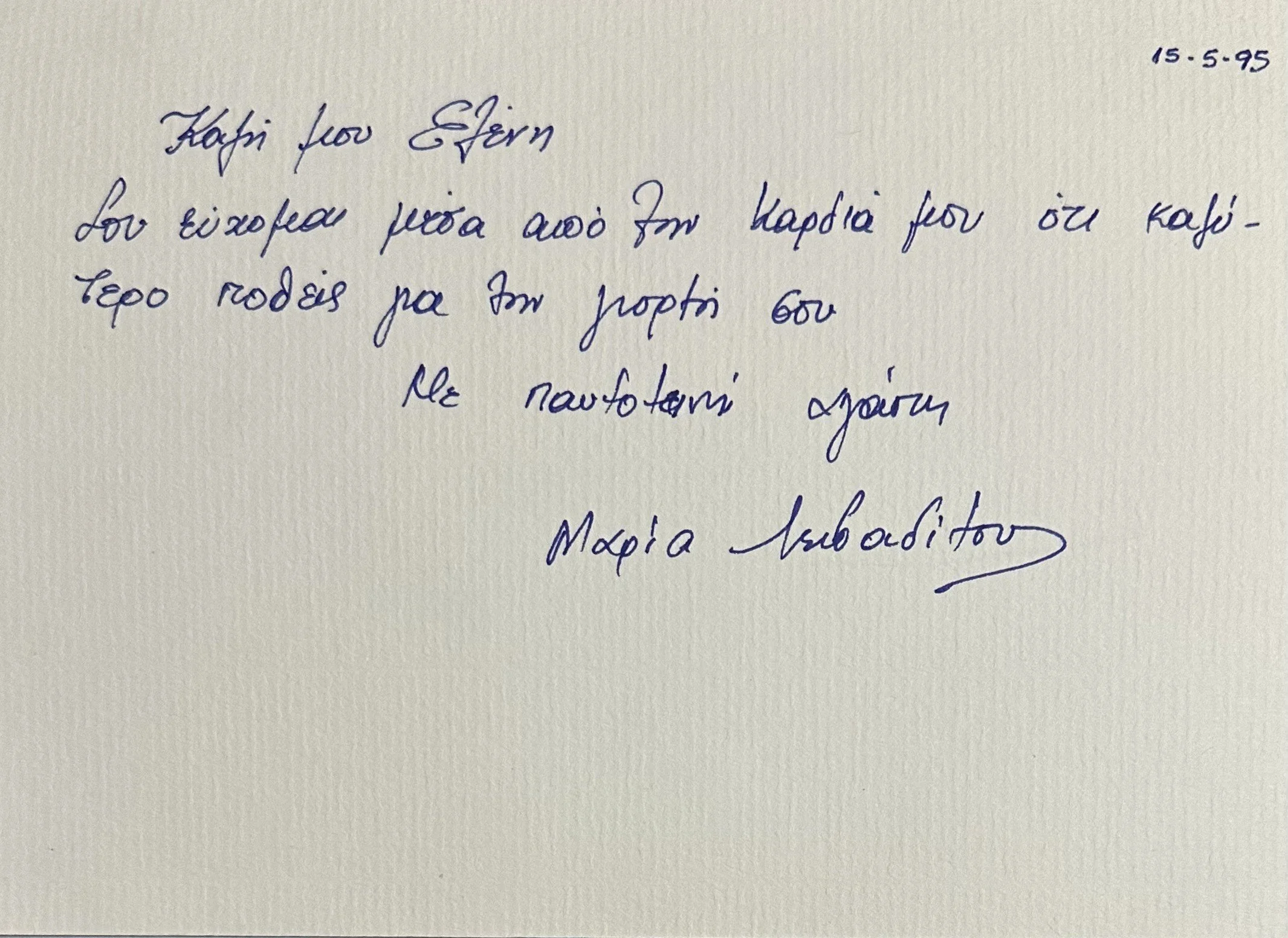
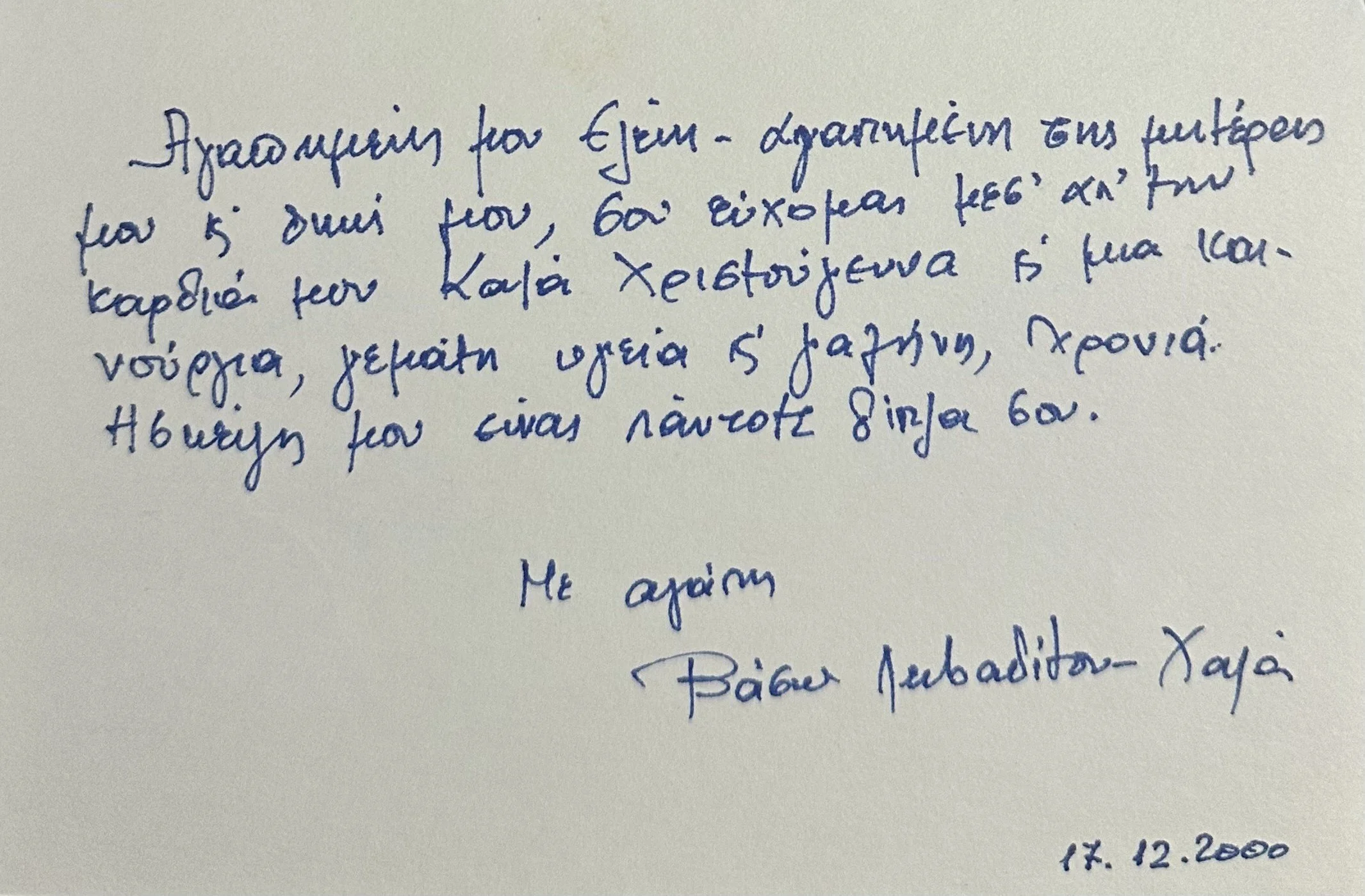
Two beautiful cards with those distinct expressions of love and faith, from Maria and Vaso. (MG Michael Family Archives)
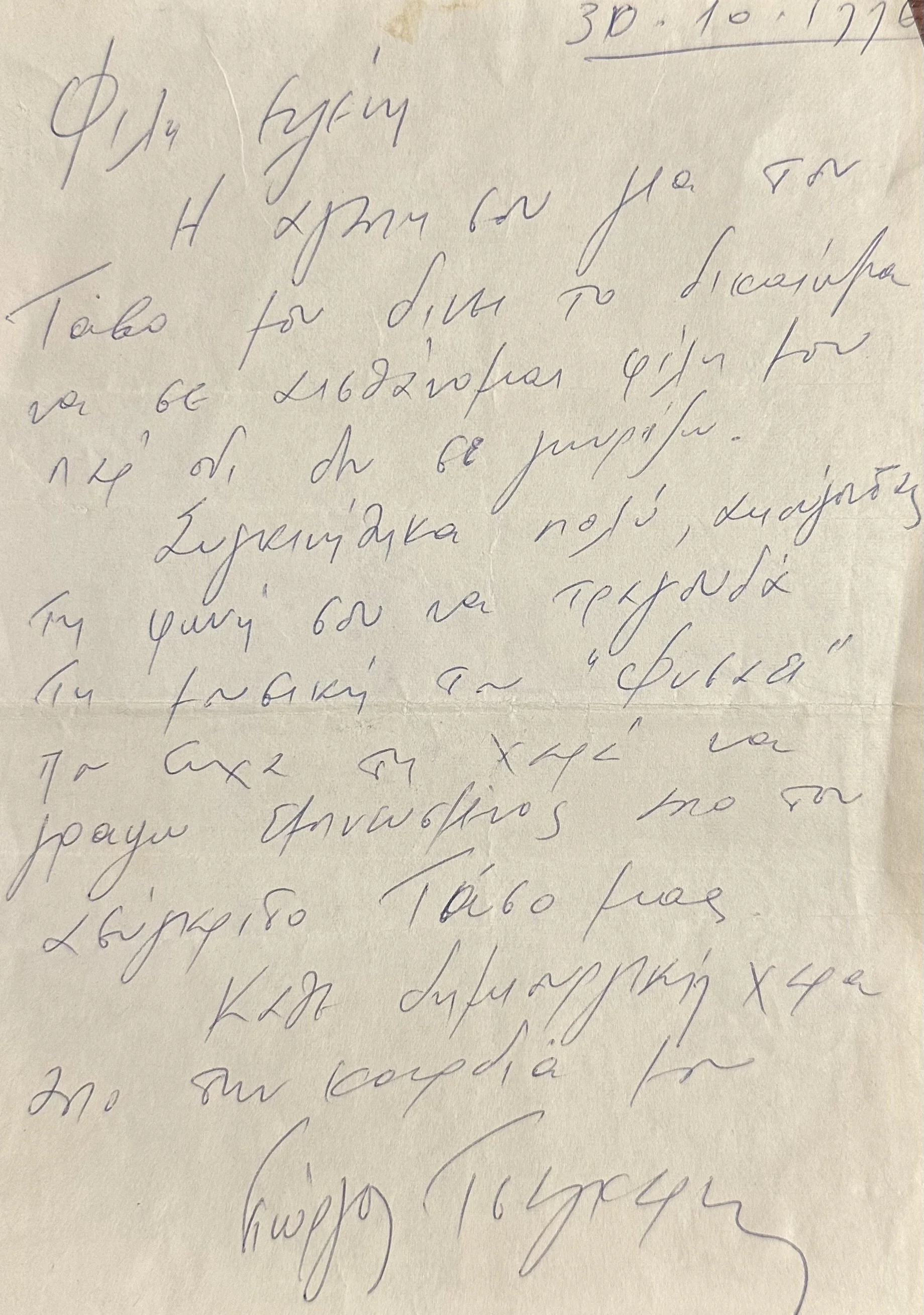
From George Tsagaris to Helen Constanti expressing his joy at receiving Helen's version of "Fysaei". (MG Michael Family Archives)
To illustrate her love of friends, even though she might not have met them in the flesh, on the morning before Katina and I were to be married, twenty-four white roses arrived. These were from Maria. This fantastic surprise has held a special place in our hearts. I knew how much she appreciated flowers and that their gifting would remind her of Tasos himself, so this gift and the words that accompanied her love for us, took on an additional dimension. I loved hearing her laugh! It was a hearty joyful laugh, and this alone would make you happy. Yes, she had that terrific sense of humour, no doubt sharpened after years of listening to Tasos and reading between the lines of his writing that would carry all of those concealed meanings. Magical realism is by its very nature connected to surrealism. In her letters, but also during our many conversations, there were only scattered references to poets and writers. For she loved her friends with devotion for a lot more than their literary reputations. This is because she had shared huge life changing experiences with them, including the aftermaths of their exiles alongside Tasos in those brutal camps in the Aegean: Makronisos, Ai Stratis, Lemnos, Ikaria, Gyaros, and then the court trials—above all as I had come to understand, Ritsos, Theodorakis, and Patrikios, were noticeably close to her. The Greek Civil War (1946-1949) divided many Greeks to the end of their lives, but it also brought many others together. Maria had also developed a lovely affection for the gentle-hearted composer George Tsagaris.[4] George had composed the music for the widely circulated album Φυσáει…—a compilation of Tasos’s poems put to music and delivered by that powerhouse voice of the Greek rock-balladeer, Vasilis Papakonstantinou.[5] Helen Constanti sang those very same selections, as a surprise gift to Maria who was so impressed that she forwarded the tape to Tsagaris. He not long after wrote to us to say it was a profoundly moving experience for him to hear his compositions sung in Australia, and sent all the way back to him Europe! George, too, adored Tasos, and Vasilis’s renditions of the poetry have since become folklore. In her early years, Lella was herself a highly respected singer and singled out by the legendary Stelios Kazantzidis when he toured Australia, but whose own trepidations in life brought her singing career to an early end.
To return to her humour. Maria was—and she would acknowledge much to her regret—a regular smoker. This was a habit she tried on numerous occasions to break. I would at the right moment take her to task, encouraging her to stop as I had become increasingly worried about her health. She would say to me: “Mihalis, you take care of the smoke in your own backyard!” And she would laugh that sweet laugh of hers that I have sorely missed, as I have Les’s sign off in his letters and cards: -“Blessings”, Les.- I had sent Maria two poems of Les Murray’s in Greek translation that I had drafted, and the next time we spoke she had some excellent questions to ask. She had spent time studying these translations and had shared them with friends. I had also sent her a number of early translations of Tasos’s that I had made into English and she asked for me to read these over the phone. I share recollections here that I have not spoken of before, but I want now at this time of my own journey, to set some of these down yet few and incomplete, not only for the record, but also should they be of interest to others.
This simple reflection in itself would not be complete without the most surreal of stories, and the unique insight into it that I have not seen anywhere else recorded—it has to do with the discovery of Leivaditis’s last manuscript The Manuscripts of Autumn. The anthology itself was published posthumously in 1990 two years after the poet’s death. It is well known that Maria found the manuscript in one of the drawers of the poet’s study. But what is not known is what compelled her to go looking for ‘something’. During one of our conversations I asked her to speak to me of that precious find. And what she added to the published version was wonderful and something that the magical realism of Tasos’s spirit would have revelled in! Maria told me she withheld this event for fear of diminishing from the unexpected find itself, but I felt, too, her natural apprehension of not being believed. On the night before her discovery she had a dream. I have tried to remember some of the finer details of that dream but they now elude me, however, this is not the point. She got out of bed and was compelled to go into the poet’s study. The next morning she returned to the study, and went through Tasos’s drawers again. And, there, ‘lo and behold’, the anthology buried beneath a stack of paper. Maria was not superstitious, her faith was healthy, so she had asked for my opinion and we both agreed, that at the very least, it was a fabulous coincidence and at best—a ‘nudge’ from the poet himself.[6] We know that towards the later years of his life, evidenced, at the same time from what is typically termed his “Third Period” (1979-1987), he explored more deeply the mystery of the person of Jesus Christ—more Tolstoyan (transcendent Christ), than Dostoevskian (human Christ). It was during this time The Blind Man with the Lantern (1983) was published, which included those enchanting 12 Conversations all beginning with the supplication “Lord” (Kyrie). Maria had told me, and this to the chagrin of some of his more left-leaning comrades, that he would not pass a church without stepping inside to light a candle, and that he had pinned numerous little paper icons on the inside of one of his coats. This, too, for her own good reasons, Maria was hesitant to make public. This is all I can say on the matter, for here, as well, I did not think it right that I should press her on the issue.
An invitation by maria to attend one of tasos’s literary memorials three years after the poet’s passing. (MG Michael FAMILY archives)
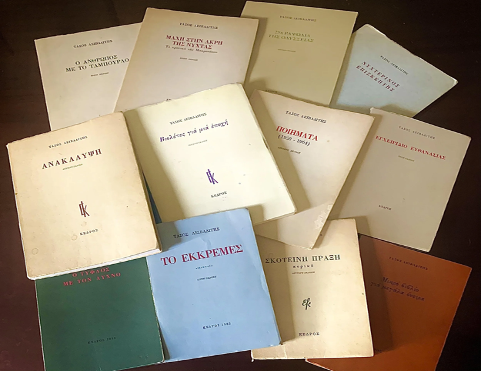
A selection of Tasos's anthologies together with the posthumously discovered The Manuscripts of Autumn, all precious gifts from Maria over the many years of a long correspondence. (MG Michael Family Archives)
I had asked for her favourite anthology of Tasos’s. The Manuscripts of Autumn, though before that it had been The Blind Man with the Lantern. And Drapetsona was her favourite of Leivaditis’s poems set to music.[7] And, even now I will still smile, for more than once she would quote these lines from Tasos’s The Blind Man… “God is not being able to sleep.” Similarly, she enjoyed Kafka and liked it when Leivaditis would be compared to Franz.
In one of her letters Maria would also gift to me, these overwhelmingly generous words (I will share below) that have kept my spirits from collapsing on this subject given the desire that I had nurtured, to begin on a long term adventure of translating Tasos into English. I had more than once received Maria’s blessing to do with this dream of mine. I had, sure enough, a number of translations already completed, but there is no actual purpose to them now as a friend has started on this priceless labour and done a very good job himself. My own translations have occasionally appeared in my journals and in my long essay on Tasos’s thematology.[8] This was the loving spirit of my friend, Maria Leivaditis, and but one of the many expressions of her compassionate-love:
“The eternal sleep of our Tasos, may not always be peaceful because you will be hurting, that he is no longer with us… but your verse, our dearest Michael: ‘I never hid it that it is from you / that I learnt poetry’, will bring him calm.” (M.L. to M.G., 19.3.96, Athens)
“Dear friend and poet [Michael], after your last letter I can now onwards call you friend. Indeed, you as is the same with Eleni, I feel you very dear friends like those who are next to me… I confess that I am deeply moved that Tasos’s verse fit and tie in so harmoniously with your own inspirations.” (M.L. to M.G., 4.12. 92, Athens)
The famous sketch of Tasos Leivaditis drawn by Tasos's and Maria's only grandchild, Stelios-Petros. Katina and I were the first to receive this charming portrait. (MG Michael Family Archives)
During our lifetime friendships will naturally come and go, even some of the more beautiful ones that we believed would never leave. But then there are those that will survive, and it is these that will endure above and beyond any tribulation or temporal separation. For they are forged in the blood-beat of the heart, and live on in the flutter of the angelwing.
“I also enclose a sketch of Leivaditis done by my grandson Stelios-Petros which he gifted to me. Copies of this sketch I am sending first of all to you and Eleni. He is self-taught and still young of age, only sixteen-years of age… and his grandfather was proud of him.” (M.L. to M.G., 15.10.93, Athens)
This nota bene that follows was inspired by Maria Leivaditis, Les Murray, George Cazouris, and George Kanarakis. Their absence has left a marked gap in my own life and the lives of their other friends, let alone the lives of their families. I have missed each of these beloved companions beyond words, and yet it is their very words that continue to reach out to comfort me and to remind me of things I must not forget.
One of the hardest decisions one has to make (and particularly when private correspondence becomes part of a literary or historical record), what to do with letters accumulated over many decades of correspondence. It is a racking responsibility determining which letters should be kept and archived for future generations to read, enjoy, and learn from, and which should be returned to the families of one’s correspondents. Most difficult of all, deciding which should be destroyed, but sometimes even that must be done. Letters are confessional by their very nature, and I believe that, in many instances, both sender and recipient have entered into an unspoken understanding that some exchanges are never intended to be made public. I know this is what I have wanted and asked for myself. There are letters whose personal content could far outweigh their archival value. In all likelihood, I belong to an old school that believes the letter, certainly in a moral sense, has two owners, though legally that might not technically be the case. Yes, sometimes our letters are written with the express desire they survive, and that, at the right hour, they might be shared. Where a beloved of mine has passed away, I have a fairly good judgement of what their wishes might ultimately have been. If I am uncertain, I would hope to err on the side of protecting the intimacy of trust. Nowadays, the same goes especially for our emails. I hope that sometime in the future, the same compassionate discernment might be equally afforded to me.
On a more personal note, if this should be of interest, no few of those bonds that I have mentioned, have been, and continue to be, with wonderful writers and fabulous thinkers, and their correspondence has become part of the record of these friendships. Looking back, it is only rarely that I was asked to read a letter and then to destroy it—and when I have been asked, I have done so immediately. There have also been those few occasions when I have gone back to my letters and decided, with a palpable sadness, that I should not keep a particular one. This is another dimension of the practise of compassion, to keep on loving beyond those limitations of the temporal spaces.
I feel a great deal of joy in sharing this small selection of Maria’s correspondence with you here below. This sample serves a dual purpose. First and foremost, it reveals Maria as a writer of meaningfully beautiful letters; a protector of Tasos’s legacy; the love of her only grandchild, Stelios-Petros; and together with her dearest daughter Vaso, a soul of deep and unconditional faith. Then, also, her incredible gift to me that has oftentimes, and even to this very day lifted my spirits, that she discerned something of her beloved husband in my humble person. And especially during these recent times in my life, this has been of a very special significance—it was as if she knew. More than once I felt that beneath her words, both spoken and written, there were things she wanted to be made known at the right hour.
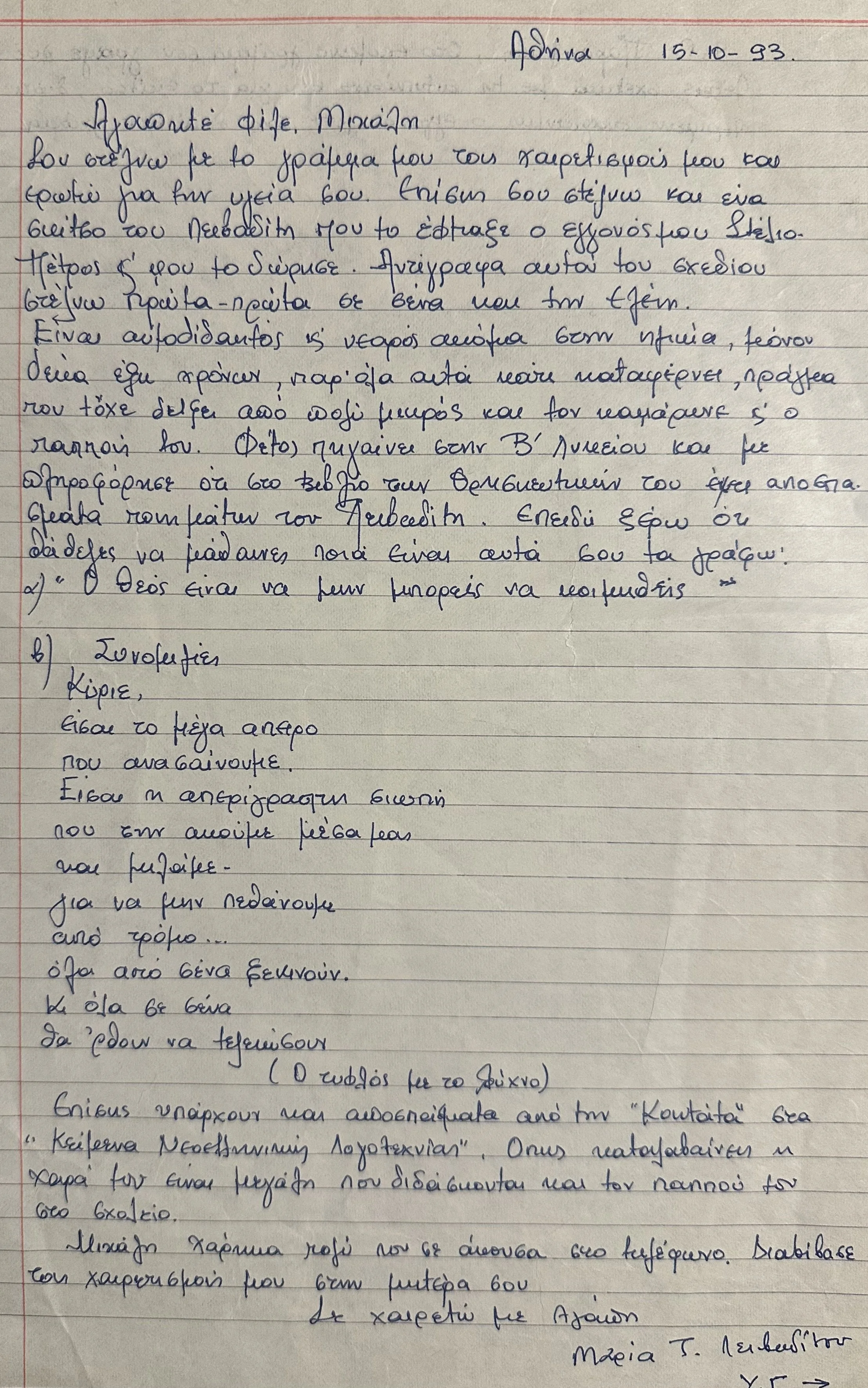
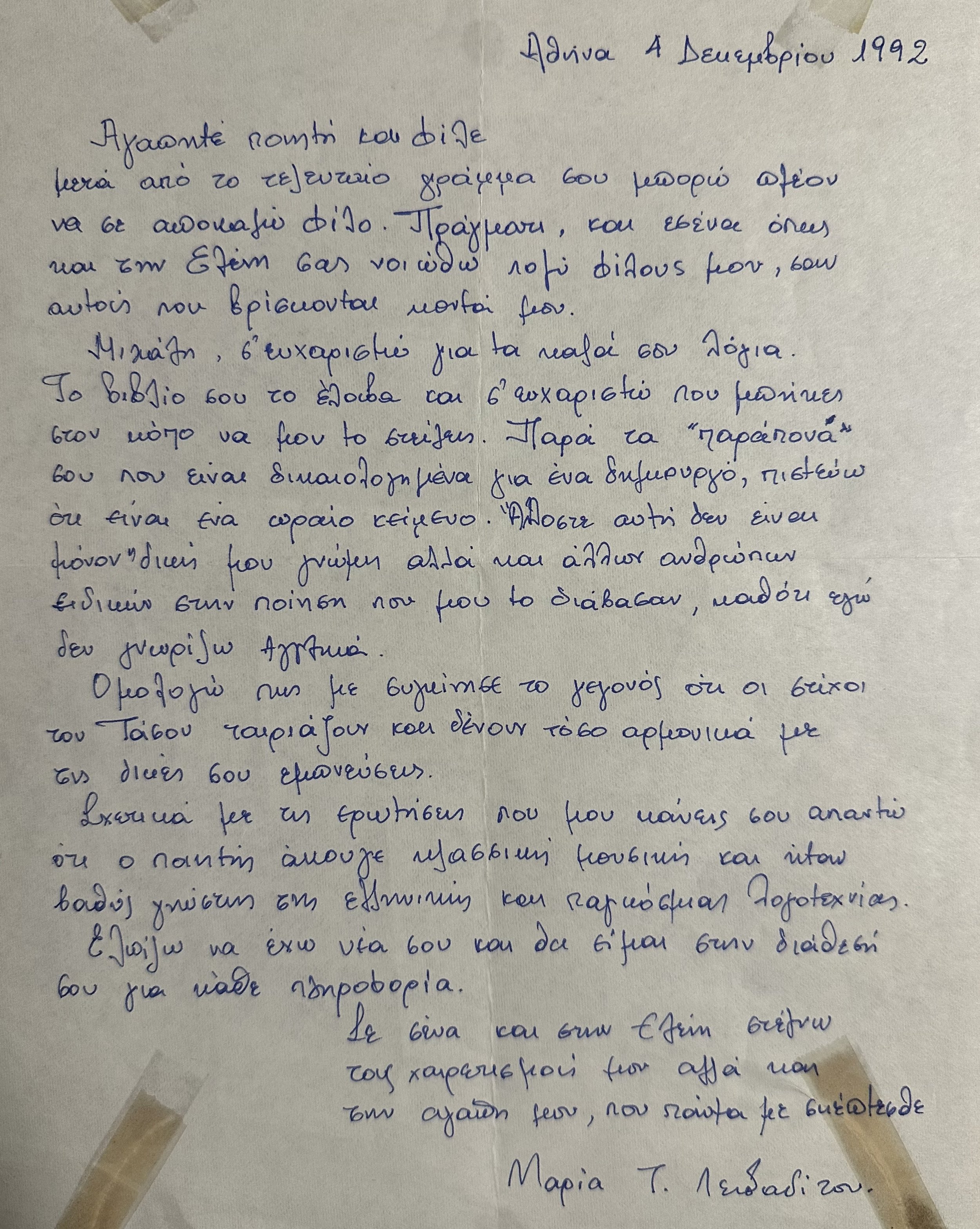
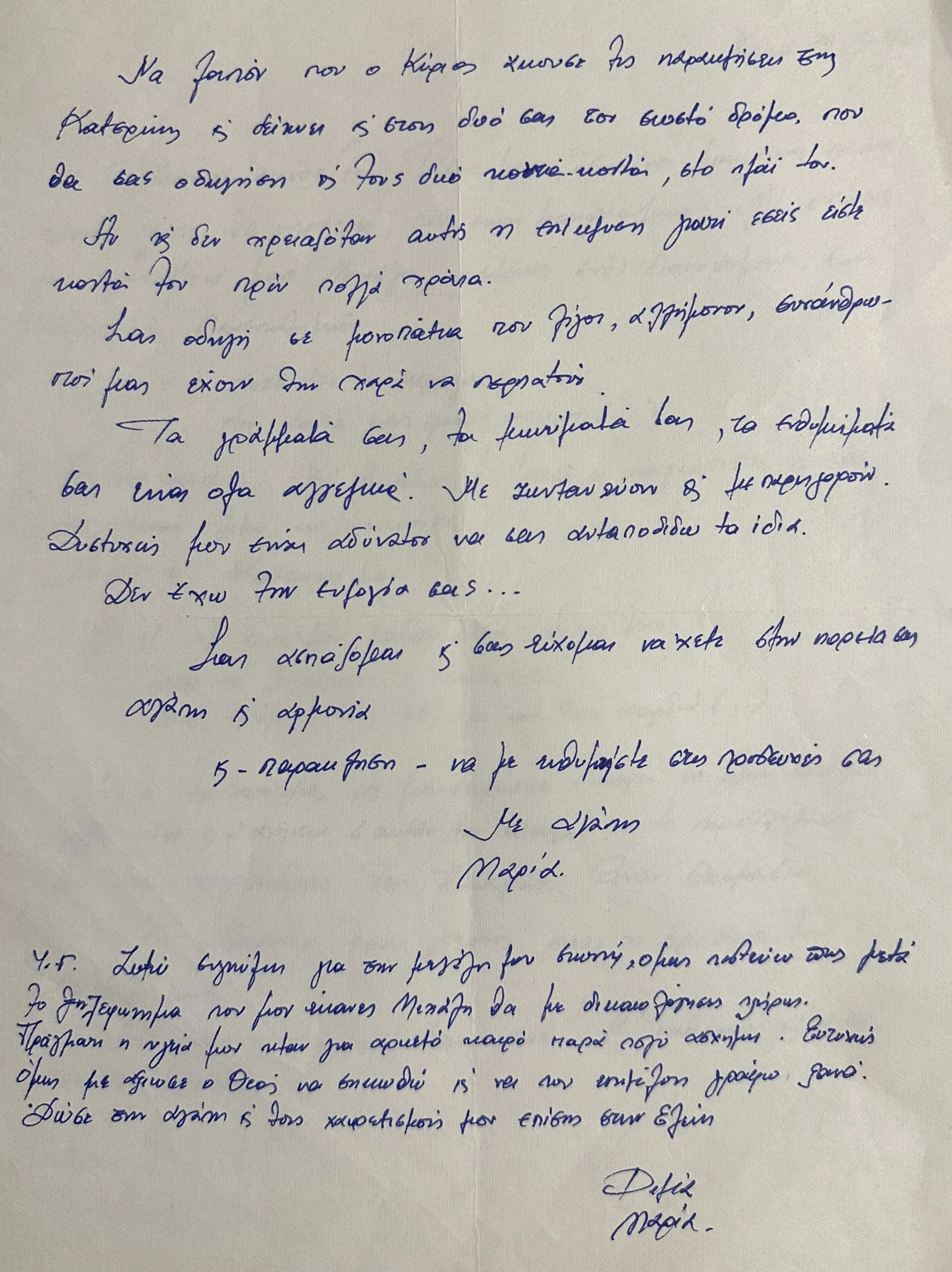
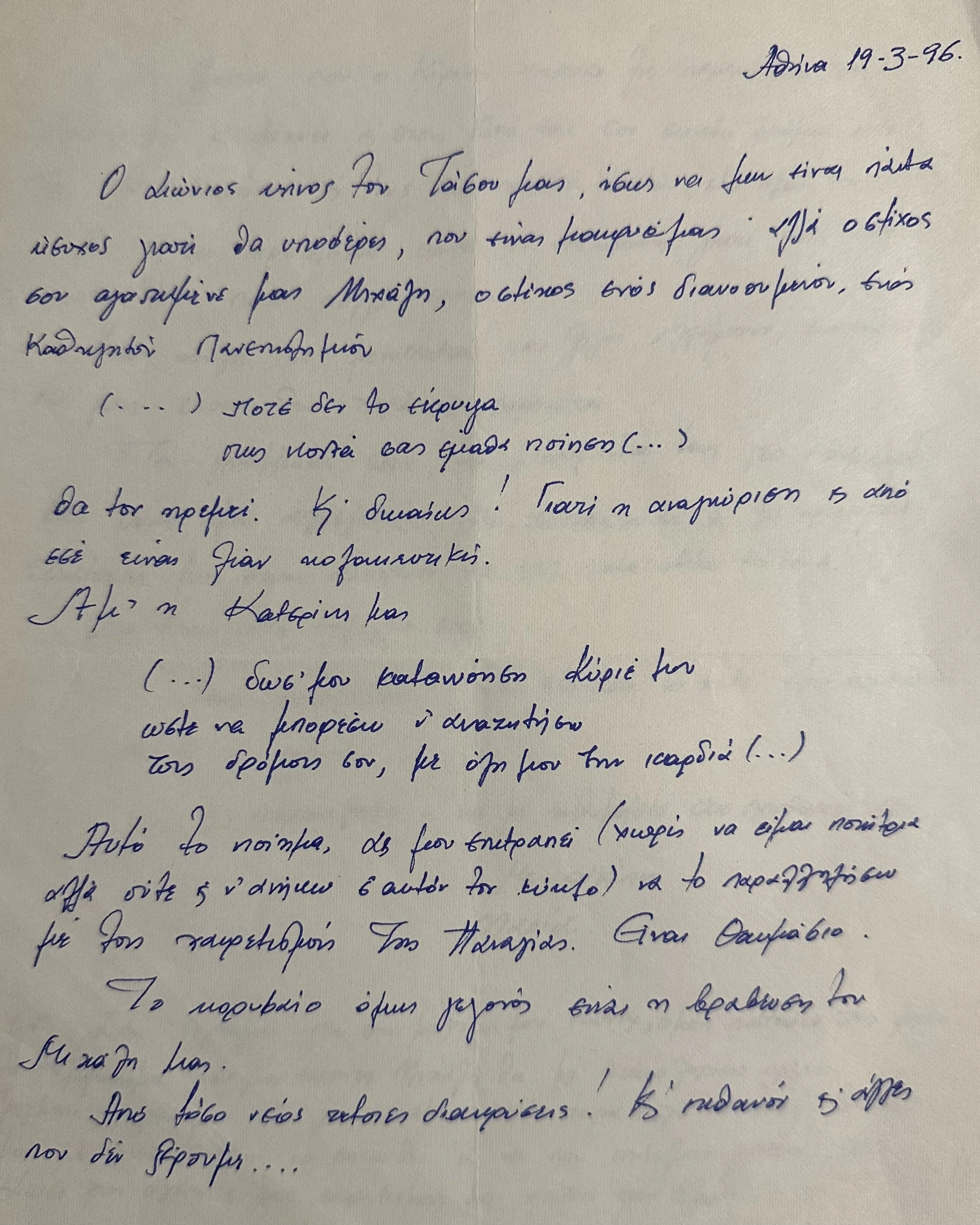
A sample of Maria Leivaditis's fabulous letters and these ones are with their own special significance. (MG Michael Family Archives)
[1] I did not wish to probe too much into these early years for I could see it was not a place she was too comfortable to readily revisit. An excellent timeline of Maria’s and Tasos’s more important milestones can be found in a special issue of ΔΙΑΒΑΖΩ, Vol. 228, 1989. Maria herself had sent me this collection of essays and she was very proud of them. I had been planning to write a dissertation on the poet and had already made quite a number of translations of Tasos’s prose but health and other issues would later intervene so this dream of ours that I had planned for my retirement years would not be realised. In that very same issue with the chronology of Tasos’s life, Maria herself had made at least two corrections in blue pen. The first where it is said that Tasos [Anastasios] was born Panteleimon-Anastasios, Maria had drawn lines over the name Panteleimon. In that same paragraph she repeated that deletion at a similar reference. She was meticulous with anything to do with the poet’s legacy and would make sure to correct the record.
[2] https://stepeha.wixsite.com/tasosleivaditis/blank
[3] https://www.youtube.com/watch?v=O0L-9DGywy4
[4] https://www.youtube.com/watch?v=958fasnXjrQ&t=10s
[5] https://www.youtube.com/watch?v=9p_nWAPeT5U&list=RD9p_nWAPeT5U&start_radio=1
[6] I have no written evidence for this marvellous story. Only what I have remembered from all of that time ago. Maria and I spoke of so many things that I hope to write another essay on what I can still reasonably recollect from our telephone talks on Tasos’s life and poetry.
[7] https://www.youtube.com/watch?v=PoVCJmId5TU&list=RDPoVCJmId5TU&start_radio=1