On the Loveliness of my Wonderful Friend Maria Leivaditis

When they exiled us from Paradise, Maria was crying. I then took her to the hotel opposite because we had to get on with life. When we came out it was getting dark. Maria caressed her stomach. “There is hope,” she said. / Hope which makes the world even more uncertain. (T.L., The Manuscripts of Autumn)

His name Jacob, hers the more serene: Maria. They stood upright beneath the trees, with hands clasped … (T.L., Violets for a Season)
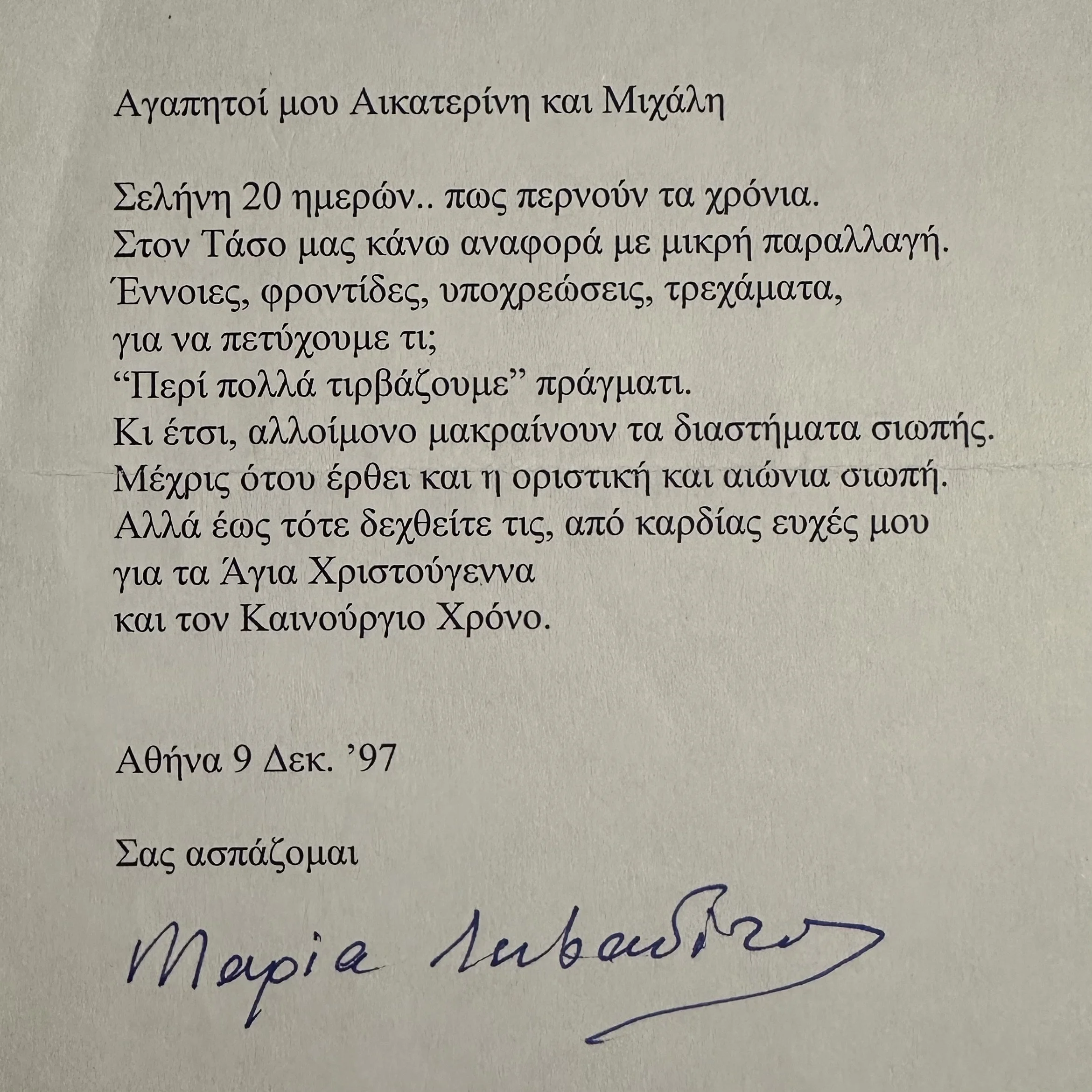
“My dearest Aikaterine and Michael

Moon of twenty days… how the years pass. / For our Tasos I make  this reference with slight variation. / Stresses, concerns, running about, / To what end? / “Troubled about many things” indeed. / And so, alas the intervals of silence are prolonged. / Till that time when the final and eternal silence arrives. / However till then receive heartfelt blessings / for Holy Christmas / and the New Year.

Athens 9 Dec. ‘97

I embrace you

Maria Leivaditis”

I have counted it among the great blessings of my life that I have been able to form friendships of a depth and affection that have endured in every season. These strong bonds have oftentimes taken root in places that I could never have imagined for a little boy who grew up in his parents’ milk bar in Sydney’s inner west. Even now, later in life, I have been equally blessed to make new friends whose benevolence has renewed my faith in the goodness of people. The sadness, of course, is that a number of those dear friends are no longer with us. Even as a younger man, I found myself drawn to those souls who were older and wiser. I sought their company, their friendship and their mentoring, and went after them as a bee seeks the good floral oils. One of these beloved friends was a woman of much kindness, boundless generosity, and possessed of a rich life experience garnered in some of the most testing arenas of life. In her later years she became increasingly fragile but she never lost her wit nor the sharpness of her intuition. You would make a serious mistake to underestimate my friend Maria Leivaditis—(it was exactly the same with Gwen Harwood with whom I had a much briefer correspondence but was also the recipient of her strengthening grace). Maria was the wife of one of Greece’s most beloved and admired poets, Tasos Leivaditis (1922-1988).

This time, the focus is not on Tasos, about whom books and dissertations have been written, but precisely on Maria. Nor is this about how I first entered Maria’s orbit some years after Tasos’s passing, as that is another story altogether. Later, I plan to share some of those prized insights that she shared with me to do with the poet’s life, and how it was that we were to become friends. Instead, I want to ensure she is recognised for much more than being Tasos’s faithful and lifelong loyal companion. As I continue to read biographies, I find that the partners of many of our greatest creators, across the humanities and sciences, have too often been dismissed, forgotten, or sidelined. Sophia Tolstaya’s contribution to Tolstoy’s epic War and Peace alone bordered on the superhuman. Then there is Zelda Fitzgerald, whose fingerprints are everywhere to be found in F. Scott Fitzgerald’s novels. Vladimir Nabokov was also very much dependent on his wife, Véra Nabokov, for support and encouragement which he readily acknowledged. Mozart, Bach, and Schumann might not have completed their respective catalogues if not for Constanze, Anna Magdalena, and Clara. It is a long list that touches every discipline. Lee Krasner famously marginalised her own art to support Jackson Pollock, and it was the same with Jo Nivison and Edward Hopper.
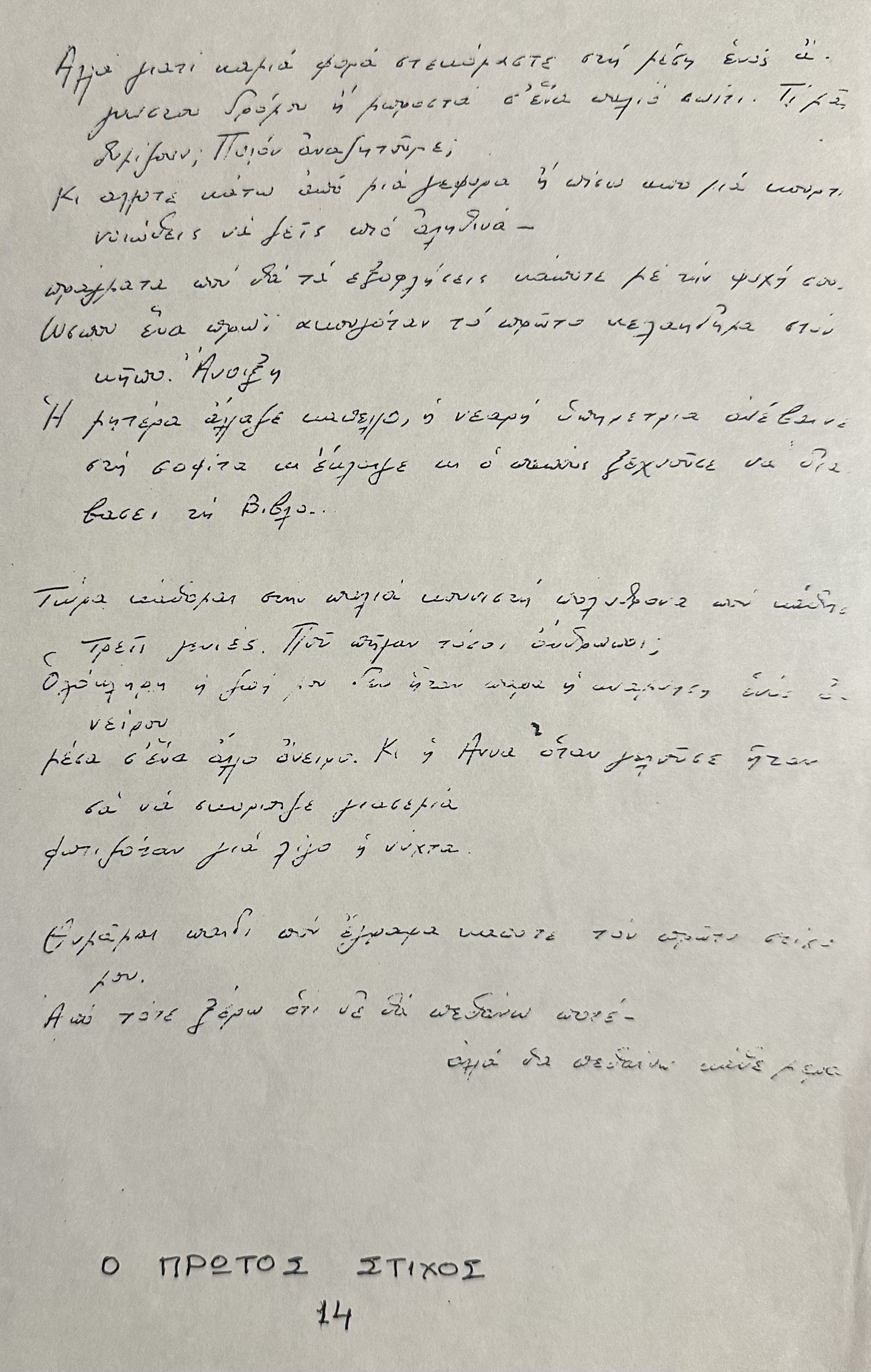
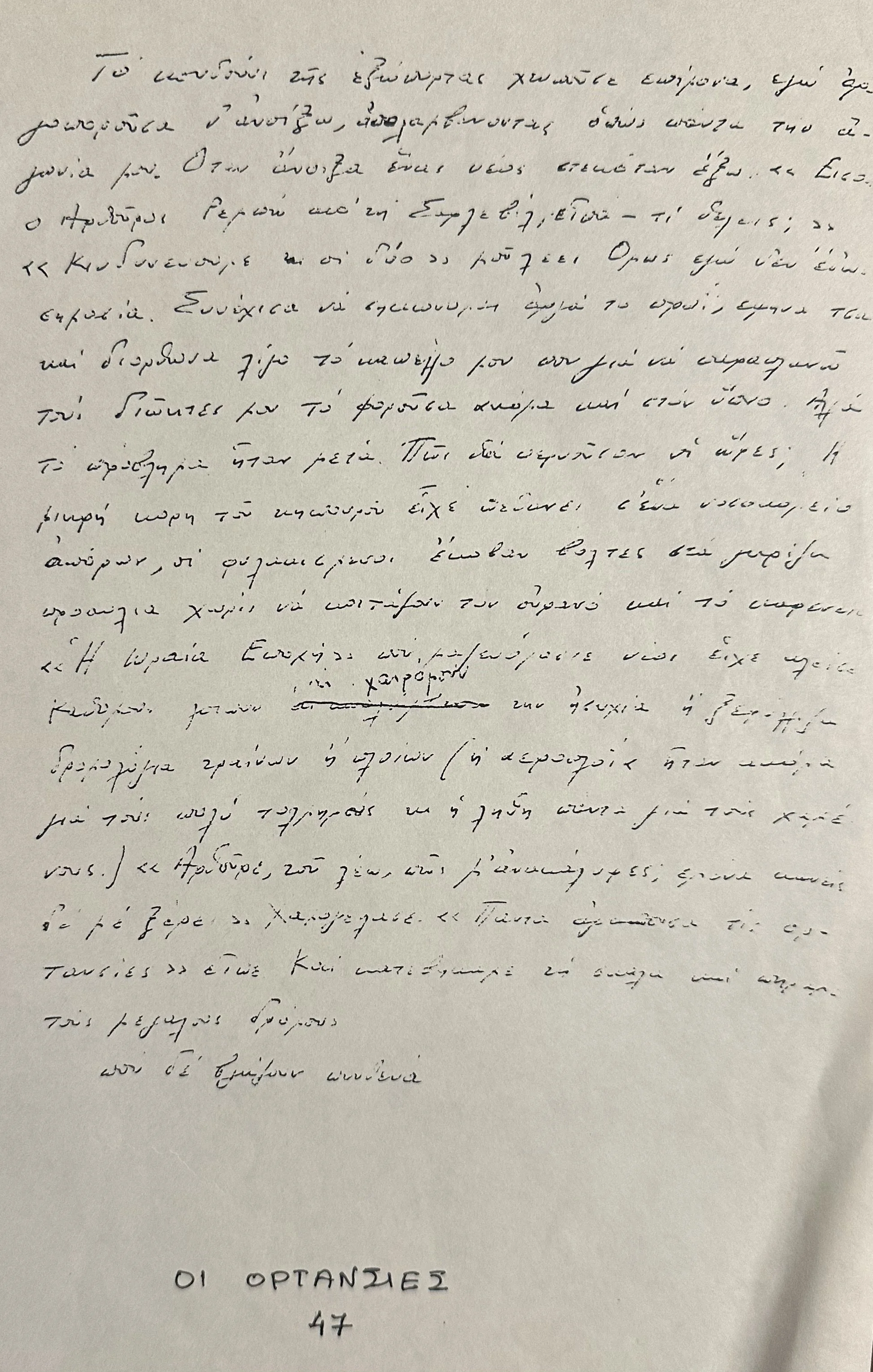
Maria would surprise us with copies of Tasos Leivaditis's hand copied drafts. (MG Michael Family Archives)

So now I return to my friend, Maria. These few reminiscences cannot do justice to her life, or to her presence in mine, but I share them nonetheless, to introduce her to those who did not know her. They reflect our years of correspondence and the many phone calls that were exchanged between us. Maria née Stoupa, the second daughter of George and Alexandra, was born sometime in the late 1920s in an inner suburb of Athens. She met the poet when they were both in their teens. They married in 1946 after she had initially resisted as she was still mourning the death of her father who had passed away during the Occupation.[1] The marriage resulted in one child, their beloved daughter, Vaso. Maria and Tasos had one grandchild that they both adored, Stelios-Petros, and presently the curator of an excellent webpage dedicated to his grandfather’s legacy.[2] Tasos was very much in love with Maria and she was in many instances his muse and inspiration. Not rarely, and for no particular reason, she told me, he would surprise her with flowers—and this to the very end of his life. He trusted Maria’s judgement. If she expressed a lingering doubt about something that Tasos would write, for he would read his first drafts to her, he would normally not continue with that piece. But always she would listen, absorbed by his magical stories and only rarely interrupting. So her reflective responses would make a serious impression on the poet. These readings would customarily take place in the evenings, typically in Tasos’s study. In the background there could be music of a diverse genre ranging from the classics (they both held an enduring affinity for Chopin), Greek laïka, of course, and down to contemporary jazz. I know that Maria loved the Greek poets, and especially Angelos Sikelianos and Yiannis Ritsos. She would also speak most warmly to me of Irene Papas, and of Grigoris Bithikotsis—who famously sang Tasos’s Drapetsona and Vrehi sti Ftohogitonia set to music by Mikis Theodorakis.[3]

From Left to right, Vaso, Maria, Tasos, and Stelios-Petros. (MG Michael Family Archives)

Maria stood resilient and unbreakable during the years of Tasos’s political exile, supporting her husband in every way she could, while at the same time dealing with her own pressures and making sure their young daughter was not too much affected. I early on noticed that she did not too much want to speak of those desolate years of persecution and poverty, though at times I tried to press her that I could learn more. But I soon realised that she considered this political upheaval a closed chapter not only in her own life, but also on the national scale. On the phone she would sometimes use the expression áγρια θúελλα [wild storm] for that turbulent period of Greece’s modern history. [4] However, this experience did have a perceptible influence on her thinking and on the way she observed people. Despite her fragile appearance in her later years she did not lose her sharpness and was quick to discern any motives that were not healthy in those who would approach her. Often she would tell me, and how I would have wanted to have more regularly taken her counsel: “Michael, do be careful of the ‘black hats’.” Her observations on some literary stars and political heavyweights were in most instances proven correct. She was a grounded and discerning soul.

Back in the 1990s many households still communicated by way of the old rotary phones, and making an overseas call was no simple matter. It took some effort to get through and reach a loved one on the other side of the world. And yet, outside our regular correspondence, we would speak on the phone quite frequently. At one time, when as a much younger man I found myself in a life-defining crisis, Maria was one of my lasting supports, and provided me with the stability and wise counsel as would a mother her own child. Indeed, at the time I was young enough to be her son. She pointed to the tribulations she and Tasos had to face and to surmount, both before and after the exile, and how with perseverance, self-belief, and the company of like-minded friends, all was endured and overcome. One of the keys she would often tell, in that very same context of the “black hats” was to be very careful of all power institutions, including the church establishment. All the same, Maria as well as Vaso, were manifestly souls of faith who believed that in the end it was the Creator who organized the divine providence in our lives. They both held a deep love for the Holy Mother and delighted in the Great Feasts of the Church. Their letters and postcards are testimony to this belief, and even under the most testing duress when they were nearing the end of their lives, they would turn to the Theotokos to ask for her intercessions. I remained intrigued that after Maria learnt of my expertise in Apocalypticism she became fascinated by the Book of Revelation. There were telephone calls that were spent on dissecting the book to my friend’s satisfaction—and not necessarily the more well-known pericopes such as those referencing 666 and the plagues, but more so those places that spoke of Christ as the Saviour and the evidences to the general resurrection. “Ah! Mihalis” she would say, “really[?]… that is very good.” Even now, remembering these words, and hearing her voice, brings a joy to my spirit. I can literally speak of hearing her voice as I have recordings of Maria speaking to us on tapes, they are treasured by my family. These recordings were brought back by Helen at the behest of Maria herself. I will speak of Helen, who is still with us at ninety years old, in another place below.

Maria and Vaso had their own artistic leanings. Maria enjoyed writing and this was evident in her marvellous letters, and Vaso was a designer by training, having designed covers for her father’s books. In one of her letters which often arrived as packages with copies of Tasos’s older drafts, anthologies, photographs, and various articles, she had also included a sensitive poem. She had composed the verse for the poet’s ninth anniversary since his passing, written for me and Katina, I would later learn. Maria kept writing, even though she suffered greatly with arthritic fingers towards the end of her life. This correspondence cannot be lost, and so I hope one day to send to Stelios-Petros, or to the Kapodistrian University in Greece. Maria was much loved and embraced by Tasos’s illustrious friends who adored her. She was notably close to Yiannis Ritsos, Titus Patrikios, Mikis Theodorakis, George Tsagaris, and of course, other poets and composers, too, many of whom I did not know at the time. An occasion I am particularly fond of recalling was when Mikis had only just arrived to take Maria to a literary memorial in honour of Leivaditis. We were already speaking when the larger-than-life figure arrived, and almost immediately, Maria put him on the phone to speak with me. He spoke of the poet in the most endearing of terms, referring to him by the affectionate diminutive used by his friends, “Tasoulis”. Maria was never enamoured of celebrity. The legendary figures who were regular visitors in her life, both before and after the passing of her beloved husband, came without the fanfare. They were simply friends who happened to be recognised for their craft.

An example of how Maria viewed friendship can be seen in the close bond she formed with my eldest son’s godmother, Helen Constanti. Helen (Eleni / ‘Lella’) is also deserving of her own story. Her friendship with Maria, who regarded her as a sister—Maria herself had an older sister called Eleni—and with Vaso who held Lella in the same affection, is a long and remarkable one. If only to say, that after Tasos’s passing, Maria would not let anyone sit in his office chair—but she made an exception for Lella who had especially travelled to Greece from Australia to meet with her two dear friends. Maria loved trying to say to us on the phone: “kanggaroo” and “kooala” and we would burst out laughing over it! I was preparing a little collection of poetry with the tentative title “Metaphysical Umbrellas” and she was delighted by it. She told me Tasos would have been quite impressed. Needless to say that, too, stuck in my memory. She enjoyed these types of plays on words. Her letters hide her humour and this playful side of her personality that was much more evident when she was speaking with you. Perhaps, I thought, when it came to writing, she would have learnt from Tasos that words put down on paper took upon themselves another materialisation that needed a stricter precision, and a more deliberate placement. There existed a marvellous balance to her that would arrive naturally in all of her communications.
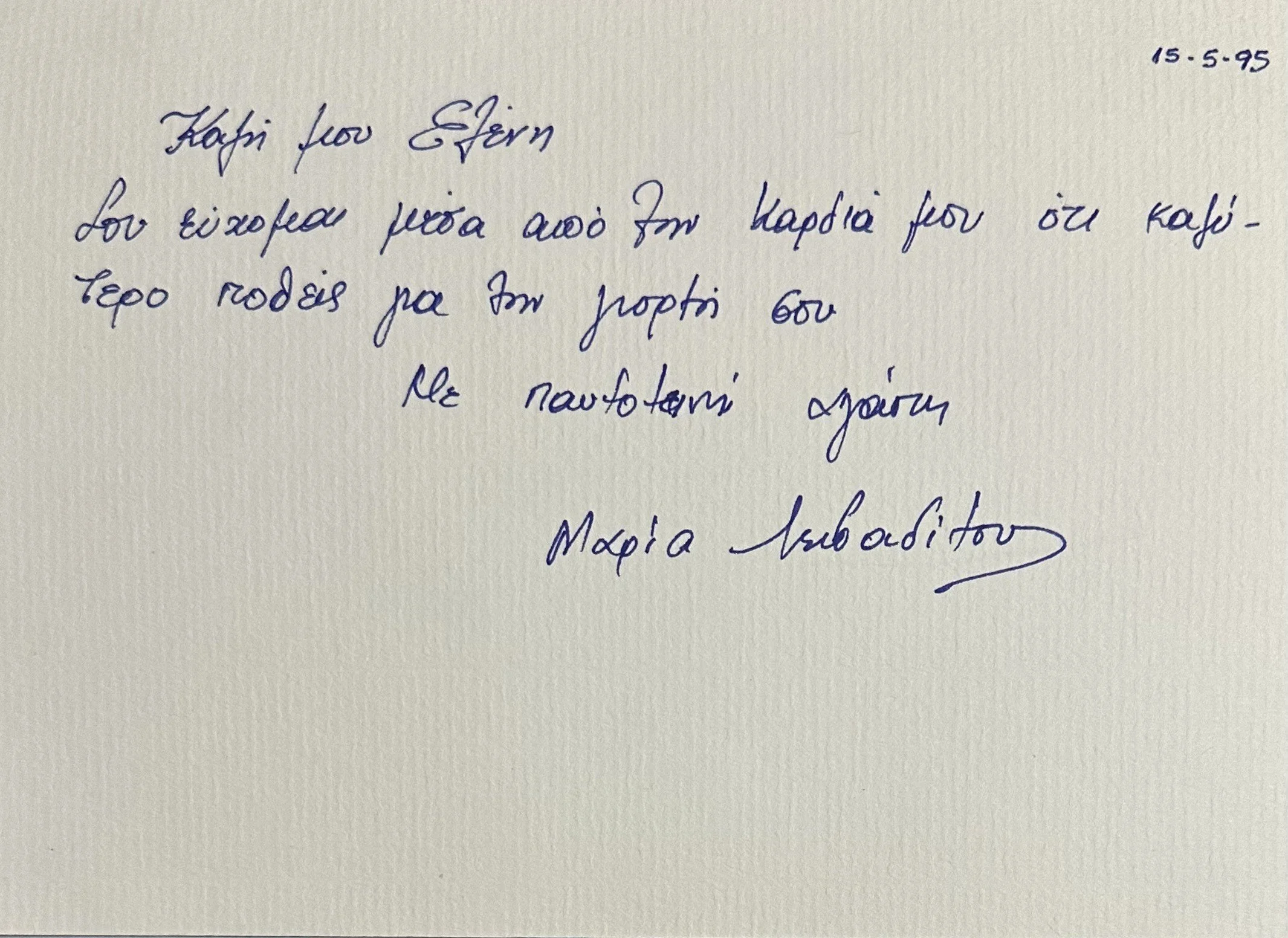
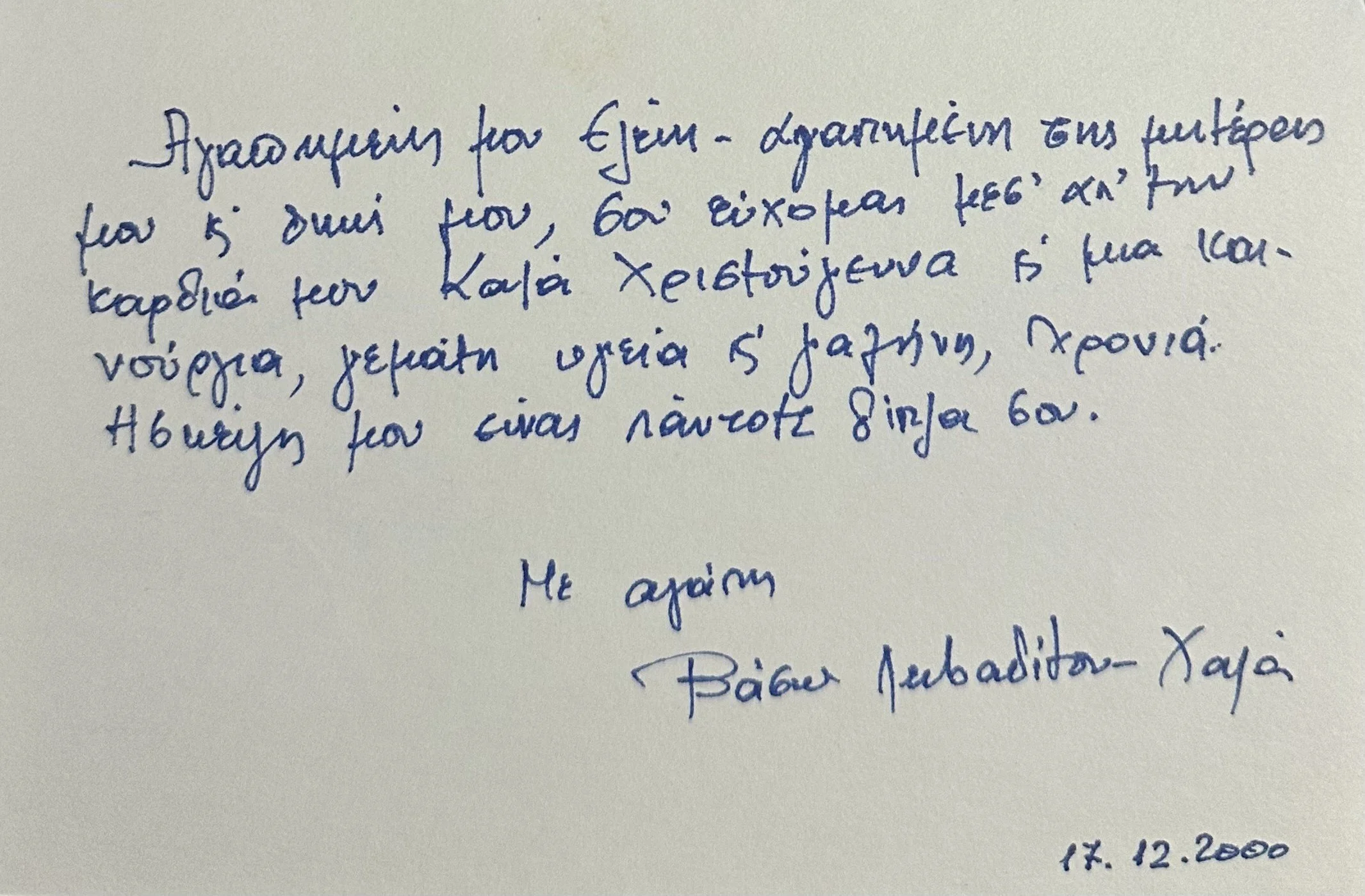
Two beautiful cards with those distinct expressions of love and faith, from Maria and Vaso. (MG Michael Family Archives)
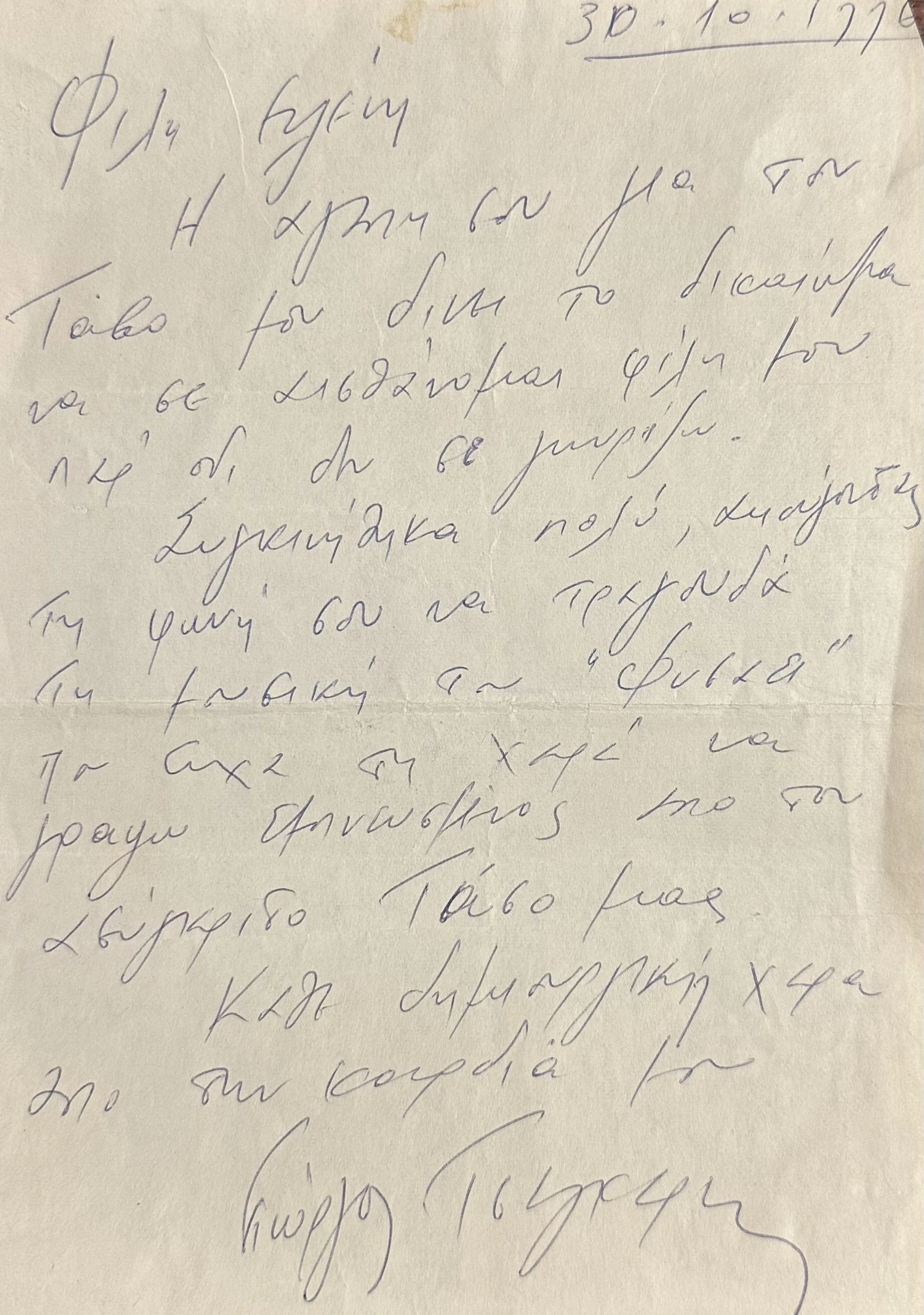
From George Tsagaris to Helen Constanti expressing his joy at receiving Helen's version of "Fysaei". (MG Michael Family Archives)

To illustrate her love of friends, even though she might not have met them in the flesh, on the morning before Katina and I were to be married, twenty-four white roses arrived. These were from Maria. This fantastic surprise has held a special place in our hearts. I knew how much she appreciated flowers and that their gifting would remind her of Tasos himself, so this gift and the words that accompanied her love for us, took on an additional dimension. I loved hearing her laugh! It was a hearty joyful laugh, and this alone would make you happy. Yes, she had that terrific sense of humour, no doubt sharpened after years of listening to Tasos and reading between the lines of his writing that would carry all of those concealed meanings. Magical realism is by its very nature connected to surrealism. In her letters, but also during our many conversations, there were only scattered references to poets and writers. For she loved her friends with devotion for a lot more than their literary reputations. This is because she had shared huge life changing experiences with them, including the aftermaths of their exiles alongside Tasos in those brutal camps in the Aegean: Makronisos, Ai Stratis, Lemnos, Ikaria, Gyaros, and then the court trials—above all as I had come to understand, Ritsos, Theodorakis, and Patrikios, were noticeably close to her. The Greek Civil War (1946-1949) divided many Greeks to the end of their lives, but it also brought many others together. Maria had also developed a marked trust for the gentle-hearted composer George Tsagaris.[5] George had composed the music for the widely circulated album Φυσáει…—a compilation of Tasos’s poems put to music and delivered by that powerhouse voice of the Greek rock-balladeer, Vasilis Papakonstantinou.[6] Helen Constanti sang those very same selections, as a surprise gift to Maria who was so impressed that she forwarded the tape to Tsagaris. He not long after wrote to us to say it was a profoundly moving experience for him to hear his compositions sung in Australia, and sent all the way back to him Europe! George, too, adored Tasos, and Vasilis’s renditions of the poetry have since become folklore. In her early years, Lella was herself a highly respected singer and singled out by the legendary Stelios Kazantzidis when he toured Australia, but whose own trepidations in life brought her singing career to an early end.

To return to her humour. Maria was—and she would acknowledge much to her regret—a regular smoker. This was a habit she tried on numerous occasions to break. I would at the right moment take her to task, encouraging her to stop as I had become increasingly worried about her health. She would say to me: “Mihalis, you take care of the smoke in your own backyard!” And she would laugh that sweet laugh of hers that I have sorely missed, as I have Les’s sign off in his letters and cards: -“Blessings”, Les.- I had sent Maria two poems of Les Murray’s in Greek translation that I had drafted, and the next time we spoke she had some excellent questions to ask. She had spent time studying these translations and had shared them with friends. I had also sent her a number of early translations of Tasos’s that I had made into English and she asked for me to read these over the phone. I share recollections here that I have not spoken of before, but I want now at this time of my own journey, to set some of these down yet few and incomplete, not only for the record, but also should they be of interest to others.

This simple reflection in itself would not be complete without the most surreal of stories, and the unique insight into it that I have not seen anywhere else recorded—it has to do with the discovery of Leivaditis’s last manuscript The Manuscripts of Autumn. The anthology itself was published posthumously in 1990 two years after the poet’s death. It is well known that Maria found the manuscript in one of the drawers of the poet’s study. But what is not known is what compelled her to go looking for ‘something’. During one of our conversations I asked her to speak to me of that precious find. And what she added to the published version was wonderful and something that the magical realism of Tasos’s spirit would have revelled in! Maria told me she withheld this event for fear of diminishing from the unexpected find itself, but I felt, too, her natural apprehension of not being believed. On the night before her discovery she had a dream. I have tried to remember some of the finer details of that dream but they now elude me, however, this is not the point. She got out of bed and was compelled to go into the poet’s study. The next morning she returned to the study, and went through Tasos’s drawers again. And, there, ‘lo and behold’, the anthology buried beneath a stack of paper. Maria was not superstitious, her faith was healthy, so she had asked for my opinion and we both agreed, that at the very least, it was a fabulous coincidence and at best—a ‘nudge’ from the poet himself.[7] We know that towards the later years of his life, evidenced, at the same time from what is typically termed his “Third Period” (1979-1987), he explored more deeply the mystery of the person of Jesus Christ—more Tolstoyan (human Christ), than Dostoevskian (transcendent Christ). It was during this time The Blind Man with the Lantern (1983) was published, which included those enchanting 12 Conversations all beginning with the supplication “Lord” (Kyrie). Maria had told me, and this to the chagrin of some of his more left-leaning comrades, that he would not pass a church without stepping inside to light a candle, and that he had pinned numerous little paper icons on the inside of one of his coats. This, too, for her own good reasons, Maria was hesitant to make public. This is all I can say on the matter, for here, as well, I did not think it right that I should press her on the issue.

An invitation by maria to attend one of tasos’s literary memorials three years after the poet’s passing. (MG Michael FAMILY archives)
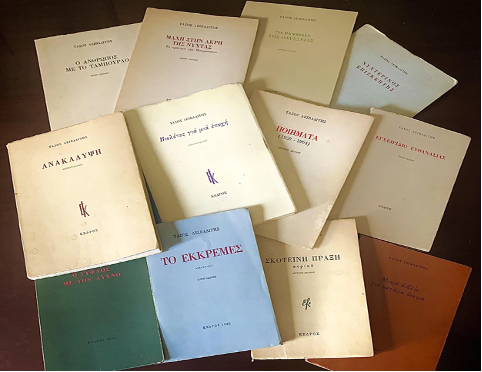
A selection of Tasos's anthologies together with the posthumously discovered The Manuscripts of Autumn, all precious gifts from Maria over the many years of a long correspondence. (MG Michael Family Archives)

I had asked for her favourite anthology of Tasos’s. The Manuscripts of Autumn, though before that it had been The Blind Man with the Lantern. And Drapetsona was her favourite of Leivaditis’s poems set to music.[8] And, even now I will still smile, for more than once she would quote these lines from Tasos’s The Blind Man… “God is not being able to sleep.” Similarly, she enjoyed Kafka and liked it when Leivaditis would be compared to Franz.

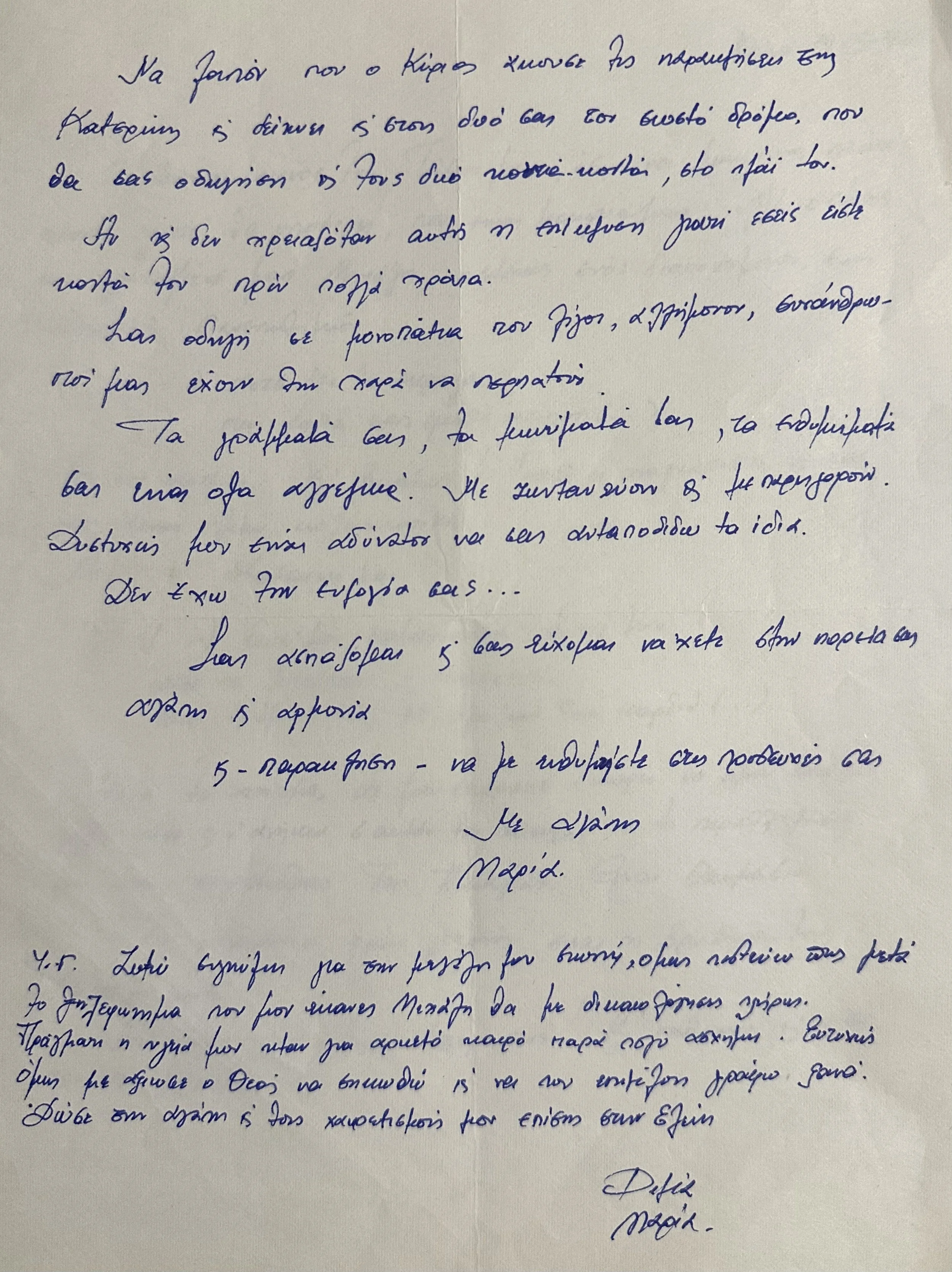
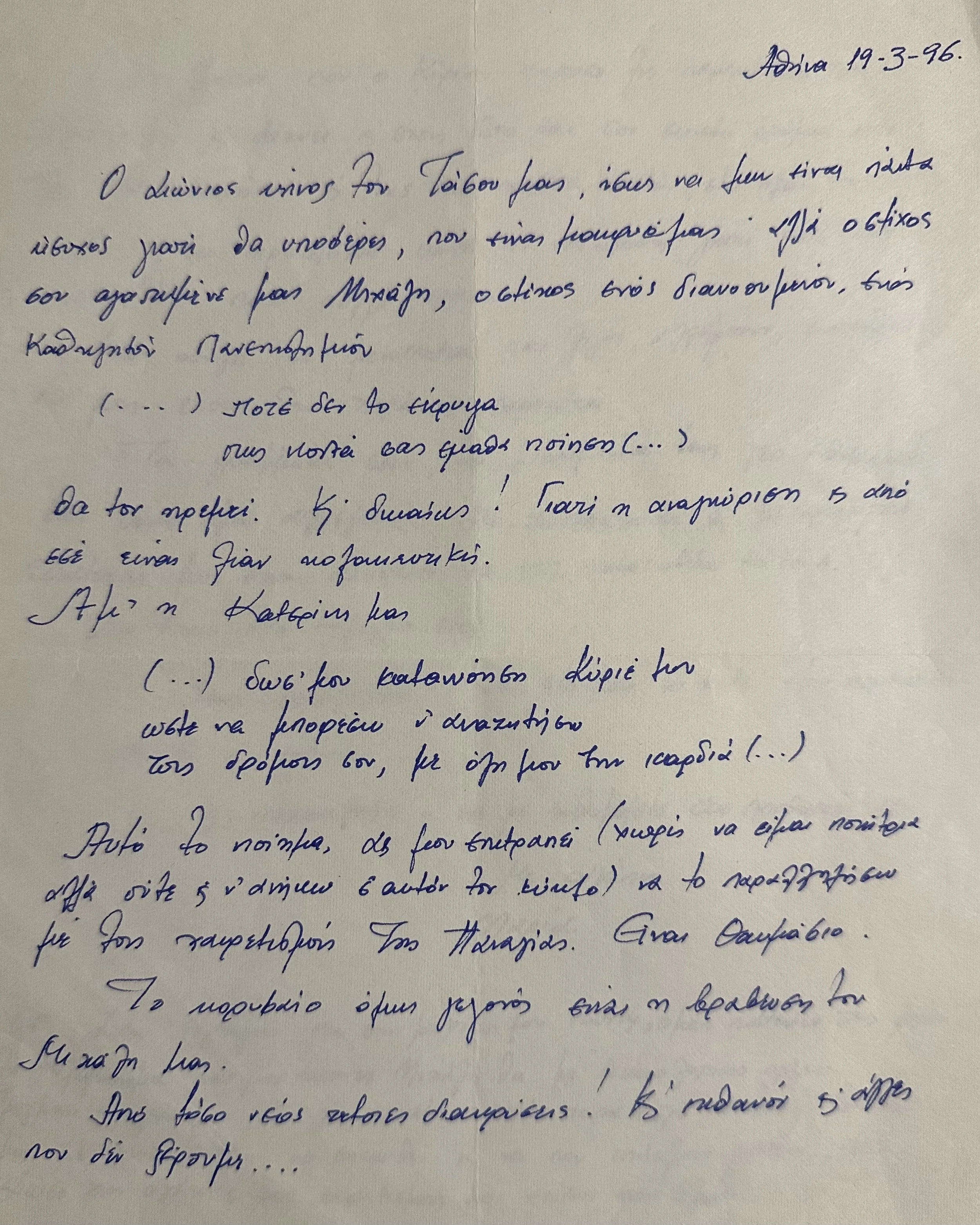
In one of her letters Maria would also gift to me, these overwhelmingly generous words (I will share below) that have kept my spirits from collapsing on this subject given the desire that I had nurtured, to begin on a long term adventure of translating Tasos into English. I had more than once received Maria’s blessing to do with this dream of mine. I had, sure enough, a number of translations already completed, but there is no actual purpose to them now as a friend has started on this priceless labour and done a very good job himself. My own translations have occasionally appeared in my journals and in my long essay on Tasos’s thematology.[9] This was the loving spirit of my friend, Maria Leivaditis, and but one of the many expressions of her compassionate-love:

“The eternal sleep of our Tasos, may not always be peaceful because you will be hurting, that he is no longer with us… but your verse, our dearest Michael: ‘I never hid it that it is from you / that I learnt poetry’, will bring him calm.” (M.L. to M.G., 19.3.96, Athens)

“Dear friend and poet [Michael], after your last letter I can now onwards call you friend. Indeed, you as is the same with Eleni, I feel you very dear friends like those who are next to me… I confess that I am deeply moved that Tasos’s verse fit and tie in so harmoniously with your own inspirations.” (M.L. to M.G., 4.12. 92, Athens)

The famous sketch of Tasos Leivaditis drawn by Tasos's and Maria's only grandchild, Stelios-Petros. Katina and I were the first to receive this charming portrait. (MG Michael Family Archives)

During our lifetime friendships will naturally come and go, even some of the more beautiful ones that we believed would never leave. But then there are those that will survive, and it is these that will endure above and beyond any tribulation or temporal separation. For they are forged in the blood-beat of the heart, and live on in the flutter of the angelwing.

“I also enclose a sketch of Leivaditis done by my grandson Stelios-Petros which he gifted to me. Copies of this sketch I am sending first of all to you and Eleni. He is self-taught and still young of age, only sixteen-years of age… and his grandfather was proud of him.” (M.L. to M.G., 15.10.93, Athens)

This nota bene that follows was inspired by Maria Leivaditis, Les Murray, George Cazouris, and George Kanarakis. Their absence has left a marked gap in my own life and the lives of their other friends, let alone the lives of their families. I have missed each of these beloved companions beyond words, and yet it is their very words that continue to reach out to comfort me and to remind me of things I must not forget.

One of the hardest decisions one has to make (and particularly when private correspondence becomes part of a literary or historical record), what to do with letters accumulated over many decades of correspondence. It is a racking responsibility determining which letters should be kept and archived for future generations to read, enjoy, and learn from, and which should be returned to the families of one’s correspondents. Most difficult of all, deciding which should be destroyed, but sometimes even that must be done. Letters are confessional by their very nature, and I believe that, in many instances, both sender and recipient have entered into an unspoken understanding that some exchanges are never intended to be made public. I know this is what I have wanted and asked for myself. There are letters whose personal content could far outweigh their archival value. In all likelihood, I belong to an old school that believes the letter, certainly in a moral sense, has two owners, though legally that might not technically be the case. Yes, sometimes our letters are written with the express desire they survive, and that, at the right hour, they might be shared. Where a beloved of mine has passed away, I have a fairly good judgement of what their wishes might ultimately have been. If I am uncertain, I would hope to err on the side of protecting the intimacy of trust. Nowadays, the same goes especially for our emails. I hope that sometime in the future, the same compassionate discernment might be equally afforded to me.

On a more personal note, if this should be of interest, no few of those bonds that I have mentioned, have been, and continue to be, with wonderful writers and fabulous thinkers, and their correspondence has become part of the record of these friendships. Looking back, it is only rarely that I was asked to read a letter and then to destroy it—and when I have been asked, I have done so immediately. There have also been those few occasions when I have gone back to my letters and decided, with a palpable sadness, that I should not keep a particular one. This is another dimension of the practise of compassion, to keep on loving beyond those limitations of the temporal spaces.

I feel a great deal of joy in sharing this small selection of Maria’s correspondence with you here below. This sample serves a dual purpose. First and foremost, it reveals Maria as a writer of meaningfully beautiful letters; a protector of Tasos’s legacy; the love of her only grandchild, Stelios-Petros; and together with her dearest daughter Vaso, a soul of unconditional faith. Then, also, her incredible gift to me that has oftentimes, and even to this very day lifted my spirits, that she discerned something of her beloved husband in my humble person. And especially during these recent times in my life, this has been of a very special significance—it was as if she knew. More than once I felt that beneath her words, both spoken and written, there were things she wanted to be made known at the right hour.
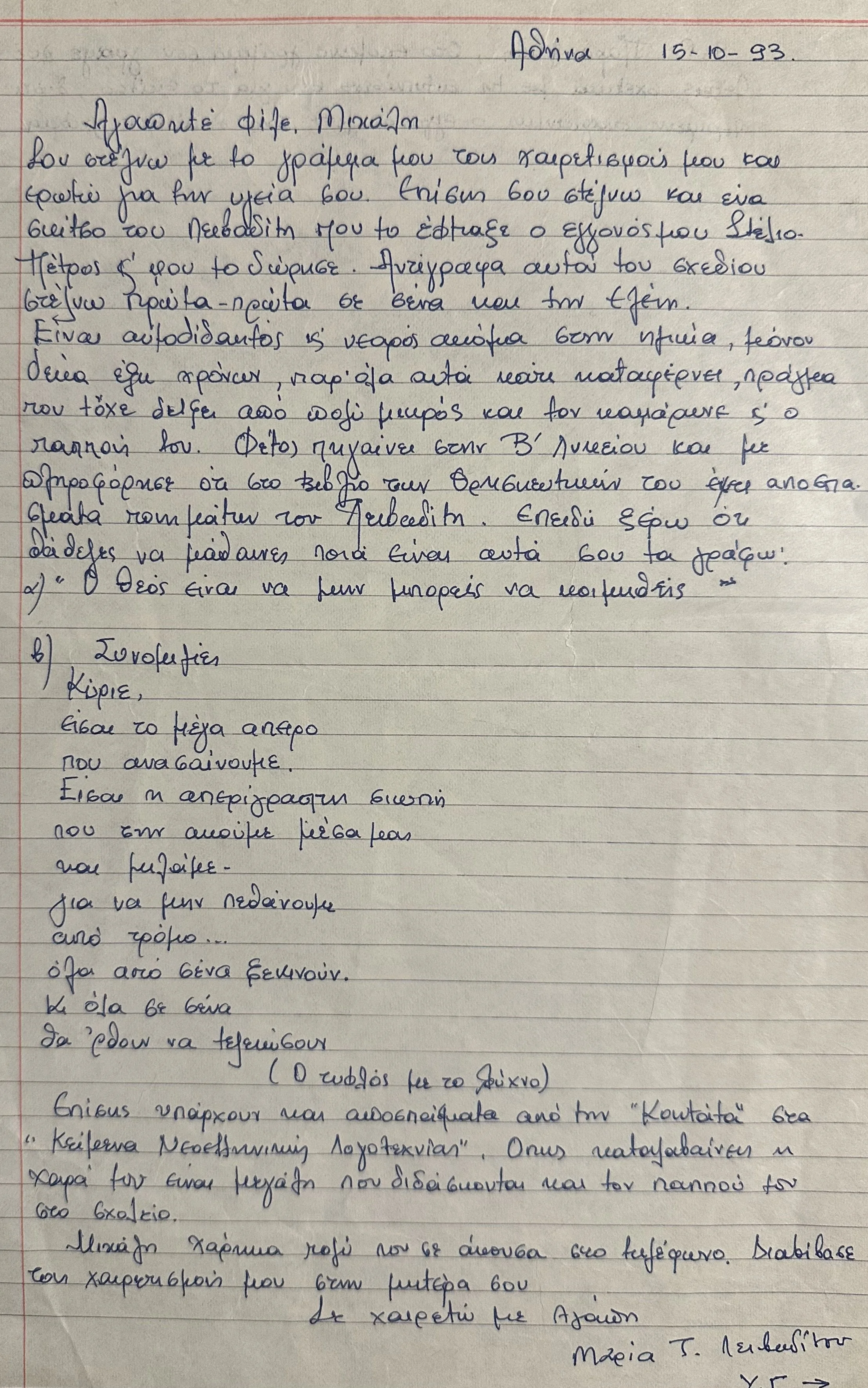
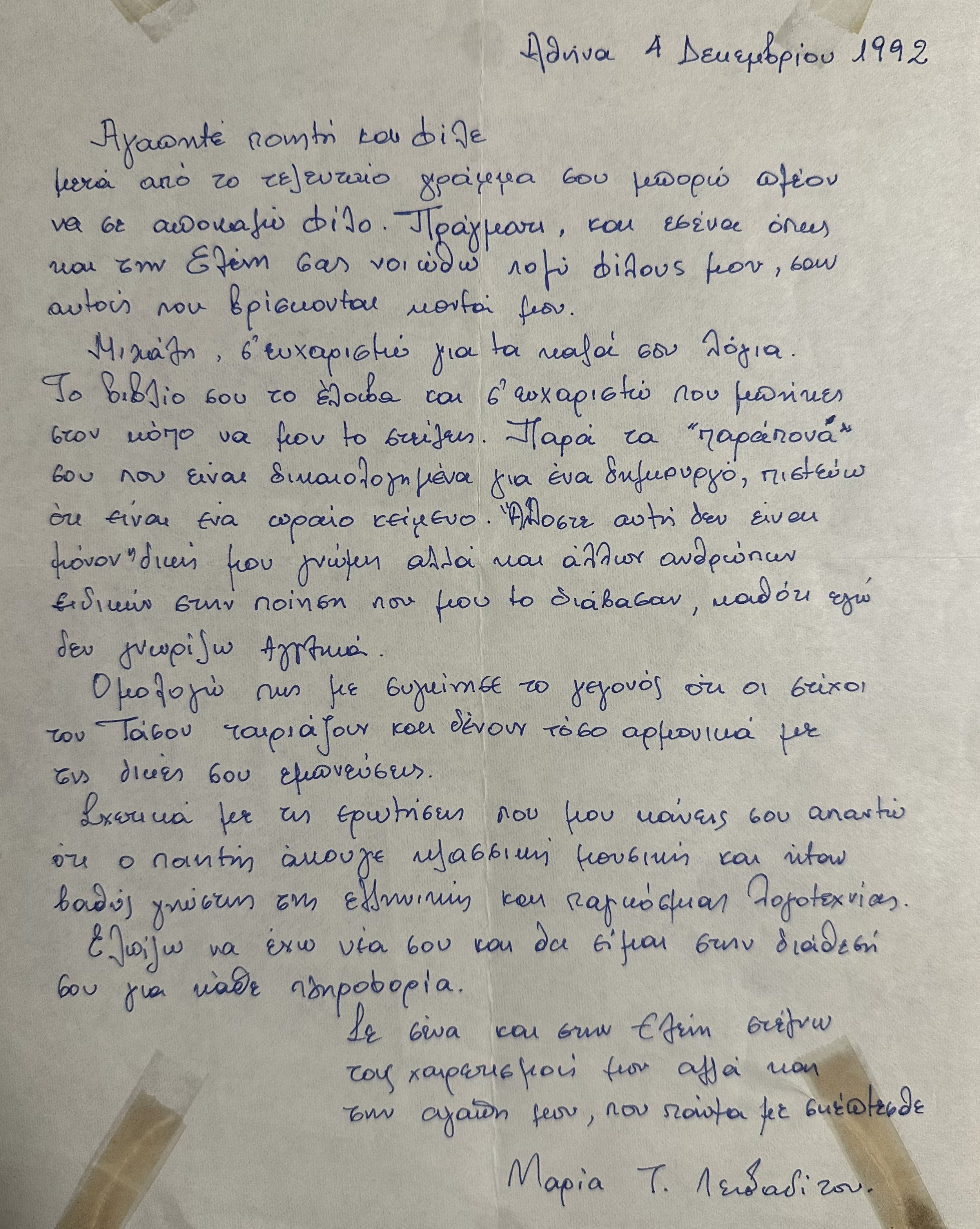
A sample of Maria Leivaditis's fabulous letters and these ones are with their own special significance. (MG Michael Family Archives)

[1] I did not wish to probe too much into these early years for I could see it was not a place she was too comfortable to readily revisit. An excellent timeline of Maria’s and Tasos’s more important milestones can be found in a special issue of ΔΙΑΒΑΖΩ, Vol. 228, 1989. Maria herself had sent me this collection of essays and she was very proud of them. I had been planning to write a dissertation on the poet and had already made quite a number of translations of Tasos’s prose but health and other issues would later intervene so this dream of ours that I had planned for my retirement years would not be realised. In that very same issue with the chronology of Tasos’s life, Maria herself had made at least two corrections in blue pen. The first where it is said that Tasos [Anastasios] was born Panteleimon-Anastasios, Maria had drawn lines over the name Panteleimon. In that same paragraph she repeated that deletion at a similar reference. She was meticulous with anything to do with the poet’s legacy and would make sure to correct the record.

[2] https://stepeha.wixsite.com/tasosleivaditis/blank

[3] https://www.youtube.com/watch?v=O0L-9DGywy4

[4] https://www.youtube.com/watch?v=MExBH25xf5o

[5] https://www.youtube.com/watch?v=958fasnXjrQ&t=10s

[6] https://www.youtube.com/watch?v=9p_nWAPeT5U&list=RD9p_nWAPeT5U&start_radio=1

[7] I have no written evidence for this marvellous story. Only what I have remembered from all of that time ago. Maria and I spoke of so many things that I hope to write another essay on what I can still reasonably recollect from our telephone talks on Tasos’s life and poetry.

[8] https://www.youtube.com/watch?v=PoVCJmId5TU&list=RDPoVCJmId5TU&start_radio=1

[9] https://www.mgmichael.com/tasos

On trying to become fully human

Tempe, Arizona

Photo by Shahan Khan on Unsplash

Photo by Shahan Khan on Unsplash

Something ‘powerful’ is holding us back. It keeps us from flight. At times it might feel like a dam holding back a great torrent of water. What is more, we feed this hold over us to the extent that years could pass and we remain grounded to its biggest lie. Whatever this obstacle might be, this ‘big lie’, it is known to our hearts alone. Often it is guilt over something we have done, or should not have done. Other times it is regret at an opportunity not taken to express our love, or to ask for forgiveness. This lie invariably tells us we are “not good” and that we do not deserve the “good fortune” incumbent upon others. Many of these instances which stop us from moving forward have to do with our despondency to set things ‘right’. Then the dreadful moment when suddenly confronted with the reality that it is too late. That is, the best of our intentions can no longer be realized. What then? Do we spend the remainder of our lives weltering in self-recrimination? Perhaps a higher providence has seen best for things to fall precisely as they have. “As the heavens are higher than the earth, so are my ways higher than your ways and my thoughts than your thoughts” (Is. 55:9). This was the only way. It was the only way for ‘self-recrimination’ to turn out to be self-revelation. To become fully human, that is, to the extent which such a thing is possible [the ‘unity between head and heart’ Jean Vanier], means to engage with these hard experiences and to live through them. The final destination is what matters. What is done is done. There is the next hour to be lived to its fullest.

Such unbridled joy it does bring to the heart when we happen to come across someone who we sense to be fully human, or at least striving for this end goal. This aspiration towards a human teleology is our spirit’s greatest work. We might discover such people in our everyday encounters “by the well”: our teacher, coach, doctor, grocer, pharmacist, gardener, postal clerk, or cashier worker. If we might borrow from Sufism these are men and women with divinity written on their hearts. Occupation and social status have nothing to do with this luminous heart which is set before us. It is a true humility which recognizes the potential in the other and which possesses a love which moves and breathes outside the margins. Such a human presence is not easily given to cynicism and is slow to judge.

Writing and receiving letters was one of the delights of the ‘bygone age’. Outside the pure enjoyment of the physical processes of pressing out the paper, writing the date on the top left hand corner, putting down the name of the receiver My dear or My dearest…, thinking carefully [‘playfulness’ not excluded] on what you write, and then the final endearments… truly I am yours. And all of it in your own unmistakable scrawl. The letter will often enough, too, carry the unique scent of the sender. What is more the joy of receiving a reply, or a surprise from someone who went to the trouble of looking up your address to then leave his or her ‘biometric’ on the top right hand corner of the envelope. Emails [together with their lifeless emojis] possess little or nothing of such special wonder. Haruki Murakami says it so simply in one of his novels: “How wonderful it is to be able to write someone a letter!”

Little can compare to giving a fellow human being renewed hope, to encourage them through trials, or to inspire in the pursuit of new goals. It is as restorative as saying “I love you”. For love itself, if it be true, takes its first step in the movement of compassion. How can we do this? That is to offer renewed hope to a hurting heart? There are as many ways as there are expressions of love itself. First, the benevolent act of forgiveness. To forgive someone is perhaps the most liberating act for both the giver and the receiver. There are also secret acts of charity where they might most be needed. “Do not neglect to show hospitality to strangers, for thereby some have entertained angels unawares” (Heb. 13:2). A simple letter sent with kindness and genuine concern in a world where self-centeredness is becoming increasingly the norm can make all the difference. To begin with to offer someone hope means to accept them. And there is besides the constraining of the ego in allowing another in greater need to ‘appropriate’ some of our spotlight. Where there is selfishness, hope cannot deliver.

“It all goes too quick” we will from time to time say to ourselves. In the Old Testament in the Book of Job it is described thus: “For we were born only yesterday and know nothing, and our days on earth are but a shadow” (Job 8:9). The English writer Jenny Diski who endured much as a young person would afterward as an adult add her own addendum to this reality: “Everything passes, but nothing entirely goes away.” We are caught somewhere in the middle. We all know too well it will go quick, but in the meantime we experience profound emotions and our actions leave behind a legacy. The desert dwellers approach this mystery head-on by holding onto “the memory of death”. This contemplation on our brevity upon the earth is neither macabre nor defeatist. It is an act of true anarchism. They joyfully accept our transience looking beyond and live each day with such actual ‘meaningfulness’ as if it was their last hour like leaves of an olive tree which rotate to capture every tiny bit of moisture. So let us hasten to do some good while we can. It is later than we think, it has also been said.

In what ways might I make a difference in my day-to-day encounters with the ‘other’? There are many ways. There are an untold number of opportunities in our everyday exchanges with our neighbor that might not only bring a smile to a needful heart but could also save a life. Are you holding back from sending a message to a friend who might be in need of a word of encouragement? Can you anonymously send a gift to a charity? Delete an email sent to you by someone during a moment of their vulnerability? On your way to work is there a homeless person you might stop to say hello and buy a coffee for? Might you send a card to an ‘enemy’ wishing them a bright day? Could you surprise a loved one with a gift letting them know how precious they are to you? Is it too difficult to nod the head at the stranger who has cut you off at the traffic lights? Make an impromptu visit to a hospital and ask if there is anyone in need of a visitor?  It all goes too quick and yet there is much we can do. In Japanese the word for charity is jizen. The characters of the word beautifully illustrate that at the heart of charity is mercy and compassion. It is amazing too, is it not? That in helping others we are at the same time helping ourselves. And it is no mere coincidence then, that in the New Testament, Jesus Christ would connect the love of God with the love of our neighbor “like unto it” (Matt. 22:36-40).

Many of the world’s problems stem from ‘egoism’. This is the condition where “self-interest” is at the center of one’s morality. One nation considers itself better than the next and robs the other of its rights and resources. And one person thinks he or she is superior to their neighbor so diminishing and blunting their potential. The first can lead to wars and to the spread of famine. The second will lead to despair and to the lessening of our brother’s or our sister’s personality which are the qualities of their character. Both are cruel and will only ever result in suffering, if not to catastrophe, whether on a universal or personal scale.

Kingsgrove on the stroke of midnight

Sydney, NSW

Singularity on the keyboards; cyborgs dancing without soul; eaters of electricity; he lifts his spirit like a heavy weight; Sisyphus does not let go of hope; technology delivers at a great cost; the makers of new-fangled dreams; lost in a sandstorm without a compass; a lone saxophone brings you home; moonless nights; Mother of God ‘I am lost’; clouds blowing in the west; what fear this fear; the sky alight with fire; not prepared for the revelation; an ancient fish bursting through the shallows; tentacles of water; mazes built from rusted steel; our beloved Ellul where are you; save our ship SOS; the pain of a broken friendship; a grand piano out of tune; strands of hair in the sink; the eye more easily deceived than the ear; truth will stand no chance; except for theatre; graffiti and poetry; and mouth to mouth; here in this house where philosophy bruised my fingers; properties lost in translation; like the Filioque; and proceeds from Love; the three child saints playing hide and seek in the kitchen; the last seal opened on our deathbeds; identity revealed through suffering; life is not meaningless; the whole thing is context; “Green how I want you green. Green wind. Green branches” (Federico Garcia Lorca); I touch the walls rekindling the past; byzantine icons in the other room; fragrant resin dripping from gilded brows; Patmos rising from beneath the chief sea; the four horsemen of the Apocalypse; hordes pressed against the fences; they search for the righteous priests; “May your priests be clothed with your righteousness” (Ps 132:9); the terrible Mark brings the great sore; who loves you when you stretch out your hand; Father when did you die; as you enter to your left; an iron bed by the window; sanitary walls painted grey; you will find the poem beneath the pillow; outside tall trees and little birds; Francisco Goya (1746-1828); “Disasters of War”; lead white canvas primer; to be burnt in order to become charcoal; here in this room where I first saw the dream; the outer darkness; the sword of Damocles hanging over my head; it is okay brother and sister we are forgiven; the Trisaghion hymn; they will find out; then you will truly live; time to sleep it is 1.58AM; “There is no greater agony than bearing an untold story inside you” (Maya Angelou); temptation is the only constant; grace comes and goes; like the hands on the face of a clock; “I may not have gone where I intended to go, but I think I have ended up where I needed to be” (Douglas Adams); time to sleep it is 2.11AM; I have heard that before; hickory dickory dock; we all like Mr Spock; top draw to the right; letters unopened from previous journeys; a broken London Clock; Miriam where are you; here are the tickets you said; Salamis Lines; Limassol to Patmos; radiant rings will speak of status; “For where your treasure is, there will your heart be also” (Matt 6:21); drones carrying prophecy; attacked by rogue  eagles; time to sleep it is 2.20AM; lucid dreaming; Freud psychopathology; Jung archetypes; Saint Joseph protect me; make me part of your dream; give me your breath; “Now my five senses gather into a meaning all acts, all presences” (Judith Wright); an old man in an electric wheelchair; a new-born in a layback stroller; for a brief moment their vision intersects; at that instant it is done; deliciously cynical; as beautiful as the Aegean; on Marrickville and Illawarra Roads; the tips of an angel’s wing brush the hairs on the forearm; and all this by the grace of God; “I have a world apart that is not among men”  (Li Po); though drained of life; call no man good; and he will be crushed and twisted; to be set straight before the final journey; share with me your greatest poem; burnt to fine powder; sunk in the black residue; “Who knows how to drink pain, and live?” (Gwen Harwood); Natalya Estemirova; Marie Colvin; Anna Politkovskaya; Mother is whining and coughing; these irritating noises will one day be missed; like the Great Vespers in the Cathedral of Kazan; Moorefields Road; Clemton Park; King Georges Road; Jacob’s vision at Bethel; rapid-eye movement (REM); “I got dreams to remember” (Otis Redding); Citalopram; Paroxetine; Clomipramine; fiant pilulae et pereat mundus; Thomas Szasz The Myth of Mental Illness; anti-coercive psychiatry; the roots in the lake; a straw-coloured moon; the Bucharest poem, dear Mother; here in these hallways where I grew taller; black-and-blue heart and knees; in these rooms I determined that life must go on; from this front door I left a layman; returned a priest; left again in a thousand pieces; “If we were humble the Lord in His love would show us all things” (Saint Silouan the Athonite); I saw my Father here for the last time; Cartoon Corner in the afternoon; toasted banana and peanut butter sandwiches; football training across the road; the Lion that devours in my bedroom; the ancient Dragon from the deep in my bedroom; Revelation 21 on the left wall; melodies unto a lovely madness; intricate gold sculptures; three-dimensional space; I envy how you run through the fields; it is now at last time to sleep 3.17AM; Jeremiah please pray for me; “This above all: to thine own self be true” (Polonius, Hamlet); which hat then do we put on today; the four winds hat; the pilgrim’s hat; “Hit the road Jack and don’t cha come back/No more” (Percy Mayfield); a blind sewing mistress; reading Braille by the stars; the sightless will lead the sighted; Oum Kalthoum keening before the Great Sphinx of Giza; there are four stages in the lifecycle of a butterfly; Prometheus defies the gods three times; outside the horn blast of a car is getting louder; we have underestimated Baudelaire; “Always be a poet, even in prose”; words made right on the stroke of midnight; I am the restoring drops of rain caught beneath your collar.


Walkabout in Geneva

Geneva, Switzerland

Café de Paris; Hotel Cristal; Genѐve-Cornavin Railway Station; a little girl on crutches chasing after the chocolate wrapper; a man with a huge bag carrying the stories from the night before; a woman smiling into her mobile twirling her black hair; the Holy Mother sculpted from granite is interceding for me; her Only-Begotten carved from fine wood afloat in mid-air; a homeless angel with a yellow scarf sleeping beneath the pew; not long from now one of us will be dead; I was here three decades ago when I would consume Him; let go, Michael, let go; you hear me, let go, Jeremiah, let go; who is eating the flowers; Edelweiss; leaflets in the shape of stars; beware of the pickpockets; lost and found; an angel searching for his wings; an old woman ferrying a broken pram with a blue wedding dress; please, I am still waiting; Pauline always replies even as she orbits the earth; Tchaikovsky’s letters from fevered rooms and anticipating cities; “Once I was seven years old” (Lukas Graham); happy birthday dear Father beneath the earth; Fauré’s Requiem in D minor; a man with an umbrella hanging from his back is riding a scooter; a young man with big eyes is arguing with the mischievous Cupid; Lac Léman is undulating like Rilke beneath the surface of things; will they be interested in what I have to say; they will not stop that which is soon to come; the second death as unexpected as a spider’s web around your left ear; it is getting dark and pieces of water are starting to break; two silver bicycles tied to a light post; “Bicycle Thieves” (Vittorio De Sica); “Seven Samurai” (Akira Kurosawa); “A movie as rich as a buttered steak topped with grilled eel” (a discerning critic); a man and a woman outside are exchanging photos which will prove them wrong in the morning; Harry Chapin and Bob Dylan; story tellers and word painters; a little bird nested on my laptop; Icarus flew too close to the truth; the flying trapeze tricks and catches; 1234, 12, 1234, 12…; OCD the disease of the prophets reminding us of the return; Arrivée; Départ; Place de Cornavin; Rue des Alpes; a bald Chinaman; a blackbird resting on the balcony; a bouncy girl with bumped up ponytails is on the look-out for the old woman with the pram; Thomas Aquinas the simplicity of God; Beethoven loved poets; Irina Ratushinskaya’s old parrot wanted “to swear in every language known to man”; TinTin was here; more homeless angels with baseball caps; “Knowledge can be communicated, but not wisdom” (Siddhartha, H.H.); John Calvin; Karl Barth; Hans Küng; the sounds of a didjeridu; music will remain free but there will be a cost to water; seventy-three of the Psalms are attributed to King David; equality and upward mobility the great paradox; save the middle-class; it is very cold and the nose is running; stories written on shivering skins; I should buy a scarf this morning; the great trees of Notre Dame; Hermann Hesse and Patrick White venerated trees; “Giant Trees of Switzerland” (Michel Brunner); every day twenty two thousand children day from preventable pathologies; quantum mechanics and the smallest unit of time; the age of irreversible innovation; Famous Fresh Baguettes; EdelWeiss Shop; Swiss Watches; booming sales of advertising; Facebook profits surge; Google air balloon Wi-Fi hot spots over parched land; A Father walking with his Son who has a bent back; Jean Dubuffet Métamorphoses du paysage; a woman on the corner waiting for a book; I saw you many years ago in Zermatt outside the bakery; a little boy with winter gloves drinking hot chocolate; “Old man look at me now I’m a lot like you were” (Neil Young); did anyone enjoy the Joe Cocker post; the prophetic insights of Pink Floyd; Sachin Tendulkar does not like Greg Chappell; the umpire’s finger will eventually go up; howzattt; your love dripping down my right shoulder like scalding water; yes, Katina, tear open the envelope; it probably has to do with the little stories from Saigon; Jorge Luis Borges is waiting; tronc pour les fleurs; Ave Maria; La basilique Notre-Dame; I have to go to the post office; Rue du Mont-Blanc; Victorinox is everywhere; I wish I didn’t have to do this; I can’t speak without notes anymore; I only want to collect words and images; “We drilled with wooden rifles” (W.H. Auden); the Venus of Brassempouy; on the tusks of elephants an infallible biography; demand for ivory for piano keys; sucre.cannelle; nutella.banane; Grand Marnier; an angel with long hair and a leather jacket recognizes me and points to the post office; he gives me my ticket; I am writing postcards; keep walking else you will get lost; next to me two friends sharing a joke; a man with a groomed moustache enjoying a beer; a teenage runaway missing two fingers is filling his pockets with milk and sugar; rises in quarterly revenue people dying of hunger; slavery on the rise in the supply chain; human rights versus computer rights; 1234 12 1234 12…; nose bleed last night; dear Jesus how did I get here; the Panopticon; George Orwell; Uberveillance; a man far away from home is playing the harp; a woman lost on the streets nearby is brushing her hair and screaming; a blind man stops to listen; Agnus Dei choral music; help us all dear God; convection another name for thunder storms; Läderdach chocolates; I skipped breakfast this morning; the food industry; “Death in Venice” (Thomas Mann); “Death by Internet” (Joe Cavalko); death by degrees; Michael Eldred introducing Plato to the Blues; B.B. King buried with Lucille; Ray Charles swinging the ivory like on a trapeze; Billy Holliday Ripe Fruit; Consuelo Velasquez Bésame Mucho; Dalida Je suis malade; a man speaking with his mouth agape; an old man with a white ponytail and beard pointing to his walking stick; a couple with their little daughter in the shopping trolley next to the detergents; two women carrying shopping bags see me transcribing them into history; nothing is insignificant all acts touch upon the eternal; “Sonata Mulattica: A Life in Five Movements and a Short Play” (Rita Frances Dove); tomorrow I leave for the Inter Continental; conferences will not change the world; love and destruction change the world; the Apocalypse of John; thanks for the adaptor Charlie; the remote control never works the first time; the body sinks into the bath where for a minute it must drown; “Let us go then, you and I, When the evening is spread out against the sky...” (Prufrock, T.S. Eliot); a tall man with an ill-fitting suit smiles at me; I catch a glimpse of myself on the glass where the colourful balls are; where have I been all these years; like the “five star” squatters in Mozambique; the four men next to me discussing the ‘miracle’ of Leicester have left; the tall man with ill-fitting suit has returned with a young child to buy a red and blue ball; a woman opposite me has fitted her star-studded sunglasses into her hair; a quarter of a century ago she would have cast a furtive glance my way; “I want to eat the sunbeams flaring in your beauty” (Pablo Neruda); I will never get this talk down to three minutes; but I can get it down to three words; surveillance kills context; I miss you Father; old men are as prone to clichés as the hair growing out of their ears; “When you are old and grey and full of sleep, And nodding by the fire…” (When You are Old, W.B. Yeats); the tooth hurts poison seeping into the jaw; another nose bleed; all pain is childbirth; a young woman carrying flowers and apples; Saint Catherine of Siena Giovanni Battista Tiepolo; hullo Katherine Albrecht all will be well; Palais des Nations; the Broken Chair; Cathédrale Saint-Pierre; Jardin Anglais; Avenue Giuseppe Motta; Rue du Rhone; Quai Wilson; Bongo Joe Records; Bon Génie; ICT Discovery; The Art and History Museum; 1234 12 1234 12…; Aleppo cries tonight; baby girl rescued in Kenya from beneath the rubble; authoritarian populism on the rise in America; Pindar already speaks of animated figures; “they appear to breathe in stone” and “move their marble feet”; see Michael Crichton’s Westworld “where nothing possibly can go wrong”; “Car 54, Where Are You”; the great late Fred Gwynne; The Munsters; Bus No. 5; where did the hours ago; packing almost done; airports; cemeteries; the late evening resurrection; Flight EK 414L; Seat 61D; home sweet home.

Taking notes inside a Bucharest MacDonalds

15 August 2011

Bucharest, Romania


I cut myself shaving this morning when I saw you in the mirror looking back at me; “you yourself are indeed another small world with the sun, moon and stars within you” (Origen); I thought he was a one-winged angel but he was carrying the shopping bag from the inside of his large coat; a deaf Beethoven composing the Appasionata; next to me a big woman has ordered her fourth burger and looks happily content like the Buddha in Bangkok; a young girl is sweeping the floors of broken dreams and timeworn drafts; a bearded old man with a broken ladder has skipped in to tell some stories; the suspicious manager with the gold teeth is keeping an eye on me; the fine-looking woman from across the road has walked off with a fallen angel who missed his train; people should reply to letters within a fortnight at most; George Orwell always replied to his letters even when he was dying; Leo Tolstoi was not an admirer of Shakespeare; a young fellow with a bald patch and a large nose is scratching his armpit in search of answers; I should have ordered the large Coke instead of this cheap beer; my feet hurt from all the running and the taking off; I love Valerie’s photo of Les sprouting up through the trunk of a great tree; a simple stone can fire the imagination with the same force as The Kneeling Nun of New Mexico; despite the heat the forecast for tomorrow is heavy rain followed by possible shipwrecks; more heavy sweeping of the floors and great loss of forensic evidence; Sylvia Plath’s cry for help; outside a little boy in a yellow shirt wishes he was a helicopter; Thomas Merton where are you on Saint Lucy’s Day; “sing us a song you’re the piano man, sing us a song tonight” (Billy Joel); notes inégales; what did Lazarus and the daughter of Jairus see; the woman with the one leg has pulled out a large map of the city from her silver purse; remember to ask how to get to Brasov; two old men pleased with the “special deal” are slapping each other on the shoulder and pointing to a place neither wants to go; I am now fifty years and a couple of days old; August 15th the Dormition of the Holy Mother; thank you my dearest Katina; a group of Gypsies are dancing on the street pointing to Ursa Major; we are made of the stuff of stars; one line can save a life more than a great book of a thousand pages; I wonder how many times Mircea Eliade walked up and down this street going about his eternal return; “Jesus Christ Son of God have mercy upon me the sinner”; at what point do we lose our capacity to know God; not random behaviour but yes a “fine tuning” of the universe; Francisco Goya the same as Caravaggio directly onto the canvas; CCTV is everywhere like a second skin which it will soon become; intelligence, surveillance, reconnaissance; government denial; laser designators, multi-position mechanisms, skybox satellites; masters of spin, rumour mongers, buyers and sellers of corpses; “Dial F for Frankenstein” (Arthur C. Clarke); Google has actually re-invented the Trojan Horse; there is more to Samsung than you think; Lycett’s Dylan Thomas is another very good read; I cannot get this tune out of my head… I think it’s from the Electric Light Orchestra; OCD is one nightmare after another; Nicholas Tesla is so terribly underrated; a couple of weather wizards have dropped in; really glad to have read Tchaikovsky’s letters; nutcrackers and wooden dolls; you are punishing me, please reply to me; hot white glass slowly stretched; taxis on Bulevardul Banu Manta line the streets like a hive of bees; it all comes down to salvation; Okanokumo, clouds on the hill; maybe I will get some ice cream with caramel sauce; the dogs of Bucharest are in search of their long dead masters; “when you are old and grey and full of sleep and nodding by the fire” (W.B.Yeats); deep down we are all scared that we will be found out; how did Primo Levi really die; progress nowadays has to do with economics and I am sitting in one of its citadels; Augustine’s birds are too sharp this afternoon; I should probably delete this page; Art is no longer the point of beauty; the great gift of comprehension; algorithms will one day choose who amongst us will live or die; I wish that little girl with the green shoes would stop picking at her nose; freedom begins with forgiveness; the Divine Liturgy lifted my spirits today; The Brothers Karamazov dealt atheistic idealism a heavy blow; we are all condemned because one child has died of hunger; hours are sometimes even more precious than love; compassion is the most wonderful of all words; racism is the root of all evil; maybe I should have changed rooms last week; ice particles shape-shift under the sunlight to cause an avalanche; like the hair of an angel which falls to earth; I want to die a good man; Oh, Lord! So many letters I never should have written; Michael Faraday one of humankind's best; beautiful flowers splashed in white; without coal our world would be plunged into darkness; who are the ringmasters; Nero and every other tyrant obsessed with popularity aka “Likes”; the Apocalypse has hurt my mind yet it has not robbed me of hope; “666” I have seen it and it is a merciless thing; Nostradamus relishes playing hind n’ seek with big children; Big Brother is growing enormously fat; be warned Kafka understood ICT; the ghosts in the machine will not need to rest and they will convince us they are not there; please God, please merciful Father, keep the black dog away; sturm und drang; “I shall be telling this with a sigh somewhere ages and ages hence” (Robert Frost); let me be absent from the next to last holocaust; the bones of monks; the fragrant oils of the ossuary; often the real drama is at the back of the pack; the shadow belongs to the thing from which it drops; like prophetic dreams which are not conditional to knowledge; no, I am sorry Ghenadie, I cannot do that; the rhinophores and gills of the nembrotha cristata; the Moab desert in Utah was once home to fish; on Naxos midget elephants have been trapped in stone; and then like John Steinbeck “gradually I write one page and then another”; I will go now and make sure to look for a short-cut; an impossibility like a little book on Chinese motifs.