How Does One Deal With A Life Changing Moment

So we do not lose heart. Though our outer nature is wasting away, our inner nature is being renewed every day. For this slight momentary affliction is preparing for us an eternal weight of glory beyond all comparison, because we look not to the things that are seen but to the things that are unseen; for the things that are seen are transient, but the things that are unseen are eternal. (2 Cor. 4:16-18)

How does one respond to a new challenge in life, when almost overnight, everything changes dramatically? You look in the mirror and you recognise that your old physical self is to a large extent gone. There is denial. There is grief. And yes, in the middle of the tears and self-pity, an anger that could surprise you. Perhaps worst of all, the onset of a gnawing despair. You are in fact experiencing the inner and outer metamorphosis. All the self-help books in the world are of no use, for their premises are no longer relevant to you. The man looking back at you is not the man you once knew. The body you inhabited for sixty-five years can no longer serve you in the same ways. One can pretend to the world that these natural human emotions do not apply to them, that you have been able to rise beyond such fallible responses. Yet, and this much I must say, if you have belonged to the community of believers, and you have seen abundant evidence of Jesus Christ, the God-Man, at work in your life, then you will not question your faith nor put away the trust in the providence of your Creator. But your hitherto public stoicism, and those standard rejoinders to the problem of pain, as theologians have long framed this paradox—so much suffering in the world and still at the same time the goodness of God—will be thrown into upheaval and shaken to its core.

What this “thorn of the flesh” is for the present writer is entirely irrelevant. It is not the affliction itself that is of concern to him, nor is his experience at all unique. What he describes here is an undergoing that belongs in whole or in part, to at least some of his gentle readers. The question, then remains, how does one deal with a life-changing moment that has to some degree, made different much of one’s life. The saint, for there are saints who either live here in our midst or in monasteries or in faraway deserts, will reckon this as part of the soul’s journey toward redemption. Then there are too, the stoics, who courageously accept it all as part of the greater story of the cycle of life. But there is something very much in common to both of these positions, the acknowledgment whether be it manifest or tacit, of the joyful-sorrow of life and of the inevitability of our report here in this world one day coming to its close. From Siddhartha Gautama, to Socrates, to Saint Paul, to Blaise Pascal, to Martin Heidegger, to Sophrony Sakharov, to Viktor Frankl, to Irvin D. Yalom, to Dean Rickles, this ontological acquiesce is there in every profound thinker that has walked the earth. There are those winter seasons in which, as my dear friend Joseph Carvalko writes in one of his enthralling essays, that we are drawn to think of our souls in different ways until that time when they reach "that final purpose" (Paradox of Hope).

Pass then through this little space of time conformably to nature, and end thy journey in content, just as an olive falls off when it is ripe, blessing nature who produced it, and thanking the tree on which it grew. (Marcus Aurelius, Meditations)

When we are no longer able to change a situation, we are challenged to change ourselves. (Viktor Frankl, Man’s Search for Meaning)

https://stockcake.com/i/butterfly-life-cycle_3152617_1654139

So we live each day grateful for all we have been taught, not despairing of the new stories we will now live through, and ultimately grateful for these additional narratives we might now write down. For these things, the precious fruits of courage and perseverance are not at all outside the realms of reality and have been manifested in the lives of so very many. And more recently we witnessed this in the life of my late and much beloved Momma. Not long before she left us she “woke” from her deep sleep and in English (her second language which to this point she had almost completely forgotten) to say: “I saw Jesus. He said He loved me.” Her countenance was amazingly bright. Of course, one can interpret these fabulous words in different ways. We took them at their face value, and at that moment she gave us a vision of meaning above and beyond what I could hope to describe here, that change when even at its most difficult hour is not bereft of the light. Suffering can only be met head on, there are no shortcuts to the problem of pain. There on those hard edges of Gethsemane, where the human spirit is tested that it might be refined as gold, awaits the revelation of our true name written on the white stone (Rev. 2:17).

Our eyes and hearts can become opened to astonishing depths of love (now re-defined and re-experienced on account of our new condition) and to all-encompassing fields of compassion once only imaginable when we were at our very best—those days when we refused to chase away the birds from our fruit-trees and considered the practise of forgiveness as the highest expression of agape.

Even with all of the hard knocks and heavy collisions along the way, we all have a fabulously rich story to tell. Whether we can write it down or not, will matter only very little. The narrative will take on its own life to become our legacy. I remember an elderly monk from Mount Athos, Father E., who would refuse to wear laces on his boots. One afternoon after the refectory I summonsed the courage to ask him ‘why’ [and here I must confess to paraphrasing him a little]: “One must be prepared and on time for the unexpected.”

We were in search of our identity

I have increasingly wondered what it would be like, how wonderful beyond the conception of words, to have in the one room towards the closure of one’s life, all your adversaries—I have never liked the word enemy. To reveal to each and every one of these souls that without their presence, the puzzle would not be complete. Even, if as Seneca has said, we are injured most by what we do not expect. I say to myself even during the excruciating hours, I would not be who I am today without you. To embrace these adversaries tightly and to whisper into their ear which too has been aching: “We were in search of our identity. I have always loved you.” In the panic of this pursuit we enter into the realms of brokenness. Wounded we are all in need of healing. To then paraphrase those great words which on this earth will bring us closer to the divinity than most any other: “All is now forgiven. We knew not what we did.” The adversary is a good teacher. If not for you, this prayer that I am now setting down, would not have been born. To weep those melliferous tears of pure joy before it all ends in this room where the great peace will now at last begin to reign. I wonder how much of the pain we have suffered came down to a misunderstanding? Or that an hour would not have reconciled us the one to the other. All else outside the realm of love and forgiveness, when that final moment comes—and it will come to us all, was possessed of little enduring value or meaning. Release the other from their hurt. Do not leave them frozen like a deer caught in headlights.

Seminary: The most difficult thing would be to change ourselves

Sydney-Gerringong

In Sydney this morning I had an interesting encounter with a young person at a bookstore when the conversation for one reason turned to seminaries (from the Latin seminarium for “seed plot”). Chance meetings can prove a catalyst to go back into past stories of our lives. I hope one day that I might be able to write down my own seminary experience, the place where some of us go that we might receive an education in theology. It is only afterwards we learn those places are in reality but a training ground for spiritual survival. Even now and after almost four decades, it is not an easy thing for me to revisit this period of my life. Allow me, if you will, to share but a small reflection going back to those times.

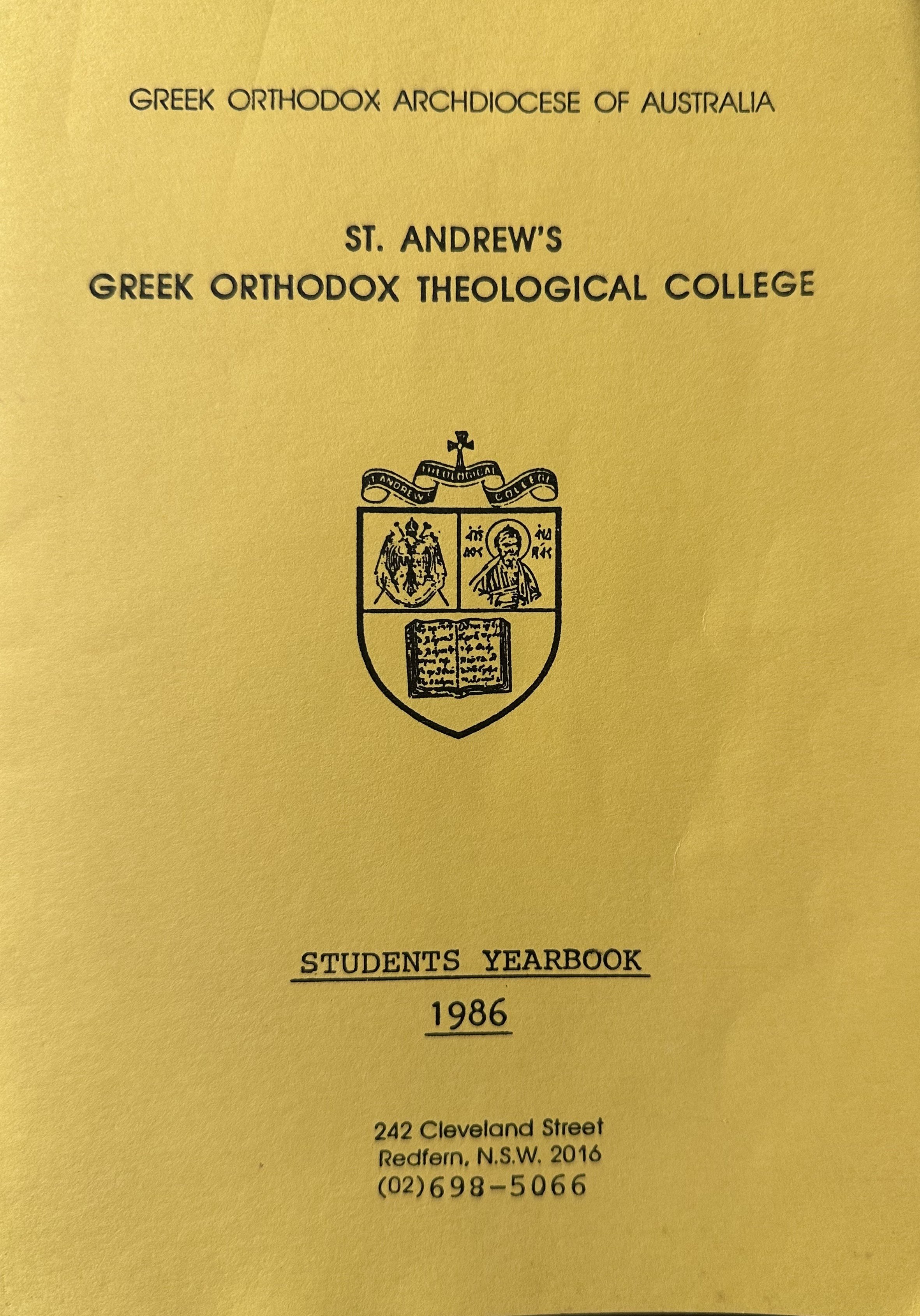
This college is unique—and it belongs to all of us. It could be said that it has an Australian body, a Greek mind, a bilingual tongue, and a heart that is distinctively Orthodox. (Dimitri Kepreotes, SAGOTC Students Yearbook, 1988)

Following the final address of our Archbishop Stylianos, His Eminence Metropolitan Maximos read a warm message from His Holiness Patriarch Demetrios. This concluded the official opening and dedication of our new College; the dream was over and the reality of it all was just about to begin. (Spiros Haralambous, SAGOTC Students Yearbook, 1986)

Around fourteen young men of different dispositions and backgrounds started out in our first year of seminary in 1986 as the inaugural class of this new theological school in Australia (being an Eastern Orthodox institution and an accredited member of the Sydney College of Divinity SCD it was the first of its kind in the Southern Hemisphere). Some of us believed we were going to change the world. No more than a few weeks had passed and then there were nine. The “Messiah Complex” which afflicts a large number of seminarians did not last long. We were enthusiastic but hugely foolhardy in our aspirations. Those of us left after that initial loss of numbers were compelled to lower our original enthusiasm and expectations. Now it was simpler, or so we thought, how are we going to change the already compressing atmosphere of our new place of learning. Surely, we could at least do this—could we not? No, not even this. It is true I also discovered, what a discerning soul once said about seminaries, that they will (as a rule) “relegate Jesus to the background.” Not too many more weeks would pass and then we were down to seven.

Finally, let it be said that nothing good comes easy: should you be sincere in studying a “faithful theology” be prepared to carry thy cross. (M. G. Michael (Ed.), SAGOTC Students Yearbook, 1986)

We have triumphed in that we have grown and learnt to accept not only our responsibilities, but our limitations as well, to be more sensitive to our brother’s needs, to realize the importance of study—more importantly, to kneel in prayer. We have failed in that we could have been less assertive, less demanding, slower to anger and reprove, more humble. (Fr. Jeremiah Michael (Ed.), SAGOTC Students Yearbook 1988)

At the start of the second year two more of the younger seminarians would leave. We were now officially down to the “pioneering five”, as our little group would come to be known. As time progressed and each one of us would do battle with their own particular demons and personal disappointments, we arrived at the hardest and most difficult realization of them all—the most difficult thing would be to change ourselves. Metanoia does not play games. I should have known better. I was one of the older seminarians, a former police officer and already a graduate of another academic institution. I was twenty-five years old. Yet, even I would fall into these deep traps. Now, almost forty years later, I continue to fight with the last of these admissions—that indeed, the road to the restoration of the self is not only arduous but also long-lasting. Which, I must confess, has not become any easier and not for any lack of belief. Unless we learn to forgive but more importantly ask to be forgiven, we will not make spiritual progress. Human nature is terribly complex and we can be deceived even by the noblest of our ideals and intentions. So, please, give each other the room and space to grow and to evolve. Who among us has not been broken? The Japanese art of kintsugi has a great deal to teach us. We cannot ever fully know the background story of another soul’s journey or how our actions might adversely hurt them. These things, as well, you learn in a seminary. To teach the Divine Word, and to preach the Gospel, the “Good News”, is not to be taken lightly:

Not many of you should become teachers, my fellow believers, because you know that we who teach will be judged more strictly. (Jm. 3:1)

Outside some of the basics which we were able to collect over the four years of study (alas to afterwards even mangle many of those lessons), there remain two enduringly meaningful compensations from that time. First, we have the spirit within us to endure through almost anything so long as we have a reason, that is, a “meaningfulness” to persevere. Second, the most beautiful gift we can offer the other is compassion, that is, to “suffer with the other”—and that any pastoral theology however impressive in its exposition bereft of this charism is entirely, and absolutely without meaning. Lest, I have discouraged any soul from attending seminary (and this is certainly not my intention) there will be great days of spiritual delight, too, when you will believe with all of your heart and mind that here in this place—the sometimes “furnace”—is precisely where you had to come. You will learn to pray if indeed this is the desire of your heart and you will fall to your knees in earnest supplication. Studying theology is good. Practising the content of theology is even better. My only purpose here to forewarn you it is an arena where you must be well prepared to engage in spiritual warfare, at times brutal, with the self and the “bad” side of the ego. Pressures will arrive from every side. You will in all likelihood lose friends. You will be betrayed by some in whom you have placed your trust and perhaps had even loved. Your passions will surely be magnified. We come to seminaries wanting to be a Bonhoeffer or a Spurgeon or a Saint Maximus the Confessor, and then reality hits home hard. Above all let us work diligently on our own piece of clay and where we can help the other to do the same. For this is our lifelong task. Along the lines of what Carl Jung termed, “individuation” (the process of self-realization). We are made in the “image” but we forever work towards the “likeness”. I have thought of Christ’s “forty days and forty nights” (Matt. 4:1-11) in the desert as an analogy in some ways to the seminarian’s own testing—and especially if it leads to the priesthood.

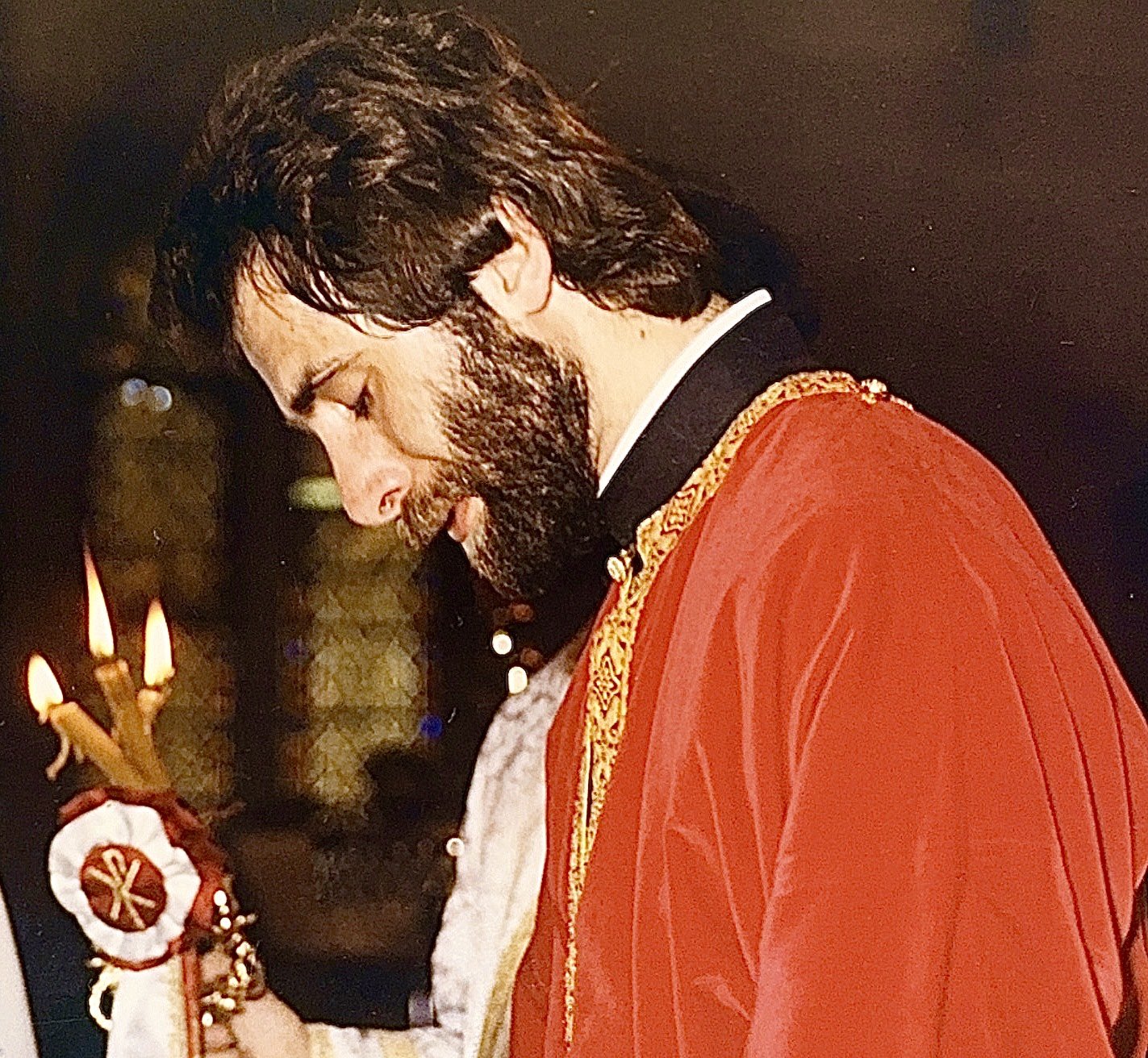
All five who remained were ordained. Of these five, one would later ask to be relieved of their Holy Orders. This fellow was me. A decision, I must also confess, one cannot ever rightly find peace with. Particularly, if you belong to a believing community with entrenched religio-cultural values which are parts of each other. Yet, there is no escaping the fact that I took my hand off the plough and I will one day have to give an account to my Lord. Though I have referred to myself as a theologian, I do not wish to be known as one. The word alone, theologos (“one who speaks of God”), terrifies me for its implications and for the truth that I have every day fallen short of the mark. I am, indeed, the very least of the brethren. It is enough to ponder on the grace and mercies of our Creator. To be occasionally filled with an overwhelming awe—and to find opportunities to share this awe of the “tremendous mystery” with our neighbour. During our long walks down by the edge of the Pacific, that I might keep in practice, our beautiful husky, Mishka, will listen patiently as I ‘sermonize’ to her on the vitalness of endurance. Other times I will preach to the fish and the rocks and the trees, for all things are moving towards their transfiguration. This has now been my ‘captive’ congregation since the time of my exile. The photo which I have posted here after much toing and froing, I had not been able to hold for a long time. It is fine now. I have come to be grateful for that hour. I have understood a lot more of that journey in the ensuing years. And why it was necessary for me to cross this path. In spite of that, good things are never too far away for as the Scriptures say: “And we know that in all things God works for the good of those who love him, who have been called according to his purpose” (Rom. 8:28).

MG Michael Family Archives

Then there are those periods in our life

Tempe, Arizona

In Shellharbour, NSW, one afternoon in 2018 waiting at school for my children. Courtesy: Michael Family archives.

In Shellharbour, NSW, one afternoon in 2018 waiting at school for my children. Courtesy: Michael Family archives.

Then there are those periods in our life when it would seem are reserved for the darkest thunderstorms. And the heavy rains keep coming. Most of us can look back on our lives, especially as we move deeper into middle age and pinpoint three or four of the toughest times. If we could survive those trials then surely we can survive the present ones and those yet to come. It is critical if we should feel ourselves becoming overwhelmed that we look back on those testing weeks, and months and sometimes even years, to see how we pulled through and what lessons can be drawn. Life is indeed a series of ‘ups and downs’ with the ups ever fleeting while the downs have a tendency to linger. This is why I will often refer to one of my favorite maxims gleaned from the desert dwellers that our existence is one of “joyful sorrow”.[1] I have also through my own ups and downs found great comfort in the words of Saint Paul:

“For I consider that the sufferings of this present time are not worth comparing to the glory that is to be revealed to us” (Rom. 8.18).

In recent months it has been one of those periods for me. They have been emotionally and physically difficult. I have had to navigate five deaths each one holding a specific significance in my life with three of these opening up an abyss of triggers affecting my mental well-being. Physically I was once more experiencing severe pain owing to a dental procedure to do with my jaw. We witnessed our eldest boy dealing bravely with having his boyhood dream taken away from him. Nepotism is such a terrible thing. A fortnight ago I also left my beloved UOW to go into possible retirement. A self-identity crisis [and I’ve had a few of these] are not good at any age. And in recent weeks I was preparing for my flight to the United States to catch up with the children and Katina. A trip I was greatly anticipating. Except I now have a fear of flying after almost dropping out of the sky and into the Caribbean on board a small Cessna a few years ago. All these things started to gradually overwhelm me. My blood pressure too rose dangerously which can give rise to other complications. I wept but these were not always the tears of prayer. If truth be told I was suffering in ways not dissimilar to earlier dark times, despite my being older and I would hope a little wiser.

The details behind these recent trials do not matter. They remain peripheral to this entry. For you can be certain that someone somewhere is battling with darkness more impenetrable than our own. Like my beloved Aunt Stella whose entire family was wiped out within the twinkling of an eye or Leo who everyday educated me mowed down riding his motorcycle by a drunkard who until he died one morning could only speak by flicking his eyelids. You try to reason through all of this? You either risk losing your faith or going mad. There are no shortcuts either. You cannot go round suffering. You confront it at the center and by sheer force you compel yourself forward. It can be brutal. It can be ugly. But it is the only way, and it is worth the struggle to get to the end of the race. It is the one true place where we discover our name. There is light on the other side and it is there waiting our entering. “I will fear no evil, for You are with me; Your rod and Your staff, they comfort me” (Ps. 23:4).

But I would like to share with you how this storm too was pushed through that I can now sit down and write these few paragraphs in the relative calm of our little apartment in Tempe, Arizona. I would like especially for the next few minutes to resonate with my younger readers. One of the deaths I spoke of above had in fact to do with the tragic loss of a beautiful young boy. And this is mourning beyond words. Together with the deaths of the bishop who had ordained me into the priesthood my first father confessor Archbishop Stylianos with whom after years of estrangement I had not reconciled and weeks later the sudden passing away of one of my dearest friends our national poet, Les Murray, brought mortality directly into my heart and it did wage war against me one more time. I was taunted amongst other doubts that my own life had been of little if any merit and that for the greater part my few talents had been wasted.

In dealing with the above experiences which came parceled in one hard fist and which not surprisingly released the ‘black dog’ together with an exacerbation of my OCD invariably following behind like a beast in pursuit of its prey, I went through a series of extreme emotions and temptations. And so it happened during these ‘visitations’ that a number of life’s sufferings and impulses arrived closed together: the raw impact of death, the specter of hopelessness, the unbearable thought of the loss of grace, lost opportunities at reconciliation, the weightiness of an overriding guilt, hurting through the unfair treatment meted out to my eldest son, the onset of a melancholia, frustration and anger, the crisis of identity, and strong physical pain. I had confronted such distresses in the same battlefield before but I was younger and more vigorous in spirit. The closest and the most terrifying yet, even more potentially devastating for me, the agonizing aftermath of my leaving the priesthood and the technical issues behind our multiple attempts of trying to save my doctorate which would at times quite literally delete line by line before our eyes. I do not wish for anyone to experience anything of this which was unremitting in its persistence and seemed to me an almost catastrophic situation that would not come to an end. During these times the soul does struggle in its efforts to pray. Do not be alarmed if this is happening to you. It is a natural phenomenon as the ideal situation for prayer is peace, and tribulation is not a peaceful condition. Christ Himself labored in prayer during His most difficult hours on earth: The Agony in the Garden of Gethsemane (Lk. 22:43f.). It is vital to persevere in our own ‘garden of the soul’.

So how can one deal with these multiple attacks? If there is a general formula I would like to know. There is no such thing and we each walk into these green fires on our own, and one way or another, we emerge different beings to what we were the hour before. There is no ‘general formula’ except for tears and the disquisition of whether to live or die. You can choose to live or die in a multitude of ways. This is because each one of us carries single life experiences into the ‘fire’: a present informed by a different past; a different set of values and beliefs even though we might belong to similar faith communities; we are of different ages and significantly of varying degree of resilience. In the extreme, and there are those amongst us who have been to this frightful place, suicidal ideation infiltrates our waking moments right through to our sleepless nights.[2] Yet, there is common ground, even if by virtue of our shared elements of flesh and blood. There is a ‘soft’ intersection of experiences where the crux of the human condition is at its most visible and sensible. It could be that place which Frankl has memorably called ‘man’s search for meaning’[3] or “the will to life” described by Schopenhauer as the fight for self-preservation.[4] For those who move and breathe within a belief-based community both these great pillars of hope and action can be summed up for example by Saint James’ connection of faith to perseverance through trials (Jas. 1:2f.) or to Buddhism’s teaching of Virya Paramita the perfection of perseverance through courage.[5]

Irrespective of our background or philosophical perspectives what these and other deeply felt insights borne from the observation of humans striving to survive are saying: there is meaning to your life, so will yourself to live.

It is possible, others many before us, have gone through these green fires and have come out alive the stronger and the more compassionate. They practice forgiveness of themselves and towards others. Suffering which never lies can do this to us. Adversity can be our most trusted friend. Blessed are they who mourn. It has been done before, and if we should persevere but another day, this too, it will pass.


Postscript Yesterday morning after I dropped off Eleni at summer school classes, I took my long walk down Southern Ave., Tempe. The heat would be unbearable if not for the fact it doesn’t ‘burn’ you like the summer scorchers back home in Australia. The forecast for today is 110 ℉! My ritual has been to take an initial short break at the Back East Bagels for a light morning breakfast. Then the much longer trek retracing my steps back past the school left into Rural Rd., to spend the next three hours at Tempe Public Library. I love spending time in libraries. Cicero well compared libraries to gardens. This evening George is leaving with his Arizona rugby teammates for Denver, Colorado, to contest the Regional Cup Tournament (RCT). Tomorrow morning Eleni and I will be flying out to join him to catch some of the round games.

And yet this impromptu postscript had another reason. On my way to the library yesterday turning left into Rural in the corner of the road my eyes caught sight of a little bird lying motionless in a ditch. It could have been a House Finch. I am not sure. It was dead still. It faced upwards its wings folded around its brown breast like a cloak. Eyes and mouth closed. It might have died for the lack of water. I don’t know. We can never know the whole truth. Not even about ourselves. I wept like a child. Is this normal? Do these things happen to you as well? I thought of the thousands of men and women and children who would on that day likewise die anonymously in the world whether of thirst or famine, homeless somewhere on a city street, or by themselves in a hospital bed. Anonymously and alone like this little bird which, too, had a history and stories to tell.

[1] https://pittsburghoratory.blogspot.com/2012/05/joyful-sorrow-compunction-and-gift-of.html

[2] https://www.youtube.com/watch?v=7CIq4mtiamY

[3] https://www.psychologytoday.com/us/blog/hide-and-seek/201205/mans-search-meaning

[4] https://en.wikipedia.org/wiki/Will_to_live

[5] https://www.learnreligions.com/virya-paramita-perfection-of-energy-449709

Providence, Coincidence or Meaningful Decisions

homer.jpg

Providence is mostly connected to theological reflection and generally associated to divine purpose. Coincidence on the other hand is normally thought of in terms of luck, fate, or chance. In some other instances coincidence has been thought of in the context of meaningful decisions, perhaps it is here where it ‘coincides’ with providence.[1] Ultimately, whatever our definitions [throwing in the ‘problem of evil’ to boot], both can be understood as forces of influence which determine destiny. In the Homeric writings ‘destiny’ is more coincidence with providence connected to ‘divine intervention’. Destiny is fate [moira] for Homer, it cannot be escaped. Divine intervention, however, can manipulate destiny even with the direct involvement of human agency.[2] The stories of Achilles and Hector as described in the Iliad are good examples of destiny as a combination of divine intervention and human agency. And this complex interaction between divine action and free will is a fundamental principle in the New Testament, accordingly Saint Paul writes to the Christian community in Philippi that both human responsibility and sovereign control are at work in the Christian life (Phil 2:12-13). What is it that drives us to understand something of these impenetrable forces and to try to put a name to them? An illuminating response from a contemporary piece of literature can be found in Christos Tsiolkas Dead Europe. The protagonist and not irrelevantly a photographer, the young Greek-Australian Isaac, reflects in one place when asked to use his camera to document events of the past, “[t]his desperate need to confirm the relevance of history…”[3] I did have significant problems with some of the content in Tsiolkas’ book, but the masterly use of time and space in this admittedly disturbing novel leave their mark.

Flemington Markets

Katina had turned nineteen and was in the second year of her BIT at the University of Technology Sydney and I at thirty-three had started on the MA Honours at Macquarie University. I needed to find some payable work, we were managing with the help of our parents and our scholarships but our personal finances were starting to run low. My pride and self-belief suffered a severe blow when I joined the ranks of those on unemployment benefits. I was now no longer someone who was greeted with the respect accorded to a professional, let alone a clergyman. It did not matter too much during the time when I was alone. I had already lived in this ‘post’ existence of mine for a number of years, but now what affected me would also have an effect on my younger wife [who as events would prove was blessed with wisdom beyond her years]. From Reverend or Father I was now a “number” doing the rounds knocking on doors and looking for work. This could be anything from stacking sheets of tin in warehouses to selling encyclopaedias in shopping malls. It was humbling, I have to confess, to be asked if I understood or knew how to complete the paperwork relating to my new found unemployment. This process of ‘deconstruction’ had begun a number of years earlier upon my return from Europe where I had worn my favourite black cassock for the last time. Things were made all the more grim for my former “employer” the Archdiocese would not supply me with a reference. The exception was the heroic Father Themistocles Adamopoulo who by this time was himself persona non grata.[4] I asked some other good men from there as well, but their support was qualified. They wanted to know beforehand “where” their references would be going. Walking away from the priesthood is viewed very dimly. Even by formerly trusted friends. And I did understand. As I still do. I thanked them but declined.

It took some weeks getting used to, but I began to love going to my new job at Flemington Markets, more exactly at Paddy’s Markets.[5] It was a time of long stretches of peace and a new type of learning. I was hired as a cleaner: toilets, floors, potato conveyers, fruit crates, large vats, giant coleslaw mixers, windows, walls, and more. If it had to be cleaned, I was the man! But this had a potentially serious health implication for I had been using some very harsh chemicals without any appropriate protection. For afterwards during my service in the Cypriot National Guard the medical investigator was concerned with the state of my lungs, there were some “shadows”, he said. I was told it might be tuberculosis or lung cancer. On my return to Australia I was given the all clear and in another place I will say more on this experience both in terms of divine intervention and human agency. I was also proud of my new ‘vestments’: a pair of weatherproof boots, gloves, overalls, and a yellow raincoat with a hood. The hours as well, they suited an old night-owl like me. Work started eleven at night and I would clock off the following morning around seven, it was not full-time so I had rest days in between. There were many things I enjoyed during those few months that I was able to stay at Paddy’s before I left to entirely focus on the first dissertation, the one dealing with the infamous “666” and the antichrist conundrum. Each night I looked forward to greeting my new ‘con-celebrants’: the Asians who would cut and prepare the salads; the sunburnt farmers; the busy stall owners; the testy truck drivers; and every now and then the pest-control fellow who would also moonlight as a Reiki Master.

The coffee-breaks were history classes in themselves. I heard many stories in that small kitchenette by well-weathered men who had seen much and just about done it all. These were tough but honest folk, people you could trust and where you quickly learnt to "call a spade a spade.” They reminded me of the abattoir workers I used to help load meat trucks in the early hours of the morning to supplement my allowance when I was a student in Thessaloniki. They were also not lacking in the stories department. During this time at the markets I would read whenever I could steal a few minutes during the morning breaks or in between my scheduled jobs. The Philokalia[6] and the Art of Prayer[7] were invariably within reach, together with the lives of two saints whose personalities had especially attracted me, Saints Seraphim of Sarov and John of Kronstandt. Yet again I would be taught that wonderful and encouraging lesson often heard on Mount Athos: it is not the place, but the Way. Other times it might be as simple as the positive energy good spirits [people] release into the air. 

Given my earlier life at the café this was not unfamiliar territory. I was in my element in these environments. I look back over more than thirty years later when I first put on the cassock and I realize it is with these ‘straight-talking’ people at places like Paddy’s and King Street, Newtown and in the side streets of Egnatia Odos, where I am most happy and comfortable. And I would have stayed at the markets for much longer if not for my pride “this perpetual nagging temptation” as C.S. Lewis has so well put it and because I knew in the words of one Martin Heidegger that I had “unfinished business”.

Of course, much had happened even before this time. I had spent a lengthy period in the Palestinian desert with the monastic community at the Holy Lavra of Saint Sabbas the Sanctified [also known as Mar Saba] and had privately tutored and taught a number of subjects at secondary school. Later I will speak at length on these wonderfully significant experiences which would afterwards greatly impact upon my life. Providence, coincidence or meaningful decisions? To be at least prepared to walk through those doors which we might reckon belong to the right provenance. 

[1] https://plato.stanford.edu/entries/providence-divine/

[2] http://legacy.owensboro.kctcs.edu/crunyon/HRS101/Homer/03&4-Iliad/Fate_Schein.html

[3] Christos Tsiolkas, Dead Europe, (Vintage Books: Australia), 2005, 151.

[4] http://www.abc.net.au/news/programs/one-plus-one/2015-11-26/one-plus-one:-rev.-themi-adamopoulo/6978258

[5] http://paddysmarket.com.au/history/

[6] https://orthodoxwiki.org/Philokalia

[7] https://www.amazon.com/Art-Prayer-Orthodox-Anthology/dp/057119165