On the grief of losing the love of a beautiful friend

In the end, we will remember not the words of our enemies, but the silence of our friends. (Martin Luther King Jr., Trumpet of Conscience)

Whenever someone who knows you disappears, you lose one version of yourself. Yourself as you were seen, as you were judged to be. Lover or enemy, mother or friend, those who know us construct us, and their several knowings slant the different facets of our characters like diamond cutter’s tools. (Salman Rushdie, The Ground Beneath Her Feet)

I have, of course, broached this subject in other ways, but never, I think, with the same weight that I now carry in my heart. What encourages me to continue writing these little essays, which have taken on a more discernibly urgent mood in recent times, is not only the wonderful support with which you have received them, but also the knowledge that I am speaking to realities common to the human condition. Indeed, many of you will have lived through experiences much like those I have described and, in many cases, have addressed them far more eloquently than I could hope to do. And, yet, it is good that we speak to one and other in such ways, meeting in those places of vulnerability where so much of our hidden truth resides.

There is a suffering that can, for those who live with chronic pain, go deeper than the ache felt in the bones. It is the grief of being rejected by someone we love. These are the people whose faces fill our photo albums and with whom we have shared some of the largest moments of joy and sorrow in our life. Their absence can leave a wound that could seem impossible to heal. The relationships we had with these souls are of different degrees, and each loss brings with it a discrete sorrow to the heart. Here I will reflect on the loss of a like-minded friend, one who had for a season stuck closer than a brother (Prov. 18:24). The importance and archetypal beauty of friendship has been celebrated throughout the arts, and magnificently in the great epic narratives of Homer, to the searing confession of St. Gregory Nazianzus on the loss of his friend St. Basil the Great, and the notable essays on the same subject by C. S. Lewis:

For a friend with an understanding heart is worth no less than a brother. (Homer, The Odyssey)

Do not leave me here;  / Do not, I beg: I swear upon your tomb, / Never will I forget you and move on; / I could not, if I wanted. (St. Gregory Nazianzus, Poems)

Eros will have naked bodies; Friendship naked personalities. (C. S. Lewis, The Four Loves)

Friendship is also attributed to our Creator and is a recurring motif common in the Scripture, and in Buddhism it is considered essential to one’s spiritual growth:

And the scripture was fulfilled that says, “Abraham believed God, and it was credited to him as righteousness,” and he was called God’s friend. (Jm. 2:23)

The friend who is a helper, the friend through thick and thin, the friend who gives good counsel, and the compassionate friend; these four are friends indeed. The wise understand this and attend on them carefully, like a mother her own child.  (The Buddha, Sigalovada Sutta)

When Jesus Christ himself, was abandoned by his closest disciples during the hours of his most gruelling testing, at the Gethsemane temptation when they would fall asleep (and no less than on three occasions), and then on Calvary where outside of John they all would later flee, he allowed for the frailty of the human condition and freely gave of the benefit of the doubt knowing that: “[t]he spirit is willing, but the flesh is weak” (Matt. 26:41). Later he would build his Church on St. Peter “the Rock”, the one who had also denied him three times at the courtyard of the high priest. This is what a great benevolence a friend can deliver to another by crushing the silence and allowing for love and compassion to lift the other to their most utmost potential. Yes, as friends, we, too, do possess such ‘godly’ power to raise the other by not too quickly extinguishing the prospects of reconciliation. This was the same with Saints Peter and Paul, strongly antagonistic the one towards the other, to eventually reconcile and then to lay down the first foundations of the Church. So we do not give up hope. The seed that once gave birth to the oak though now made complete, lives on in the acorn. Friendships that were originally built on love are rarely completely extinguished, we sometimes only need but a little distance to allow for nature and for the deeper humanity to take their course.

One common trap in our grief is to deny that these individuals were true friends in the first place, and so we start to look for those ‘obvious’ patterns that might now prove it. Every previous slight or let down take on another more sinister connotation. Such counsel is short-term comfort and in the end doomed to failure. It can only contribute to an ongoing agonising. To begin with, it seems to me, to be self-contradictory. Such a negative perspective could suggest the same for ourselves. That is, were we too, then, not true friends? Relationships built over years of genuine concord and intense shared experiences cannot be pretended. It does not take too long for fakery to manifest itself. And so, they were true friends to us, as we were to them. For this precious gift alone, it is good to be thankful. It is a difficult truth, especially if we have been deeply wounded, to accept that in almost every instance there was a strong love between the two souls. It is only natural when the pain goes deep, to look for any way out that might alleviate some of that suffering. Halfway through one of the most fabulous violin performances of Vivaldi’s “Winter” strings from Ray Chen’s bow broke. He continued to play. The music did not suffer and it went its course. Despite this visible disruption, the beauty of the score was not diminished.

The word concord comes from the Latin concordia (meaning harmony or agreement), which is built from con- (together) and cor (heart). Literally, it means "hearts together". It entered English through Old French (concorde) in the 12th century to mean peace, union, or friendly agreement. (Wiktionary)

https://unsplash.com/photos/two-woman-sitting-on-beach-sand-while-facing-sunlight-hkkQbPa49UA

The grief we live through, this intense emotional sorrow ordinarily associated with mourning, is caused by the "remembrance of things past," to recall Marcel Proust. A photograph; a song; a road; a scent; a Christmas gathering. A laugh you hear in the shopping mall that you would swear was your friend. Then you see the beloved. It IS them. They walk straight past or worse, they turn their back on you. These are excruciating moments should you experience them. These souls inhabit big pieces of our life. One can hurt from a difficult disease but the pain at such a blatant rejection can stay with you for years. It can cut in places deeper than that ache to the bones. So what happened? A miscommunication? An innocent mistake? A misplaced word spoken in anger? Not being there at a needful time because you could not. Ultimately, not being that ‘perfect’ friend. Who can be—and who has been able to measure up perfectly to that ideal? Yet, here is the archetypal form of the brother friend, to accept the one and other within the full realm of the graces, to be wise enough to at least accept, that we are all liable at some unforeseen moments in our life to fall short of the mark.

How can one respond to this unspeakable pain of a beloved’s silence? The recognition that we are all fragile and broken in the secret places, goes some way towards not only battling this grief but to also have compassion for our friend, they, too, are carrying their own cross in life. We are all looking to be loved and to be rescued from those burdens that haunt our hearts the most. Spending the remainder of our lives blaming the other for their silence will ultimately prove annihilating. Being the first to reach out requires both courage and vulnerability, and some friendships are worth the risk of a second rejection. That said, repeated attempts are not good for either of the souls. One might become more hardened in spirit, while the other could plunge deeper into grief. So there will come an hour when we must accept that things are unlikely to change. It will be the time to stop interrogating ourselves and the past in search of answers. This will be the moment when we have to make our own closure and not wait indefinitely for the other to deliver it. Our worth and dignity are not diminished when we are rejected. Self-identity and selfhood are not dependent on another’s perception of our presence and value in the world.

Our life’s journey and the gifts that we can offer to others and build on already existing meaningful friendships, do not all of a sudden come to an end because we might have been “ghosted”—and such a terrible word. Though very difficult at first, this rejection which in the beginning could appear to us to be impossible to overcome, will open the door to not only a profounder awareness of the self, but also to the founding of new friendships—and oftentimes in those places we might not have expected—on a city street in the middle of a downpour or in the corridors of a hospital ward. These new friendships will play their own significant part in carrying us through to the remainder of our lives. When our final days arrive, whenever that might be, we will be surrounded by those who have truly loved us, who have recognised the good intentions of our hearts, and who have inspired the best in us. As difficult as it might now be to believe, this terrible pain inflicted by those who were once dearest friends will, at that last hour be entirely forgotten, for they too would have by this time entered even more deeply into our hearts.

We were in search of our identity

I have increasingly wondered what it would be like, how wonderful beyond the conception of words, to have in the one room towards the closure of one’s life, all your adversaries—I have never liked the word enemy. To reveal to each and every one of these souls that without their presence, the puzzle would not be complete. Even, if as Seneca has said, we are injured most by what we do not expect. I say to myself even during the excruciating hours, I would not be who I am today without you. To embrace these adversaries tightly and to whisper into their ear which too has been aching: “We were in search of our identity. I have always loved you.” In the panic of this pursuit we enter into the realms of brokenness. Wounded we are all in need of healing. To then paraphrase those great words which on this earth will bring us closer to the divinity than most any other: “All is now forgiven. We knew not what we did.” The adversary is a good teacher. If not for you, this prayer that I am now setting down, would not have been born. To weep those melliferous tears of pure joy before it all ends in this room where the great peace will now at last begin to reign. I wonder how much of the pain we have suffered came down to a misunderstanding? Or that an hour would not have reconciled us the one to the other. All else outside the realm of love and forgiveness, when that final moment comes—and it will come to us all, was possessed of little enduring value or meaning. Release the other from their hurt. Do not leave them frozen like a deer caught in headlights.

Seminary: The most difficult thing would be to change ourselves

Sydney-Gerringong

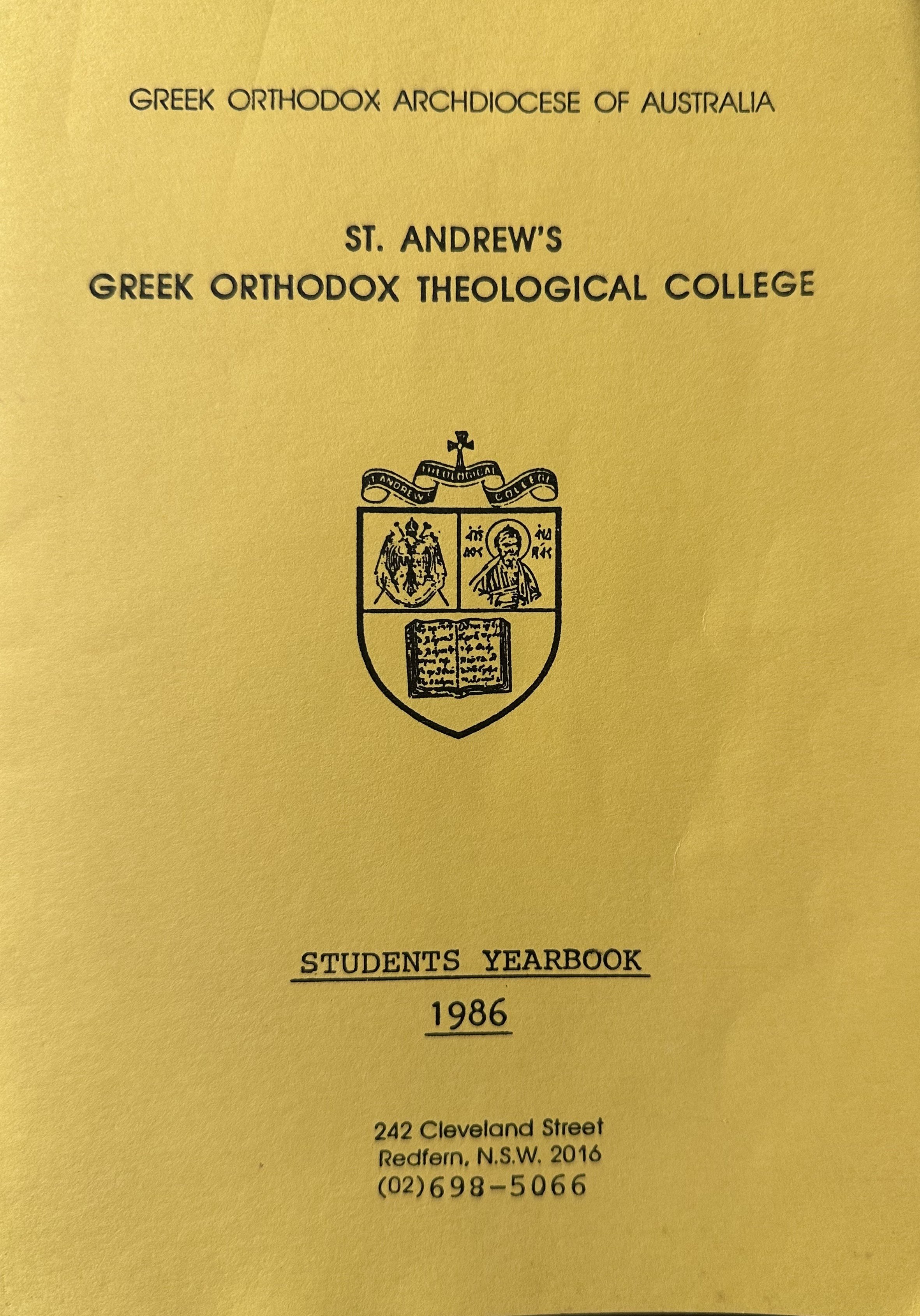
In Sydney this morning I had an interesting encounter with a young person at a bookstore when the conversation for one reason turned to seminaries (from the Latin seminarium for “seed plot”). Chance meetings can prove a catalyst to go back into past stories of our lives. I hope one day that I might be able to write down my own seminary experience, the place where some of us go that we might receive an education in theology. It is only afterwards we learn those places are in reality but a training ground for spiritual survival. Even now and after almost four decades, it is not an easy thing for me to revisit this period of my life. Allow me, if you will, to share but a small reflection going back to those times.

This college is unique—and it belongs to all of us. It could be said that it has an Australian body, a Greek mind, a bilingual tongue, and a heart that is distinctively Orthodox. (Dimitri Kepreotes, SAGOTC Students Yearbook, 1988)

Following the final address of our Archbishop Stylianos, His Eminence Metropolitan Maximos read a warm message from His Holiness Patriarch Demetrios. This concluded the official opening and dedication of our new College; the dream was over and the reality of it all was just about to begin. (Spiros Haralambous, SAGOTC Students Yearbook, 1986)

Around fourteen young men of different dispositions and backgrounds started out in our first year of seminary in 1986 as the inaugural class of this new theological school in Australia (being an Eastern Orthodox institution and an accredited member of the Sydney College of Divinity SCD it was the first of its kind in the Southern Hemisphere). Some of us believed we were going to change the world. No more than a few weeks had passed and then there were nine. The “Messiah Complex” which afflicts a large number of seminarians did not last long. We were enthusiastic but hugely foolhardy in our aspirations. Those of us left after that initial loss of numbers were compelled to lower our original enthusiasm and expectations. Now it was simpler, or so we thought, how are we going to change the already compressing atmosphere of our new place of learning. Surely, we could at least do this—could we not? No, not even this. It is true I also discovered, what a discerning soul once said about seminaries, that they will (as a rule) “relegate Jesus to the background.” Not too many more weeks would pass and then we were down to seven.

Finally, let it be said that nothing good comes easy: should you be sincere in studying a “faithful theology” be prepared to carry thy cross. (M. G. Michael (Ed.), SAGOTC Students Yearbook, 1986)

We have triumphed in that we have grown and learnt to accept not only our responsibilities, but our limitations as well, to be more sensitive to our brother’s needs, to realize the importance of study—more importantly, to kneel in prayer. We have failed in that we could have been less assertive, less demanding, slower to anger and reprove, more humble. (Fr. Jeremiah Michael (Ed.), SAGOTC Students Yearbook 1988)

At the start of the second year two more of the younger seminarians would leave. We were now officially down to the “pioneering five”, as our little group would come to be known. As time progressed and each one of us would do battle with their own particular demons and personal disappointments, we arrived at the hardest and most difficult realization of them all—the most difficult thing would be to change ourselves. Metanoia does not play games. I should have known better. I was one of the older seminarians, a former police officer and already a graduate of another academic institution. I was twenty-five years old. Yet, even I would fall into these deep traps. Now, almost forty years later, I continue to fight with the last of these admissions—that indeed, the road to the restoration of the self is not only arduous but also long-lasting. Which, I must confess, has not become any easier and not for any lack of belief. Unless we learn to forgive but more importantly ask to be forgiven, we will not make spiritual progress. Human nature is terribly complex and we can be deceived even by the noblest of our ideals and intentions. So, please, give each other the room and space to grow and to evolve. Who among us has not been broken? The Japanese art of kintsugi has a great deal to teach us. We cannot ever fully know the background story of another soul’s journey or how our actions might adversely hurt them. These things, as well, you learn in a seminary. To teach the Divine Word, and to preach the Gospel, the “Good News”, is not to be taken lightly:

Not many of you should become teachers, my fellow believers, because you know that we who teach will be judged more strictly. (Jm. 3:1)

Outside some of the basics which we were able to collect over the four years of study (alas to afterwards even mangle many of those lessons), there remain two enduringly meaningful compensations from that time. First, we have the spirit within us to endure through almost anything so long as we have a reason, that is, a “meaningfulness” to persevere. Second, the most beautiful gift we can offer the other is compassion, that is, to “suffer with the other”—and that any pastoral theology however impressive in its exposition bereft of this charism is entirely, and absolutely without meaning. Lest, I have discouraged any soul from attending seminary (and this is certainly not my intention) there will be great days of spiritual delight, too, when you will believe with all of your heart and mind that here in this place—the sometimes “furnace”—is precisely where you had to come. You will learn to pray if indeed this is the desire of your heart and you will fall to your knees in earnest supplication. Studying theology is good. Practising the content of theology is even better. My only purpose here to forewarn you it is an arena where you must be well prepared to engage in spiritual warfare, at times brutal, with the self and the “bad” side of the ego. Pressures will arrive from every side. You will in all likelihood lose friends. You will be betrayed by some in whom you have placed your trust and perhaps had even loved. Your passions will surely be magnified. We come to seminaries wanting to be a Bonhoeffer or a Spurgeon or a Saint Maximus the Confessor, and then reality hits home hard. Above all let us work diligently on our own piece of clay and where we can help the other to do the same. For this is our lifelong task. Along the lines of what Carl Jung termed, “individuation” (the process of self-realization). We are made in the “image” but we forever work towards the “likeness”. I have thought of Christ’s “forty days and forty nights” (Matt. 4:1-11) in the desert as an analogy in some ways to the seminarian’s own testing—and especially if it leads to the priesthood.

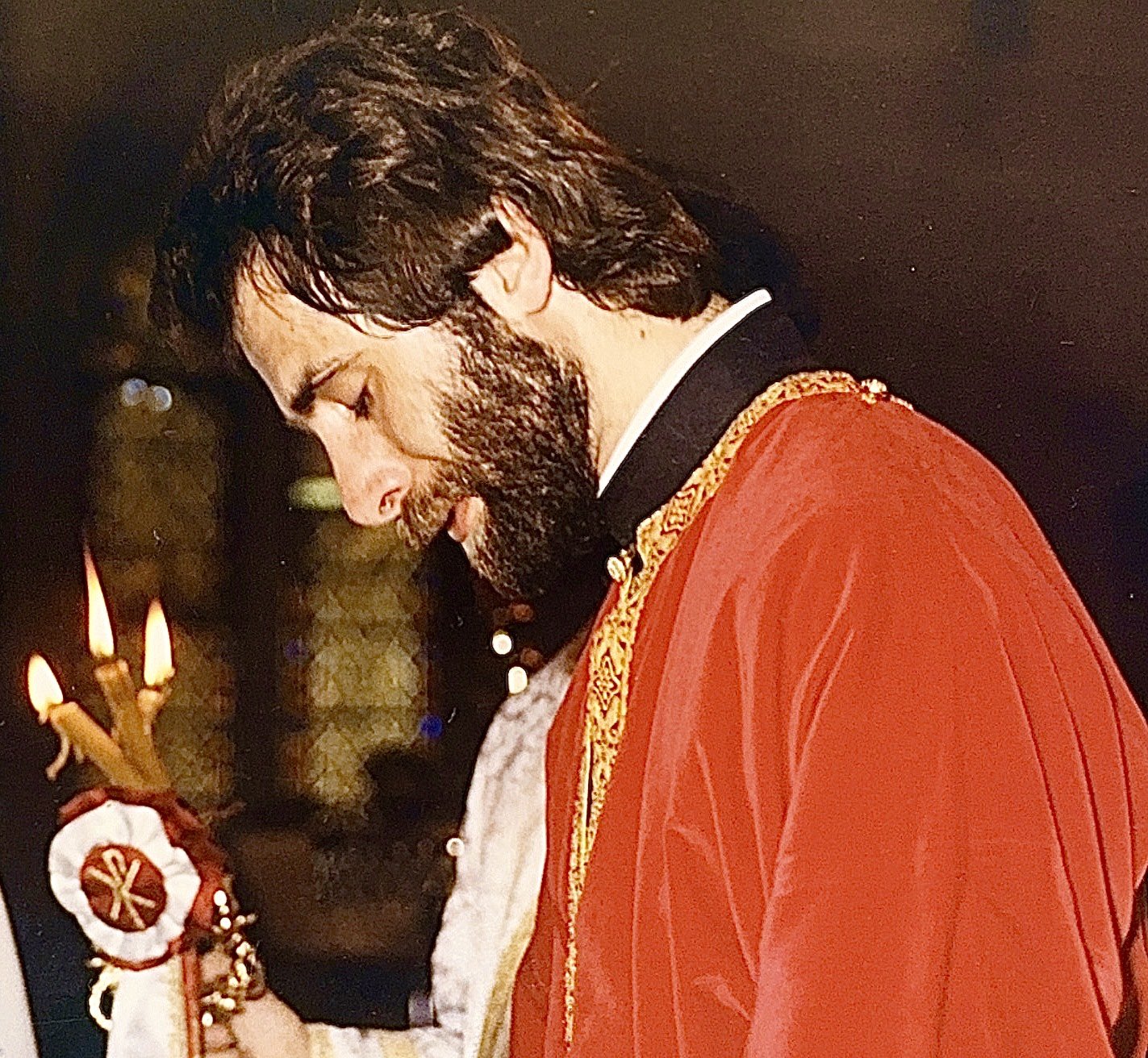
All five who remained were ordained. Of these five, one would later ask to be relieved of their Holy Orders. This fellow was me. A decision, I must also confess, one cannot ever rightly find peace with. Particularly, if you belong to a believing community with entrenched religio-cultural values which are parts of each other. Yet, there is no escaping the fact that I took my hand off the plough and I will one day have to give an account to my Lord. Though I have referred to myself as a theologian, I do not wish to be known as one. The word alone, theologos (“one who speaks of God”), terrifies me for its implications and for the truth that I have every day fallen short of the mark. I am, indeed, the very least of the brethren. It is enough to ponder on the grace and mercies of our Creator. To be occasionally filled with an overwhelming awe—and to find opportunities to share this awe of the “tremendous mystery” with our neighbour. During our long walks down by the edge of the Pacific, that I might keep in practice, our beautiful husky, Mishka, will listen patiently as I ‘sermonize’ to her on the vitalness of endurance. Other times I will preach to the fish and the rocks and the trees, for all things are moving towards their transfiguration. This has now been my ‘captive’ congregation since the time of my exile. The photo which I have posted here after much toing and froing, I had not been able to hold for a long time. It is fine now. I have come to be grateful for that hour. I have understood a lot more of that journey in the ensuing years. And why it was necessary for me to cross this path. In spite of that, good things are never too far away for as the Scriptures say: “And we know that in all things God works for the good of those who love him, who have been called according to his purpose” (Rom. 8:28).

MG Michael Family Archives

Then there are those periods in our life

Tempe, Arizona

In Shellharbour, NSW, one afternoon in 2018 waiting at school for my children. Courtesy: Michael Family archives.

In Shellharbour, NSW, one afternoon in 2018 waiting at school for my children. Courtesy: Michael Family archives.

Then there are those periods in our life when it would seem are reserved for the darkest thunderstorms. And the heavy rains keep coming. Most of us can look back on our lives, especially as we move deeper into middle age and pinpoint three or four of the toughest times. If we could survive those trials then surely we can survive the present ones and those yet to come. It is critical if we should feel ourselves becoming overwhelmed that we look back on those testing weeks, and months and sometimes even years, to see how we pulled through and what lessons can be drawn. Life is indeed a series of ‘ups and downs’ with the ups ever fleeting while the downs have a tendency to linger. This is why I will often refer to one of my favorite maxims gleaned from the desert dwellers that our existence is one of “joyful sorrow”.[1] I have also through my own ups and downs found great comfort in the words of Saint Paul:

“For I consider that the sufferings of this present time are not worth comparing to the glory that is to be revealed to us” (Rom. 8.18).

In recent months it has been one of those periods for me. They have been emotionally and physically difficult. I have had to navigate five deaths each one holding a specific significance in my life with three of these opening up an abyss of triggers affecting my mental well-being. Physically I was once more experiencing severe pain owing to a dental procedure to do with my jaw. We witnessed our eldest boy dealing bravely with having his boyhood dream taken away from him. Nepotism is such a terrible thing. A fortnight ago I also left my beloved UOW to go into possible retirement. A self-identity crisis [and I’ve had a few of these] are not good at any age. And in recent weeks I was preparing for my flight to the United States to catch up with the children and Katina. A trip I was greatly anticipating. Except I now have a fear of flying after almost dropping out of the sky and into the Caribbean on board a small Cessna a few years ago. All these things started to gradually overwhelm me. My blood pressure too rose dangerously which can give rise to other complications. I wept but these were not always the tears of prayer. If truth be told I was suffering in ways not dissimilar to earlier dark times, despite my being older and I would hope a little wiser.

The details behind these recent trials do not matter. They remain peripheral to this entry. For you can be certain that someone somewhere is battling with darkness more impenetrable than our own. Like my beloved Aunt Stella whose entire family was wiped out within the twinkling of an eye or Leo who everyday educated me mowed down riding his motorcycle by a drunkard who until he died one morning could only speak by flicking his eyelids. You try to reason through all of this? You either risk losing your faith or going mad. There are no shortcuts either. You cannot go round suffering. You confront it at the center and by sheer force you compel yourself forward. It can be brutal. It can be ugly. But it is the only way, and it is worth the struggle to get to the end of the race. It is the one true place where we discover our name. There is light on the other side and it is there waiting our entering. “I will fear no evil, for You are with me; Your rod and Your staff, they comfort me” (Ps. 23:4).

But I would like to share with you how this storm too was pushed through that I can now sit down and write these few paragraphs in the relative calm of our little apartment in Tempe, Arizona. I would like especially for the next few minutes to resonate with my younger readers. One of the deaths I spoke of above had in fact to do with the tragic loss of a beautiful young boy. And this is mourning beyond words. Together with the deaths of the bishop who had ordained me into the priesthood my first father confessor Archbishop Stylianos with whom after years of estrangement I had not reconciled and weeks later the sudden passing away of one of my dearest friends our national poet, Les Murray, brought mortality directly into my heart and it did wage war against me one more time. I was taunted amongst other doubts that my own life had been of little if any merit and that for the greater part my few talents had been wasted.

In dealing with the above experiences which came parceled in one hard fist and which not surprisingly released the ‘black dog’ together with an exacerbation of my OCD invariably following behind like a beast in pursuit of its prey, I went through a series of extreme emotions and temptations. And so it happened during these ‘visitations’ that a number of life’s sufferings and impulses arrived closed together: the raw impact of death, the specter of hopelessness, the unbearable thought of the loss of grace, lost opportunities at reconciliation, the weightiness of an overriding guilt, hurting through the unfair treatment meted out to my eldest son, the onset of a melancholia, frustration and anger, the crisis of identity, and strong physical pain. I had confronted such distresses in the same battlefield before but I was younger and more vigorous in spirit. The closest and the most terrifying yet, even more potentially devastating for me, the agonizing aftermath of my leaving the priesthood and the technical issues behind our multiple attempts of trying to save my doctorate which would at times quite literally delete line by line before our eyes. I do not wish for anyone to experience anything of this which was unremitting in its persistence and seemed to me an almost catastrophic situation that would not come to an end. During these times the soul does struggle in its efforts to pray. Do not be alarmed if this is happening to you. It is a natural phenomenon as the ideal situation for prayer is peace, and tribulation is not a peaceful condition. Christ Himself labored in prayer during His most difficult hours on earth: The Agony in the Garden of Gethsemane (Lk. 22:43f.). It is vital to persevere in our own ‘garden of the soul’.

So how can one deal with these multiple attacks? If there is a general formula I would like to know. There is no such thing and we each walk into these green fires on our own, and one way or another, we emerge different beings to what we were the hour before. There is no ‘general formula’ except for tears and the disquisition of whether to live or die. You can choose to live or die in a multitude of ways. This is because each one of us carries single life experiences into the ‘fire’: a present informed by a different past; a different set of values and beliefs even though we might belong to similar faith communities; we are of different ages and significantly of varying degree of resilience. In the extreme, and there are those amongst us who have been to this frightful place, suicidal ideation infiltrates our waking moments right through to our sleepless nights.[2] Yet, there is common ground, even if by virtue of our shared elements of flesh and blood. There is a ‘soft’ intersection of experiences where the crux of the human condition is at its most visible and sensible. It could be that place which Frankl has memorably called ‘man’s search for meaning’[3] or “the will to life” described by Schopenhauer as the fight for self-preservation.[4] For those who move and breathe within a belief-based community both these great pillars of hope and action can be summed up for example by Saint James’ connection of faith to perseverance through trials (Jas. 1:2f.) or to Buddhism’s teaching of Virya Paramita the perfection of perseverance through courage.[5]

Irrespective of our background or philosophical perspectives what these and other deeply felt insights borne from the observation of humans striving to survive are saying: there is meaning to your life, so will yourself to live.

It is possible, others many before us, have gone through these green fires and have come out alive the stronger and the more compassionate. They practice forgiveness of themselves and towards others. Suffering which never lies can do this to us. Adversity can be our most trusted friend. Blessed are they who mourn. It has been done before, and if we should persevere but another day, this too, it will pass.


Postscript Yesterday morning after I dropped off Eleni at summer school classes, I took my long walk down Southern Ave., Tempe. The heat would be unbearable if not for the fact it doesn’t ‘burn’ you like the summer scorchers back home in Australia. The forecast for today is 110 ℉! My ritual has been to take an initial short break at the Back East Bagels for a light morning breakfast. Then the much longer trek retracing my steps back past the school left into Rural Rd., to spend the next three hours at Tempe Public Library. I love spending time in libraries. Cicero well compared libraries to gardens. This evening George is leaving with his Arizona rugby teammates for Denver, Colorado, to contest the Regional Cup Tournament (RCT). Tomorrow morning Eleni and I will be flying out to join him to catch some of the round games.

And yet this impromptu postscript had another reason. On my way to the library yesterday turning left into Rural in the corner of the road my eyes caught sight of a little bird lying motionless in a ditch. It could have been a House Finch. I am not sure. It was dead still. It faced upwards its wings folded around its brown breast like a cloak. Eyes and mouth closed. It might have died for the lack of water. I don’t know. We can never know the whole truth. Not even about ourselves. I wept like a child. Is this normal? Do these things happen to you as well? I thought of the thousands of men and women and children who would on that day likewise die anonymously in the world whether of thirst or famine, homeless somewhere on a city street, or by themselves in a hospital bed. Anonymously and alone like this little bird which, too, had a history and stories to tell.

[1] https://pittsburghoratory.blogspot.com/2012/05/joyful-sorrow-compunction-and-gift-of.html

[2] https://www.youtube.com/watch?v=7CIq4mtiamY

[3] https://www.psychologytoday.com/us/blog/hide-and-seek/201205/mans-search-meaning

[4] https://en.wikipedia.org/wiki/Will_to_live

[5] https://www.learnreligions.com/virya-paramita-perfection-of-energy-449709

After a few hours in Wollongong

Wollongong, NSW

Where have I seen these faces before; in a dream after I had prayed the Akathyst to the Holy Mother; in an aeroplane on my way to Estonia; double espresso; vegetable fritters with corn salsa; a small glass of cold water; Katina and the little ones in Tathra; I miss them after an hour; but now I can write one-hundred and forty-four words; a dark haired woman with a column of silver rings rubs her left eye; Geraldine is that you; a little child is crying; a young Mother bends down to whisper into her big ear; it doesn’t help; keep focused Michael, confess to the black wall; “[w]e need to search for our soul” (Carl Jung); the people’s heads are bent like a crooked elbow; mesmerized by their gleaming mobiles; wasting hours which turn into lost years; “I won’t have coffee with you,” Sophia once said to me; “you can’t kill time”; she was usually right; I will need to start for home soon; it is still raining; “Here Comes the Rain Again (Eurythmics); thirst will never lie; “I thirst” the GodMan cries out (Jn. 19:28); dig for water and not for oil; I should translate Stephen’s poem; all in good time; we must keep our promises; a girl in white jeans runs across to the escalator; a good metaphor to note down; she has forgotten her name somewhere on the floor below; where have I seen these faces before; candles and waxes; boiled cinnamon; paraffin; let him who is without song cast the first stone; Josephine Baker, the Black Pearl; “Art Deco”; playing truant in the spaces between the parables; you needn’t have taken from me; freely I’d given to you; your response in expanses of pain; a long walk into the nearest city; press your bleeding nose on the window pane; “But the beauty is in the walking, we are betrayed by destinations” (Gwyn Thomas); Wollongong Central; His Boy Elroy; Jamaica Blue; Max Brenner; a handsome old man with an aluminium walking cane; he is taking his first steps; not long from now he will be born again; I still miss you Father; I wish we had kissed one last time; I was in the clouds when you were treading earth; “It is the heart which perceives God and not the reason. That is what faith is: God perceived by the heart, not by the reason” (Pascal, Pensees); Kant from the purely rational structure to actual moral content; has it anything to do with thinking about one’s own thinking; surveillance cameras everywhere; who doesn’t understand; Big Brother inside your head coming soon; DARPA brain implant program; Eric Arthur Blair; Philip Kindred Dick; Margaret Eleanor Atwood; you are one of the latter day prophets Roger Clarke; the young man with the spiky hair behind the counter calls for Tony; we all know what he likes to drink; anonymity lost for the pleasure of a coffee; Argus Panoptes; a heavy-duty headache like a tight tourniquet; Panadeine Forte versus Panamax; too much noise everywhere; but sometimes it can be soothing; like the white noise in the Kiama Leisure Centre; during the Paleozoic era dragonflies grew to ‘monster size’; if a dragonfly cannot fly it will starve; dragonflies mate in mid-air like the clouds; they will divide us into groups; the poets will have to be silenced; only they know the real names behind things; “It’s the words that sing, they soar and descend” (Pablo Neruda); another drink please; a long black; and a banana & coconut crepe; I am still here; where have I seen these faces before; they ricochet like a Jack Storm reflective mirror; hackers breach US nuclear plants; Battle for Mosul; G20 Hamburg; “Round/ Like a circle in a spiral/ Like a wheel within a wheel”  (Bergman & Bergman); The Persuaders; Hawaii Five-0; Mission Impossible; in Greece when I was a little boy they were repeats; like the regime of the Colonels; dictatorships same old, same old; truth and political realism not compatible; Niccolo Machiavelli (1469-1527);  there was nothing new to ‘shock and awe’; except for the finger on the button; make sure there is petrol in the car; petroleum from the Greek “rock” and “oil”; separation technology; philosophers must keep their feet warm; Schopenhauer wearing a wool beanie with earflaps; my Mother-in-Law knits fabulous woollen jumpers; a family of four sit at the next table; the Father staring into space; the Mother trying to get his attention; I smile; life continues; joyful sorrow; a group of grandmothers; a wisdom; once they too, played with baby dolls; King Arthur; the wizard Merlin; Geoffrey of Monmouth; my little Jeremy is so brave; our Eleni sings like a nightingale; George is capable of so much he needs to find his way; “Clouds come floating into my life, no longer to carry rain or to usher storm, but to add colour to my sunset sky” (Rabindranath Tagore); where have I seen these faces before; 3.49 PM; in an hour or so they will close; I love you Katina; https://www.youtube.com/watch?v=cnpRZHqqPq8; you are my enduring truth; I have lost so many friends; where have they gone; we must allow each other to grow; I am a stranger here; I have always been a stranger; what does ‘perfect stranger’ mean; sometimes our cherished Dylan T., repetition is fine; you were too harsh on Tennyson; stress, accentuation, force; we are all Pentecostal to one degree or another; we speak in tongues; “mia pista apo fwsforo me dwdeka diadromous” (Lina Nikolakopoulou); you make me smile when I could almost split my sides; don’t confuse the Jesus Prayer with OCD; Saint Sophrony thank you for caring after me; Tolleshunt Knights; Tiptree the scent of jams trapped in rimed snowflakes; the tongue is a mighty organ; “Likewise, the tongue is a small part of the body, but it makes great boasts” (James 3:5); it begins as a bud; Powell & Pressburger; The Tales of Hoffmann (1951); Offenbach would have been pleased, methinks; the family next to me still here; the Father like those above, bent over the mobile; the Mother comforting the infant; life goes on; I smile, once again; my long black done; fractal patterns; the Mandelbrot set; Zeno of Elea; Lake Baikal; southern Siberia; largest freshwater lake in the world; Blade Runner (1982); Ridley Scott; genetically engineered humanoid replicants; Archytas of Tarentum; architect of robotics; the bird and the rattle; 64 squares in an 8x8 grid; opening, middlegame, endgame; Benjamin Franklin “The Morals of Chess” (1786); will the bookstores be open; how beautiful a real book between the hands; at home beneath my lamp Dumas’ The Three Musketeers; I catch another name Bethany; it is a wonderful name; she has ordered a mocaccino; they have a picture of my pelican at the fish shop down by the Kiama wharf; such a proud and beautiful animal it was; the last picture I took before the camera dropped into the water; Henri Cartier-Bresson; Steve McCurry; Diane Arbus; two young friends walk past hand-in-hand; they are laughing and licking on ice creams; one is a girl with a short haircut and a large green bag; idealism for a season is good; [Donald] Bruce Dawe; “I would never want to come back, knowing I could never be this lucky twice”; Australian poets have always been so hugely underrated; 25 minutes have passed; it is all relative like an itch behind the ear; the days go quicker now; the nights can take a little longer; “Only because you loved me I was born, so my life was given” (Maria Polydouri); triptychs; Francis Bacon (1909-1992); images reveal themselves “in series” he said;  titles from Ballarat International Foto Biennale (2017); Bones: A Body Of Work; Peaches And Scream; Hidden In Plain Sight;  Edmund de Waal; my third reading of The White Road a pilgrimage of sorts; “[t]o make something so white and true and perfect, that the world around it is thrown into shadows”; 200 Crown Street; Princes Hwy; Smith Street; writing is difficult; poetry is even more difficult; committing oneself to reality and not to the absurd, even harder; identity and language are never too far one from the other; like Duchamp and modern art; greatly misunderstood [he was] and for this reason, the cult of vulgarity; shadows are difficult to escape; like fingers dipped deep in honey; all surfaces are covered; I must not drink alcohol today; “[w]hat begins with pain, ends with pain”; a great truth dear Gabor M.; we all lead double lives; that’s not the real problem; the only thing which really matters is the outcome of this titanic tension; look for saints in their eyes; ignore the devils for now; Hannibal ante portas; okay, that’s it; pay the bill; and make sure to wipe your mouth; goodnight, Little Briar Rose.