For ‘Cecil’ and ‘Wendy’ and the Other Angels
/I did not plan on writing to my friends again this soon. Yet, just as a musician cannot help but put down the lyrics of a beautiful song, so it is with one who writes when pressed by a stirring in the heart or by an image that they simply cannot let go. And that is why, despite my determination to refrain for the hour, I was left with little choice after an encounter this morning (August 27, 2026)—I have called these types of encounters “angelic”. These fabulous events are not rare. Look around, you will find them in so many places. Sometimes, yes, they are hidden. Other times they look for you and will cry out to you as the stones in the Gospel (Lk. 19:40). How blessed we are, and this beyond measure, to be able to bring peace and comfort to another soul. Ultimately, I have come to see, and it has been proven time and time again, that we are all—all of us, capax Dei.
In the mornings, once I have taken care of my ablutions, given thanks, and dropped off our youngest to school, I will normally head off to one of our local cafes to have breakfast and a cup of coffee. Where I have been going of late, and at that particular time, I meet up with two large groups of elderly folk, many of whom are plainly suffering from different ailments— and if I could not see it, I would know about it! At the start I did not want to hear about these problems this early in the morning, but also because it would remind me too much of my own story. I did not want for this to be occupying my mind at the start of the day. Still, I kept going, for I knew that I would very well miss them one day, and so I befriended a number of these wonderful warriors of life. I ask about their lives, where they originally came from, their occupations, and their advice on how to best navigate life. A little more on that later. Only last week, let us call him Cecil for now, I found that we were both going through the same disease. I was much encouraged by this former British naval gunner who had emigrated to Australia in the 1970s from Cumbria. But the story that I am writing tonight concerns someone else. An elderly lady who was sitting alone. I had seen her once or twice before, but she did not seem to be in anybody’s particular company.
I stood up to leave and as I looked behind me, there was a quiet voice. I wished this graceful soul, a good morning. I had assumed she had wished me the same. But, smiling, she looked up at me from her seat, and said again: “Did you enjoy your coffee?” I said, “yes”, with the intention to quickly leave, for I had chores to attend to. But it would be closer to the truth, if I were to say, that I simply was not in the mood for more chit-chat, and so I made to quickly leave. At that moment I saw that beautiful smile again on her face. You could even describe it as a wink. It was as if she knew. For she had very likely, in her recent years, felt this cold-shouldering no few times before. I could not move, even if I had wanted to. Did she remind me of my mother? Did guilt at my initial response weigh me down? Or perhaps, most incredible of all, did I see myself in her pleading eyes? Whatever the reasons, and they do not matter now, I sat down opposite her and asked her where she had originally come from? Let us call her, in this instance, Wendy. We were both from Sydney in the first place, and had lived only one suburb apart. So we could have crossed paths somewhere, all those years ago. And this is why magical realism is not so fictional at times. She had moved to the South Coast with her police-officer husband and two little boys—one of whom is a well-known cyclist. She worked for many years in an Illawarra hospital as a receptionist and charity organiser. Of course, like the tone marks that aid students of Chinese poetry, there was much more to Wendy, as there was to Cecil. Michael Leunig has written of The Crowdless Man: “[h]is gaze and yearning are way outside the loop, His pilgrimage has lots of holes in it. See him wandering alone Beaming to himself.”
So what am I trying to say here, and why have I been so compelled to write down what I am experiencing right now, and then to share it with you? I keep returning to certain themes that connect us. Fragility. Contradictions. Vulnerability. Our deeper need to be completed, along with all that comes with being human. No one can escape the human condition, and the profounder our exploration of the fundamental nature of our existence, the more difficult it becomes not to have compassion, not to practise forgiveness, and not to exercise charity in all of its forms. That is to love, as best we can, to aim for that archetypical ideal of laying down our lives for the other. Especially in academia, where egos can become almost unmanageable and here I know what I am talking about, for I am not exempt (I was a professor once upon a time), we can too easily, and too often, ignore the more real and enduring places of our legacy. At the last hour, citations and h-index will not matter too much. Rumi speaks in the strongest terms, and perhaps rather scandalously for some, of taking the bad side of the ego to the “slaughterhouse”. At the end of our time on earth, many of us will ask ourselves, how close we ever came to experiencing that selfless, sacrificial love:
Greater love hath no man than this, that a man lay down his life for his friends. (Jn 15:13)
In the slaughterhouse of love, they kill only the best... [d]on't run away from this dying. Whoever's not killed for love is dead meat. (Rumi)
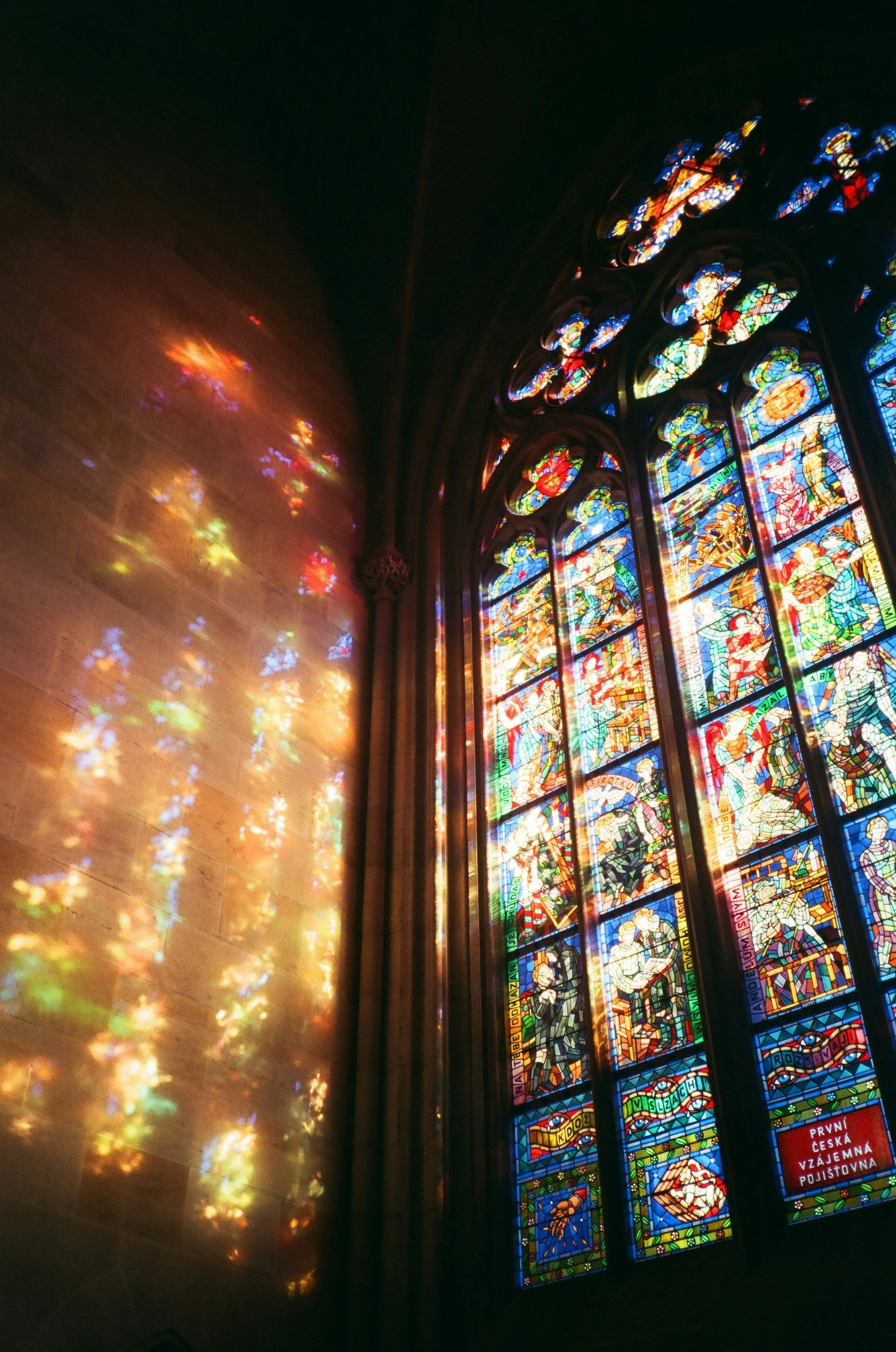
pHOTO BY Jakub Pierożyński
This elderly lady with those pleading eyes, the one we have for now, referred to as Wendy, speaks to me and tests me again. As I write, I see her here, sitting right beside me, for I am drafting these paragraphs in the very same place this morning (September 1, 2026). Why did I want to get away so quickly? What did I have to do that morning that could possibly measure up to helping make another human being a little happier and more valued? Yes, perhaps I was frightened by seeing my own reflection in her eyes as I approach her universe. But that was no excuse. Another soul was pleading for some respite, some acknowledgement of her presence and meaningfulness in the world. And by stopping to speak with her, by trying my best to listen, I learnt more of pastoral theology and of the loveliness of Emmanuel Levinas’s “the Other”. Which is, that the person standing before us, will in many ways transcend their physical presence—not unlike a glass-stained window when the light passes through it.
Nota bene: And one of the most common counsels from these warriors of life? “Keep yourself busy” and—“get your priorities right.”