For ‘Cecil’ and ‘Wendy’ and the Other Angels

I did not plan on writing to my friends again this soon. Yet, just as a musician cannot help but put down the lyrics of a beautiful song, so it is with one who writes when pressed by a stirring in the heart or by an image that they simply cannot let go. And that is why, despite my determination to refrain for the hour, I was left with little choice after an encounter this morning (August 27, 2026)—I have called these types of encounters “angelic”. These fabulous events are not rare. Look around, you will find them in so many places. Sometimes, yes, they are hidden. Other times they look for you and will cry out to you as the stones in the Gospel (Lk. 19:40). How blessed we are, and this beyond measure, to be able to bring peace and comfort to another soul. Ultimately, I have come to see, and it has been proven time and time again, that we are all—all of us, capax Dei.

In the mornings, once I have taken care of my ablutions, given thanks, and dropped off our youngest to school, I will normally head off to one of our local cafes to have breakfast and a cup of coffee. Where I have been going of late, and at that particular time, I meet up with two large groups of elderly folk, many of whom are plainly suffering from different ailments— and if I could not see it, I would know about it! At the start I did not want to hear about these problems this early in the morning, but also because it would remind me too much of my own story. I did not want for this to be occupying my mind at the start of the day. Still, I kept going, for I knew that I would very well miss them one day, and so I befriended a number of these wonderful warriors of life. I ask about their lives, where they originally came from, their occupations, and their advice on how to best navigate life. A little more on that later. Only last week, let us call him Cecil for now, I found that we were both going through the same disease. I was much encouraged by this former British naval gunner who had emigrated to Australia in the 1970s from Cumbria. But the story that I am writing tonight concerns someone else. An elderly lady who was sitting alone. I had seen her once or twice before, but she did not seem to be in anybody’s particular company.

I stood up to leave and as I looked behind me, there was a quiet voice. I wished this graceful soul, a good morning. I had assumed she had wished me the same. But, smiling, she looked up at me from her seat, and said again: “Did you enjoy your coffee?” I said, “yes”, with the intention to quickly leave, for I had chores to attend to. But it would be closer to the truth, if I were to say, that I simply was not in the mood for more chit-chat, and so I made to quickly leave. At that moment I saw that beautiful smile again on her face. You could even describe it as a wink. It was as if she knew. For she had very likely, in her recent years, felt this cold-shouldering no few times before. I could not move, even if I had wanted to. Did she remind me of my mother? Did guilt at my initial response weigh me down? Or perhaps, most incredible of all, did I see myself in her pleading eyes? Whatever the reasons, and they do not matter now, I sat down opposite her and asked her where she had originally come from? Let us call her, in this instance, Wendy. We were both from Sydney in the first place, and had lived only one suburb apart. So we could have crossed paths somewhere, all those years ago. And this is why magical realism is not so fictional at times. She had moved to the South Coast with her police-officer husband and two little boys—one of whom is a well-known cyclist. She worked for many years in an Illawarra hospital as a receptionist and charity organiser. Of course, like the tone marks that aid students of Chinese poetry, there was much more to Wendy, as there was to Cecil. Michael Leunig has written of The Crowdless Man: “[h]is gaze and yearning are way outside the loop, His pilgrimage has lots of holes in it. See him wandering alone Beaming to himself.”

So what am I trying to say here, and why have I been so compelled to write down what I am experiencing right now, and then to share it with you? I keep returning to certain themes that connect us. Fragility. Contradictions. Vulnerability. Our deeper need to be completed, along with all that comes with being human. No one can escape the human condition, and the profounder our exploration of the fundamental nature of our existence, the more difficult it becomes not to have compassion, not to practise forgiveness, and not to exercise charity in all of its forms. That is to love, as best we can, to aim for that archetypical ideal of laying down our lives for the other. Especially in academia, where egos can become almost unmanageable and here I know what I am talking about, for I am not exempt (I was a professor once upon a time), we can too easily, and too often, ignore the more real and enduring places of our legacy. At the last hour, citations and h-index will not matter too much. Rumi speaks in the strongest terms, and perhaps rather scandalously for some, of taking the bad side of the ego to the “slaughterhouse”. At the end of our time on earth, many of us will ask ourselves, how close we ever came to experiencing that selfless, sacrificial love:

Greater love hath no man than this, that a man lay down his life for his friends. (Jn 15:13)

In the slaughterhouse of love, they kill only the best... [d]on't run away from this dying. Whoever's not killed for love is dead meat. (Rumi)
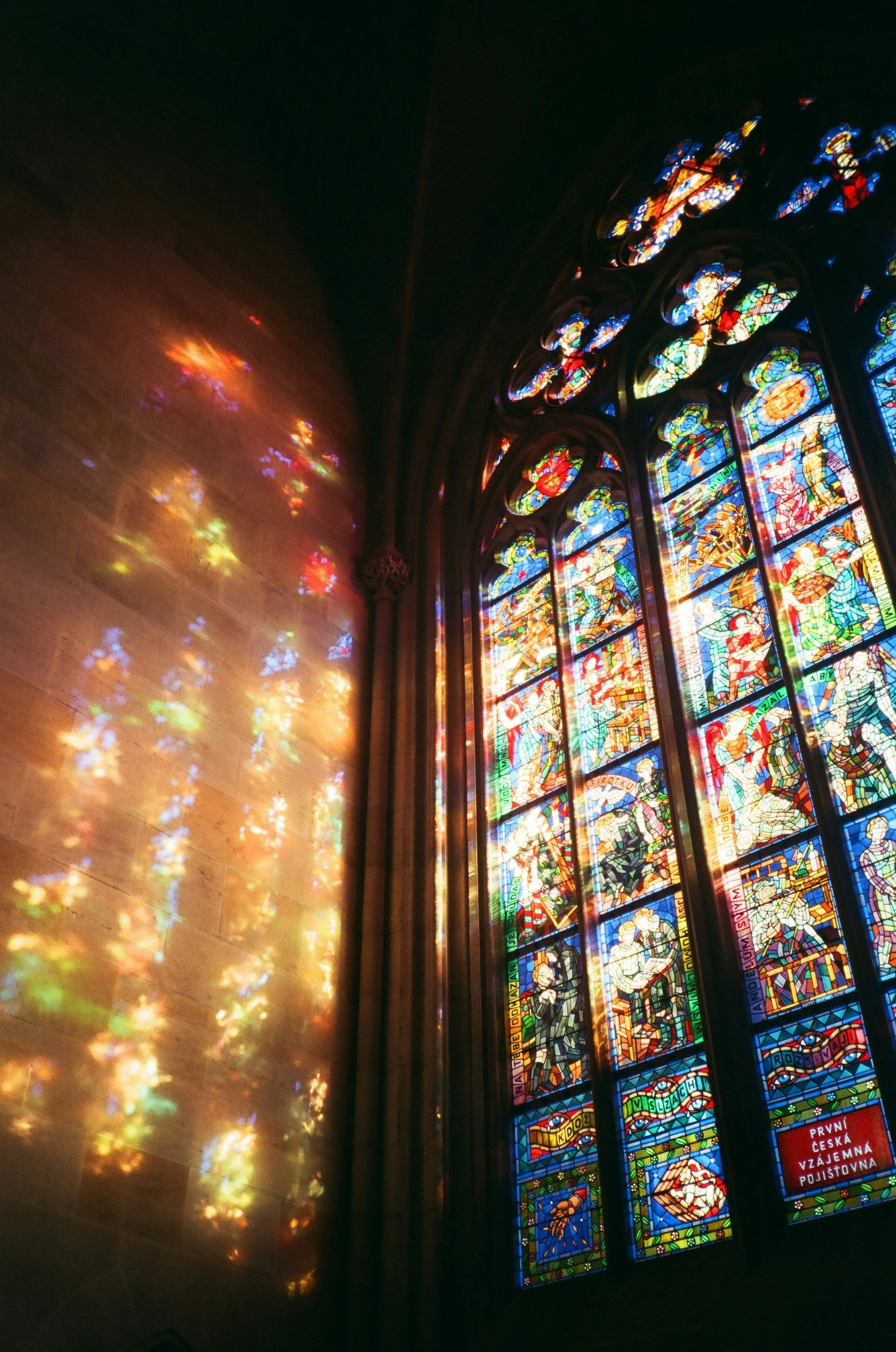
pHOTO BY Jakub Pierożyński

This elderly lady with those pleading eyes, the one we have for now, referred to as Wendy, speaks to me and tests me again. As I write, I see her here, sitting right beside me, for I am drafting these paragraphs in the very same place this morning (September 1, 2026). Why did I want to get away so quickly? What did I have to do that morning that could possibly measure up to helping make another human being a little happier and more valued? Yes, perhaps I was frightened by seeing my own reflection in her eyes as I approach her universe. But that was no excuse. Another soul was pleading for some respite, some acknowledgement of her presence and meaningfulness in the world. And by stopping to speak with her, by trying my best to listen, I learnt more of pastoral theology and of the loveliness of Emmanuel Levinas’s “the Other”. Which is, that the person standing before us, will in many ways transcend their physical presence—not unlike a glass-stained window when the light passes through it.

Nota bene: And one of the most common counsels from these warriors of life? “Keep yourself busy” and—“get your priorities right.”
This is why ‘the Machine’ concerns me

“Cannot you see, cannot all you lecturers see, that it is we that are dying, and that down here the only thing that really lives is the Machine? We created the Machine, to do our will, but we cannot make it do our will now. It has robbed us of the sense of space and of the sense of touch, it has blurred every human relation and narrowed down love to a carnal act, it has paralysed our bodies and our wills, and now it compels us to worship it. The Machine develops - but not on our lies. The Machine proceeds - but not to our goal. We only exist as the blood corpuscles that course through its arteries, and if it could work without us, it would let us die.” (E. M. Forster, The Machine Stops, 1909)

“Technique has penetrated the deepest recesses of the human being. The machine tends not only to create a new human environment, but also to modify man's very essence. The milieu in which he lives is no longer his. He must adapt himself, as though the world were new, to a universe for which he was not created. He was made to go six kilometres an hour, and he goes a thousand. He was made to eat when he was hungry and to sleep when he was sleepy; instead, he obeys a clock. He was made to have contact with living things, and he lives in a world of stone. He was created with a certain essential unity, and he is fragmented by all the forces of the modern world.” (Jacques Ellul, The Technological Society, 1954)

“Those who cannot forgive others break the bridge over which they themselves must pass.” (Confucius)

“Sorry, a machine can’t forgive your mistakes.” (Anon.)

“Books don’t need batteries.” (Nadine Gordimer)

"Now, a machine however subtle does not feel love, does not pray, does not have a sense of the sacred, a sense of awe and wonder. To me these are human qualities that no machine, however elaborate, would be able to reproduce. You may love your computer but your computer does not love you." (Kallistos Ware)

Source: https://twitter.com/nasahistory/status/951861340557234177

Source: https://twitter.com/nasahistory/status/951861340557234177

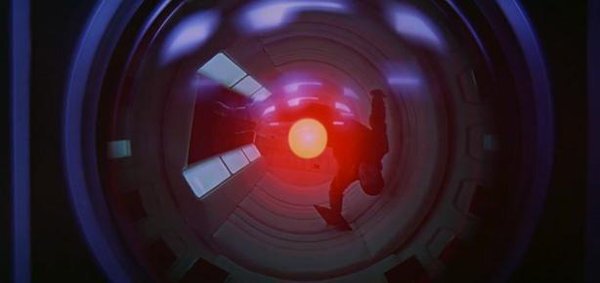
This is why ‘the Machine’ concerns me. Not that it might one day determine what I might eat or drink, or whether I can drink or eat at all, but that it will not hear my cries. That it will know nothing of physical thirst or of gut-wrenching despair. How can ‘they’ not understand this? It will have no comprehension of forgiveness. It will never wipe the slate clean. There is no delete. No such thing as absolution. It will deny to give me a fresh start [another more terrible dimension to DoS attack]. Mercy does not run through its microcircuitry. Don’t rush to embrace it too soon, this Trojan Horse which comes as a peace offering to the gods. The Creator has mercy for us, “[t]hough your sins are like scarlet, they shall be as white as snow; though they are red as crimson, they shall be like wool” (Is. 1:18). The ‘Machine’ which is ‘spirited’ by power to apply force and control, is unmoved to our petitions, “Dave, this conversation can serve no purpose anymore. Goodbye” (2001: A Space Odyssey). This is the elephant in the living room. Something holds us back, a foreboding, a premonition perhaps, that keeps us from directly addressing this subject.

It really is difficult to see people broken, humiliated, and in some instances to have their lives taken away from them because of something they might have said five, ten, twenty or more years previously. For someone, for whatever reason, to dredge up ‘sins’ of the past in order to hurt, or more concisely, to cause irreparable damage to the other. Who among us hasn’t said something which they haven’t later regretted, or where our words and sentiments can be elicited to carry a meaning or an attitude not originally intended? These can be errors of speech, peer group pressure, or the result of youth and immaturity. Yet it is there, it has been recorded. It is ‘played back’ oblivious to the context. Context is that which “throws light on meaning”.[1] We all make stupid mistakes. It takes time for wisdom and life experience to meld. And in other instances we get to a certain age and become anachronistic dinosaurs. The ‘Machine’ [input-process-output] is calculating and efficient. To ‘terminate’ these people is to simultaneously terminate ourselves. It is to do to another, that which can be done back to us. The ‘Machine’ defines us by our mistakes. It groups us in categories and dumps us in information silos. Is this the fate of the human spirit, to be “born into this?”[2] Imprisoned inside the “big iron” mainframes… like Ted Hughes’ proud Jaguar in “prison darkness” in its cage?

To forgive is an expression of one of our highest elevations as human beings. It is nobler than our finest literature, our greatest art, our most beautiful music. It is greater than all these when practised with a true heart for it takes us into the realms of the deepest mysteries of our combined representations of the Divine. In our religious experience we do not awe at the Creator’s ability with the harp or the writing of celestial sonnets, but rather we are amazed at the expression of God’s mercy and forgiveness. To the extent that we ourselves do the same with our fellow human, that is, to extend our grace towards those who we perceive to have wronged us, we are in the “image and likeness” of the Creator (Gen. 1:26).  We forgive that we could enter more genuinely into the space of compassion, that we might go on loving. The root of “forgive” is the Latin word “perdonare,” meaning “to give completely, without “reservation.” (“perdonare” is also the source of our English “pardon”).  We give up the desire or the power to punish.[3] The ‘Machine’ knows nothing of compassion. It will not forgive because it cannot love. Algorithms don’t have soul; they are devoid of incorporeal essence:

“You can’t forgive without loving. And I don’t mean sentimentality. I don’t mean mush.” (Maya Angelou)

In life not all acts of fellowship are received well or reciprocated. When the grace we give is not accepted and is returned it can be brutal. It is a place of heavy tears. We are living increasingly in a world which keeps us isolated one from the other, and where we might be called-out or cancelled as swiftly as the swatting of an irritating fly. This is not because people are wicked, on the contrary, most people are generous and kind-hearted. We are all fragile vessels on an oftentimes bumpy journey. We can crack. And this is the tragedy, the irony, that this very fragility draws us into systems and networks and ‘mobs’ where we do things so that we, ourselves, might not be hurt. It is increasingly becoming a survival technique. The online world especially has hurt and devastated people by its millions, either by their own hand [addictive behaviours] or cyber-attacks [bullying, misinformation]. “As rapidly as technology advanced,” writes Joseph Carvalko in his prescient novel Death by Internet, “goodness declined…”. Communication technologies are not exempt. They are the voice of ‘the Machine’. The apparatus has no spiritual knowledge of humility and so it cannot practise repentance. Computational empathy or affective computing, is mimicry at worst, and simulation at best. The ‘Machine’ possesses no natural ontology, knowledge representation and reasoning, does not automatically equate to higher consciousness. It cannot possess “human memory”. And therefore it does not know what it is like to be human. I dread to think, if the present-day capabilities of our 21st century technology were available to past totalitarian regimes [especially Advanced LBS and monitoring systems], how enormously more multiplied and innovative their crimes would have been.[4]

To meet likeminded spirits along the way means so very much. It could make all the difference in the world, to have the strength, to hold onto the courage, to keep pushing apart that impalpable space between the light and the darkness. How good to have a friend who is real and co-substantial. To receive an encouraging message to remind you of your humanity, to have sympathy for you precisely because of your flesh and blood. To be accepted for all your faults and list of misdemeanours. And if need be, as it sometimes will be, for one or the other to say “I am sorry”, and to hear those marvellous words in reply, “All is good, I understand.” Not just a graphical control element, or a voice on the other side of an interface, or a recorded message with push button instructions. A machine could be programmed to ‘speak’ all the good things in the realm of metaphysics, but we will always have the perspicacity, that penetrating discernment, that it is artificial, and synthetic. Those words, the programming languages [even if they should ever become distinctly compositional], will never, cannot ever come from the heart [“the blood-beat” of the poets], the place of will and intention. Technology, of course, in and of itself, is not the problem, but our connection to it needs to be kept under constant vigilance, that is, we must keep awake as to how it infiltrates and attempts to redefine our very existence as human beings. When we are in need of some light and succour all the artificial intelligence and interconnectivity in the world will mean nothing. It is like being trapped in a vault of bullion of an unlimited value with no means of escape or communication. What then the benefit of all that precious metal? What good if we are building towards this terrible prediction:

“If you want a vision of the future, imagine a boot stamping on a human face – forever.” (George Orwell)

We give our technology compelling names and dress it up with the most dazzling colours and logos. Many of these technologies, ultimately the most potentially dangerous, we make anthropomorphic. We dress up for example, and give large adorable eyes to the robots. We make-believe that we are understood and can even be loved by ‘the Machine’, that its cold intelligence will keep us warm at night. ‘It’ will seek those divine attributes which we ordinarily attribute to Deity: omnipresence, omniscience, omnipotence, and omnificence. But being created in the image and likeness of the creation itself it cannot by definition ever achieve them. And so it will incrementally grow to become commensurately desirous and aggressive. The monster built by Victor Frankenstein eventually turns on his creator in murderous rage for making him hideous and incapable of fulfilling its integrated dynamism [5] . The singularity will not breathe new life into us to make us immortal. It could one day make you the ‘undead’, but never immortal. We would do good, as well, to not quickly forget the lesson of the story of the Tower of Babel (Gen. 11:1-9). Technology gone awry on account of the hubris of the builders and the resultant breakdown of communication.

We know ourselves better than those who might be wanting to hurt us and much better than ‘the Machine’ which wants to imprison us in its central repositories and data warehouses. Their efforts to cause us pain, to potentially bring us to some humiliation, pale in comparison to our own battles, the fight against our compulsions, and those myriad fetishes within. We know much better than our real-life adversaries and the ‘electronic eye’ of the darkness fighting, assailing our souls, as we try to limit its impact on our lives and on the lives of others. If only they [both the adversaries and the ‘comptrollers’] knew the whole truth, had some insight of the context, they would be ashamed and terrified at the same time. Big Brother and uberveillance as much they might try to get inside the head, to get to the “whole truth” with their own particular strains of watching techniques, can only endlessly fall short of the mark. Our life is a mystery infinitely inexhaustible. We are so much more, much more than our search history and CCTV captures. It is weight enough to grasp what those words below from Miłosz mean for each one of us, before even ‘the Machine’ goes after our self-discovery to take away that private space where away from prying eyes we do our living and our dying: 

“To believe you are magnificent. And gradually to discover that you are not magnificent. Enough labour for one human life.” (Czesław Miłosz)

[1] https://www.merriam-webster.com/dictionary/context

[2] https://www.youtube.com/watch?v=qQJengH58ow

[3] https://www.etymonline.com/word/forgive

[4] https://ro.uow.edu.au/cgi/viewcontent.cgi?article=1716&context=infopapers

[5] https://mitpress.mit.edu/books/frankenstein