Life can be a bit like the 'underside' of a tapestry at times

“Immediately, something like scales fell from Saul’s eyes, and he could see again.” (Acts 9:18)

“Acquire the Spirit of peace. And thousands around you will be saved.” (Saint Seraphim of Sarov)

“Everything I love is born unceasingly/ Everything I love is always at the beginning.” (Odysseas Elytis)

“The impatient idealist says: ‘Give me a place to stand and I shall move the earth.’ But such a place does not exist. We all have to stand on the earth itself and go with her at her pace.” (Chinua Achebe)

“To know how much there is to know is the beginning of learning to live.” (Dorothy West)

“His gaze and yearning are way outside the loop. His pilgrimage has lots of holes in it. See him wandering alone Beaming to himself.” (Michael Leunig)

“In the dark one can sometimes see/ so much more clearly than in the day.” (David Brooks)

Hold fast onto your dreams

September 17, 2011

Christina Hotel, Bucharest, Romania

You tell me you want to see your name in one of my stories. I really don’t know why. Perhaps it is more of encouragement, that you like the few things I have read to you. I am not who you think I am. I am an ordinary man. I do write, yes, but more than likely what I scribble down will be lost or deleted, or at best dismissed of little or no value. So, okay, my dearest Alina, consider yourself amongst my lost and found. Hold fast onto your dreams and never betray the fairy tale in your heart which makes you hop, skip, and jump when you serve my breakfast in the morning. And remember, if you should ever happen to fall into quicksand the mistake is to panic and to fight it. The secret, they say, is to relax best you can and slowly waddle yourself out. Other times, you will know when, think of the jet pilots who must go full throttle when landing on the flight deck lest they miss the bands and drop into the water.

Then there are those heartrending times

Like magnets which point in opposite directions to push apart and repel for the field lines cannot join up, there are souls, too, which are incompatible. There are times when we seem to know it as if by intuition, like a parent might instinctively know when something is bothering their child. In other instances it could take longer. We might hurt a little for we have given something of our heart to the other, yet after some time has passed, we move on. We learn from the experience and take down ‘notes’. Then there are those other desolating times, when we have given, it would seem, all of our heart and spirit to the other [and sometimes this might be to an institution we have dedicated our lives to] and we find much to our shock and disbelief that when it really mattered, we were incompatible. There was no harmony. The one was not consistent with the other. This is when it gets very hard and moving on will not happen quickly as we might wish. Invariably, “the deepest wounds”, as the Greek philosopher and Eastern Orthodox theologian Christos Yannaras has said, are those of an “unfulfilled relationship”. But it also from here, from this high place which marks the wound, that we have the better view of the landscape which is still ahead.

Our own communities might reject us too

Organizations to a large extent help shape identity which makes individuals definable and recognizable. How much more faith-based institutions or similarly based workplaces with their overwhelming references to community and fidelity. We might be belittled and made to feel unwelcome, and whatever gifts we might possess, they are neither recognised nor acknowledged. We could consider that “it has all been such a dreadful waste”. Already in the grip of that horrible feeling of having the life sucked out of you, now left with nothing: an empty shell, you think. There is a marvellous title to one of Philip Roth’s books that describes this perfectly. The Humbling. Consider the first line: “He had lost his magic.” What to do when you have been made to feel you have lost your magic? Do not stop believing in your talents and capabilities. Ever. To do otherwise would be your adversary’s greatest victory, and your life’s most serious loss. You might often feel defeated, maybe even vanquished, but your mere presence is the sign that your “seed” is not yet done. There are the many lessons of this resilience in nature herself. Think of the lotus seed that slept in a dry lake bed in north eastern China for more than 1,000 years to sprout in our lifetime like its modern sibling. It resisted the drought. It waited. It is the plant which has come to symbolize rebirth.

The first thing is to accept this ‘time frame’

The first thing is to accept this ‘time frame’, that is, to understand that no amount of anguish or anger will make the hurting “go away” any quicker. It helps immeasurably for someone we trust, who has travelled in among those fields, to tell us to endure and that the suffering and pain we are feeling at the moment will decrease in intensity, that is the one certainty. You learn to carry it. To then become a wound which has healed and which only we ourselves can re-open. The potential for hurt will remain. Some fortunate few will be able to discard it once its purpose has been served. Like the larvae which shed their old skins. But if you accept this wound as a ‘pearl of wisdom’ for your soul, on that day when you are able to receive it as such, you need not see it as a wound but as a piece of history marked on your body, a period in your ‘book of life’. We write the story as we go. We might not be able to go back and delete the pages, but we can to a large extent determine how the next chapter is to be written and what goes into it. The German-born Swiss author and painter Hermann Hesse whose writings reveal a detailed search for identity and self-knowledge, has perfectly said [summarising the ancient philosophical lesson]: "Each man's life represents a road toward himself." So we not only discover ourselves by going on this great adventure, but we are at the same time participating in creation.

Some people are frightened by this actual possibility

Some people are frightened by this actual possibility. It is either too difficult to imagine or too great of a responsibility to accept. Sartre was wrong in this, that “hell is other people”. We need not be forever trapped in other people’s perceptions and judgements of who we are. Rather our neighbour might very well prove to be our salvation. The comprehension that our freedom can determine who we are or can be, should not be a source of anguish.  Rather it should be an acknowledgement to the reality of our potential [from the Latin potentia ‘power, might, or force’]. To be sure, we do not control the future, but we can go a long way to determine what we put into it. More often than not, it is this alone which makes the difference. And to a large degree determines the results of our providence. We find this disclosure in the earliest of our literatures, including in Homer’s two epic poems the Odyssey and the Iliad. Later generations find this same truth reiterated in Constantine Cavafy’s unforgettable Ithaka. It is the most famous of his designated “Homeric poems”:

“Ithaka gave you the marvellous journey/ Without her you would not have set out/ She has nothing left to give you now/ And if you find her poor, Ithaka won’t have fooled you/ Wise as you will have become, so full of experience/ you will have understood by then what these Ithakas mean.”

Life can be a bit like the ‘underside’ of a tapestry at times

https://www.heirloomtapestries.com/tree-of-life-tapestry-light.html

https://www.heirloomtapestries.com/tree-of-life-tapestry-light.html

‘A tapestry is made by repeatedly weaving the horizontal (weft) threads over and under the vertical (warp) threads, then squishing (or tamping) those horizontal threads down so they are very close together, thus completely hiding the vertical threads from view.’

Tapestry is originally from Old French tapisserie, it means “to cover with heavy fabric, to carpet”. In the medieval period they were valued even more than painting, the more intricate were highly prized and sought after. Two of the most beautiful and incredibly intricate as examples of this now much underestimated art form are the 100m “Apocalypse Tapestry” (1377) and the mysterious suite of seven tapestries with the ‘AE’ monogram which comprise “Unicorn Tapestries” (1500). Even a tapestry of average quality can amaze us when we contemplate not only the intricately created image before us, but also astound us at both the patience and endurance of the creator. But pause for a moment and consider the back of this creation, that is, the “underside”. What might you find? It can appear to be a mass of contradictory and haphazard movements of thread. Overlapping and going in all manner of direction, it has very little of the cohesion and beauty of what you see on the ‘other side’. But that’s exactly what was required to create this astonishing impression in the first place. Life can be a bit like a tapestry at times. It might not always look good or appear to be going in the right directions, but it’s a splendid design in the making. For the community of believers the image of the Creator as the Potter comes to mind: “But now, O Lord, you are our Father; we are the clay, and you are our potter; we are all the work of your hand.” (Is. 64:8)

If we don’t let go of those darker dispositions

If we don’t let go of those darker dispositions, we can ourselves become that which has hurt us. That is, we can begin to associate too closely with our pain. Even to risk returning the same negativity that we receive, and so mirroring that very soul we were incompatible with in the first place. This is a form of transference. It remains one of the deepest flaws in the presentation of atheistic existentialism, to not see the other as a possibility for your restoration. Compare this against the teaching of Jesus Christ: “Love your neighbour as yourself” (Mk. 12:31). This concept of ‘self-love’, which is also vital in Buddhism, is “not be confused with narcissism or selfishness”, but as it has been expressed in the Udana of the Pali canon as an act of self-compassion which results in not hurting others; or as it has been elsewhere said, we are not punished for our anger, but by our anger. ‘Letting go’ makes us lighter. It makes it much easier for us to move, to not remain anchored in the wrong spaces. And to get on, with what Heidegger might say, our “unfinished business”.

We are always chasing that ‘elusive’ something

We are always chasing that ‘elusive’ something. And our obsessions or unreal expectations can lead us onto paths of self-destruction. This was one of the fundamental lessons behind what has been called “the great American novel”, Herman Melville’s Moby-Dick. Whether Captain Ahab was chasing after ‘god’ or he was simply ‘possessed’ by his own nightmares is not necessarily the point. The overriding message is that a ‘life purpose’ based on revenge or driven by pure animalistic instinct can only lead to destruction, not only for ourselves, but also for those who are “on board” with us. The history of nations, let alone those of individual examples, are replete with such ruinous conclusions.

“...all evil, to crazy Ahab, were visibly personified, and made practically assailable in Moby Dick. He piled upon the whale’s white hump the sum of all the general rage and hate felt by his whole race from Adam down; and then, as if his chest had been a mortar, he burst his hot heart’s shell upon it.” (Herman Melville)

Sometimes we can never wholly forget

Sometimes we can never wholly forget. This is only normal. We can grow to accept our history and be at peace with its providence. This comes with the knowledge our memories are here to stay. They will not be wiped away. We use them best we can, to become stronger and wiser in this test [Old French teste “an earthen vessel, especially a pot in which metals were tried”], as we plough on through, and deeper into the fields of life. I will sometimes catch myself thinking back to my ancestral home and to the days before my father died, when I was absent in New Zealand to miss him by a few hours. It is like Joyce who was desperate to leave Dublin but never could, Faulkner who mistakenly thought he could escape Lafayette County, or Sylvia Plath who would never break free from Winthrop. But we do not stay there, in those old neighbourhoods, for too long. We cannot, for invariably that would be to our own peril. There is also a lesson to be learnt from the Old Testament story of the wife of Lot who looked back to turn into a “pillar of salt” (Gen. 19:26). To be sure, we keep what is good from our old places, to then move on the best we can. For each one of us there is a time and place of restoration, this is where we come closer to our truest identity.  Sometimes it is in times and ways where we might least expect. The marks of pain like the signs of ageing on our body are what make us human. "Our days may come to seventy years, or eighty, if our strength endures; yet the best of them are but trouble and sorrow, for they quickly pass, and we fly away" (Ps. 90:10). The novelist Marie Bostwick has put it very well: “I don’t know what tomorrow will bring. None of us does. That’s why we get up and go on because, until forever comes, you can’t stay where you are.”

Degrees of distance diminishing and dissolving

In brass instruments the act of blowing by the instrument player makes the air in the tube vibrate and produce a sound. As the notes get higher and higher, they get closer and closer, for the air in the tube vibrates in smaller and smaller ‘packets’. Brother Raphael, who used to be  a lead trumpet player with a philharmonic “somewhere” [on account of their humility they never do tell you where], would explain such things to me as we would make the long trek down the mountain to the orchards. What he said in this instance made me think of the affection we share and experience in the company of our loved ones. The more time we spend with each other the closer we grow one into the other. Degrees of distance diminishing and dissolving. Individuality is not lost for each member is still master and remains in control of his or her own pitch and timbre. This proximity is what creates context and permits us to explore the dynamics of relationships. The French chemist Michel-Eugène Chevreul has demonstrated to us that the manner in which a colour is perceived is influenced by the other colours surrounding it. In the context of the Holy Trinity, theologians speak in terms of ‘perichoresis’ [or a “rotation”] as to the relationship and movement of the love of the three persons in the triune God:

"May the grace of the Lord Jesus Christ, and the love of God, and the fellowship of the Holy Spirit be with you all."  (2 Cor. 13:14)

The Werri Beach Prayer

Gerringong, NSW, September 14th, 2019

“How long, Lord? Will you forget me forever? How long will you hide your face from me?” (Ps. 13:1)

Old Man in Prayer from Rembrandt

Old Man in Prayer from Rembrandt

To what purpose this pain which rents the spirit

In those secret places which makes the bones throb

For what intent my Lord this dreadful brokenness

This deepest despair like the nightingale’s last song 

Like the final gasp of air from the second crucified thief


What caused You to turn Your face from your beseeching servant

From Your high place you see him fall onto his knees in the midday Sun

To cry unto the heavens ‘be merciful to me, Oh! Lord be merciful to me’

Even my tears you have taken away, I have none left, my eyes burn

They are scored by the sand which by Your command rises up to scrape my face

My soul laments this terrible desolation visited upon it for it has known

The divine sweetness of Your presence and the ineffable peace of Your holy places

‘My God, My God’

How will I survive this night when Your absence will break my heart

And deeper still in those unspoken places where the only infallible words

Ever spoken by the mortal mouth keep forever in the blood and marrow:

‘be merciful to me, Oh! Lord be merciful to me’.


We document the story, our autobiography

“There is a candle in your heart, ready to be kindled. There is a void in your soul, ready to be filled. You feel it, don’t you?” (Rumi)

“You cannot wander anywhere that will not aid you. Anything you can touch – God brought it into the classroom of your mind.” (Rabia Basra)

“What is a charitable heart? It is a heart that is burning with charity for the whole of creation…” (Saint Isaac the Syrian)

“The mystery of human existence lies not in just staying alive, but in finding something to live for.” (Fyodor Dostoevsky)

“I paint the way some people write their autobiography. The paintings, finished or not, are the pages of my journal, and as such they are valid. The future will choose the pages it prefers.” (Francoise Gilot)

“What, what am I to do with all of this life?” (Gwendolyn Brooks)

“We all have idols. Play like anyone you care about but try to be yourself while you’re doing so.” (B. B. King)

Things will not always go according to plan

Source: https://piccadillyinc.com/products/the-story-of-my-life/

Source: https://piccadillyinc.com/products/the-story-of-my-life/

Things will not always go according to plan or follow the schedule. Unpredictability does not only belong to chaos theory and to weather, but to everyday existence: the ‘big things’ like life and death, good and evil, love and hatred, health and sickness. Despite the super computers, natural human ability to forecast complex weather patterns is still critical, humbling news for machines capable of trillions of calculations per second. Small things can also go awry and sometimes even these apparently insignificant events can become reason for a greater story. Missing your train in the morning; or being given the wrong business card; or writing the incorrect address on a letter; or turning right instead of left. These can all become causes for the unexpected. Despite the planning and attention to detail the future is out of our control. Yet we readily deceive ourselves into believing otherwise, particularly given the advancements in our technological innovations. The reality is perhaps more challenging but far more positive and exciting. We do have some ‘control’ of that world which ultimately does matter: our ‘inner world’. That space within [the ‘inscape’ to paraphrase Gerard Manley Hopkins] which goes a long way to determining our uniqueness, and what we do, and who we become: “[t]he human heart is no small thing, for it can embrace so much.” (Origen)

Truth is the correspondence between language and reality

In simple words, for this is a huge subject, truth is the correspondence between language and reality, a practical definition which probably sits well with most.[1] Then what of truth in literature? How are we to understand metaphor, or poetry, or even myth for instance? Is there a better example of the evident stresses that this correspondence will often elicit than the battle over the exegesis of the biblical account of the creation in the Book of Genesis? What is the cognitive value of this universal story and what kind of truth is it meaning to convey? And what of the spiritual truths put in the mouth of the Starets Zossima by Dostoevsky in his masterpiece The Brothers Karamazov? Or how true is Plato’s famous “allegory of the cave”? An autobiography, a memoir, a life-journal, for example; to what extent are they both literature and science? And how long does a text or document maintain a stable and determinant meaning before the deconstructionists get to it and challenge its structures and propositions? These questions become especially problematic from the moment we make reference to scientific method. One way to arrive at some kind of real-life resolution is to think in terms of context [from Latin contextus, from con- ‘together’ + texere ‘to weave’]. Truth in whatever way we might define or understand it, is ultimately interwoven into and inseparable from life. Following in the spirit of the great storytellers, Sue Monk Kidd writes: “[s]tories have to be told or they die, and when they die, we can't remember who we are or why we're here.” Revelation and redemption invariably play an important part in how we mentally grasp the ‘story’ and in what ‘setting’ we locate it.

Providence or Coincidence

Providence is mostly connected to theological reflections and generally associated with divine purpose.[2] “Are not two sparrows sold for a cent? And yet not one of them will fall to the ground apart from your Father” (Matt. 10:29). Coincidence on the other hand is normally thought of in terms of luck, fate, or chance. In some other instances coincidence has been thought of in the context of meaningful decisions. Perhaps it is at that point when it ‘coincides’ with providence.[3] Ultimately, whatever our definitions, both are forces of influence which determine destiny. In the Homeric writings ‘destiny’ is more coincidence with providence connected to ‘divine intervention’.[4] Destiny is fate for Homer. It cannot be escaped. “And fate? No one alive has ever escaped it, neither brave man nor coward, I tell you— it’s born with us the day that we are born.” Divine intervention, however, can manipulate destiny even with the direct involvement of human agency. The legends of Achilles and Hector as illustrated in the Iliad are classic examples of destiny and divine intervention intertwined. What is it that drives us to understand something of these incomprehensible forces and to put a name to them? An insightful response can be found in Christos Tsiolkas’ Dead Europe. The protagonist, not irrelevantly a photographer, the young Greek-Australian Isaac, reflects in one place when asked to use his camera to document events of the past: “this desperate need to confirm the relevance of history…”. And so we are born into the world. We document the story, our autobiography [‘the account of our life’] as it unfolds, according to the opportunities we accept or dismiss. The love we share or withhold. All the time hoping that at the end of our days, we have been of some relevance.

It does not take much to strip us down to our base animal nature

It does not take much to strip us down to our base animal nature for our repertoire of the most beautiful songs and enlightening philosophies to turn into howls and screams. When our stomach is full, when we are not thirsty, when we live in a comfortable home and have good paying work, it is not difficult to act sophisticated and cultured. How refined would we be if there were ten of us fighting over one loaf of bread? Trying to outrun each other for a cup of cold water to quench our thirst? These thoughts are disturbing not only in the context of our hierarchical needs and natural instinct towards self-preservation, but also when ‘self-preservation’ leads to questions of motivation, self-defence and to punishment. It is shocking, too, to imagine that high culture and the cultivation of the Arts serve as no guarantee to the wisdom and compassion of the human spirit. The Nazis [and others before them and not a few afterwards in similar vein] would do their slaughtering during the day and in the evenings listen to classical music, write poetry, and read Goethe. We are only days, even hours or minutes away from being stripped from the personalities and personas we ideally choose to present ourselves to the world and according to which society rewards us. Self-awareness, to objectively evaluate ourselves, our character and feelings, will make some strong demands of us and oftentimes be a painful eye-opener. It can be a terrifying experience to stop and to listen to ourselves. To say when you have gone to your deepest places, to have found those things you would never want to have found, yes, all of it, that’s who I am. But it is this honest evaluation which also makes us capax dei: “capable of knowing God”. (Augustine)

Sometimes we have to look, nay search

Sometimes we have to look, nay search, for the light in places we might not normally want to look. Think for a moment of the response of the first community of believers to the vision of the brutalized and crucified Christ (Matt. 26:1-27:66). The gaze which normally precedes dogma is invariably more faithful to the reality of things. Difficult words and mind-boggling doctrines can often confuse and meddle with our initial revelation. The first bright illumination which inflamed our hearts and ran down our spines like a bolt of electricity. There is a holding place to most things that they might ripen and mature. Siddhartha Gotama and the prophet Daniel, Saint Isaac the Syrian and Jalaluddin Rumi, Rabia of Basra and Saint Symeon the New Theologian, Saint Francis of Assisi and Moses Mendelssohn, Meister Eckhart and Rabindranath Tagore, Dag Hammarskjöld and Saint Sophrony Sakharov are examples of those profound lights who looked deeper and beyond the margins of their prescribed canon. These souls to be sure remained faithful to their received tradition. The power of their witness is to be found in the unshakeable belief that every human being is of equal value and possessed of the same intrinsic possibilities. The list is a long one and includes meditative minds from every region and culture. In other fields of human endeavour where the “canonical boundaries” were tested, James Joyce did it with experimental literature; Pablo Picasso with Art; James Clerk Maxwell with physics; Ludwig Wittgenstein with his views on the purpose of philosophy; Frank Lloyd Wright with his architectural design; and Rosa Parks who says “No” to become the mother of the civil rights movement. And the great improvisers of music who did it with their blues in Mississippi and jazz in New Orleans. But all of this dialectical movement, the tension of the spirit with all of its divergent impulses, can come with a heavy cost and no small sacrifice, though surely it is worth the risk to be able to one day write: “…with the last ink in the pen I lived, each day I loved and lived.” (Michael Ondaatje)

Things are indeed different from up here

Somewhere over Yekaterinburg and Salekhard  
Altitude 36500 feet, Ground Speed 536 mph

Things are indeed different from up here. I do not mean the obvious, the physical perspective of being inside a ‘flying cigar’ with hundreds of strangers almost thirty-seven thousand feet above the earth. How often is it, that we are of one mind with people we have never met before. People of different races and colours and religions, men and women of different education, some virtuous and others corrupt, some in the prime of their lives and others nearer to their Maker than they might care to imagine. Yet with all these vagaries we are of the ‘one mind’. We all want to get somewhere and we all want to arrive there safely. The place which is calling us is love. We also call it home. Up here in space we are living for whatever the duration of our journey, as the saints do, when they come together in communio sanctorum. Is there a term for the ‘communion of travellers’? Fate would forever bind us in the unlikely event that this aeroplane drops from the sky, and it would not be with our dearest we would be spending the last and most truthful moments of our life. We would go to the other side in the company of hundreds of strangers all having hoped to make it safely home. If we could honestly recognize and live out this shared mortality, what differences we might see in the world. John Donne who especially prized this ‘inter-connectedness’ of humanity, has memorably written: “[n]o man is an island entire of itself…”. It is like the passage of time which none of us can escape, except to write on its pages our individual stories. And the eschatology we did battle with when nobody was watching.

[1] https://plato.stanford.edu/entries/truth/#pagetopright

[2] https://blogs.ancientfaith.com/glory2godforallthings/2018/01/24/god-god-providence/

[3] https://www.theatlantic.com/science/archive/2016/02/the-true-meaning-of-coincidences/463164/

[4] https://muse.jhu.edu/article/2579/summary

The immeasurable value of perspective

“The heart governs the entire bodily organism and reigns over it, and when grace possesses the heart, it governs all the members and all thoughts, for it is in the heart that the intellect is found and all the thoughts of the soul as well as its desires; through its intermediary, grace equally penetrates into all the bodily members.” (Saint Macarius of Egypt)

“Mythology is not a lie, mythology is poetry, it is metaphorical. It has been well said that mythology is the penultimate truth--penultimate because the ultimate cannot be put into words. It is beyond words. Beyond images, beyond that bounding rim of the Buddhist Wheel of Becoming. Mythology pitches the mind beyond that rim, to what can be known but not told.” (Joseph Campbell)

“The metaphor is perhaps one of man’s most fruitful potentialities. Its efficacy verges on magic, and it seems a tool for creation which God forgot inside one of His creatures when He made him.” (José Ortega y Gasset)

“It was books that taught me that the things that tormented me most were the very things that connected me with all the people who were alive, or who had ever been alive.” (James Baldwin)

“Every canvas is a journey all its own.” (Helen Frankenthaler)

In the tradition of Hamlet

In the brooding tradition of Shakespeare’s Prince Hamlet of Denmark, the French writer and Nobel laureate Albert Camus has said that if life is without meaning and purpose, this “feeling of absurdity” he called it, then suicide becomes the only “really serious philosophical problem.” So we must live he concludes, as if our lives have some meaning.[1] But to simply act on this premise, that is, to create a ‘theatre of meaning’ [or of the ‘absurd’], can only end in disaster for eventually this deception will catch up with us to dismantle our every foundation. We cannot hope to convince ourselves that there is some intelligent meaning to Sisyphus pushing his boulder up the mountain to only have it roll back down again. Peace and happiness are not to be found in futility. Augustine in his Confessions describes the heart as “restless” unable to stay still or quiet for we are primarily desiring beings before we are rational. The role of the senses is strong, ears and eyes open to divers input, and so our senses are connected to the movement of the heart which is the seat of our attitude and will. All the great poets have understood the basis of this truth: “I hold a beast, an angel, and a madman in me.” (Dylan Thomas)

The endearing Didi and Gogo

The endearing Vladimir (Didi) and Estragon (Gogo) meet near a “leafless tree” to engage in a series of discussions waiting for the mysterious Godot who never arrives. It all seems so meaningless. They, too, consider suicide. Whether they are to be taken seriously or not is beside the point. But the problem is neither of these characters actually articulates what they want; or what they are looking for; or who Godot actually is. Or even if he ultimately exists. Ennui is at them. Entropy. Apathy. “[t]he boredom of interminable waiting. The entire play, in fact, is made up of attempts to fill the time.”[2] In existential terms, it is not even knowing what you want. It is, as some critics have said, the most successful literature ever written about “nothing”. Nothingness leads to ‘nothing.’ And to the deepest of despair. “Nothing happens. Nobody comes, nobody goes. It's awful.” (Samuel Beckett)

Viktor Frankl and the search for meaning

Throughout history philosophers have postulated different motivational forces behind the lives, acts and decision-making processes of men and women. According to Viktor Frankl this “force” is “man’s search for meaning”.[3] Frankl believes, and he is not alone in his contention [for example Kierkegaard and centuries before him the prophet Jeremiah], that humans are motivated by the "will to meaning". Logotherapy is pursuit of that meaning and particularly in our attitude and response to unavoidable suffering. Logos is the Greek for “reason”. That is, he argues, that human nature is motivated by the search for a life purpose. This contra Nietzsche’s “will to power” as the driving force in humans and against Schopenhauer’s “will to live”, or Freud’s “will to pleasure”. Certainly, it can never be this clear cut for we are much too complicated in our psychosomatic make-up, but there is something universally engaging and trustworthy with Frankl’s discernments. His influential and reflective voice was authenticated having survived the horrors of the holocaust and by his personal experiences of suffering and loss in Nazi concentration camps. Logotherapy proposes that humans have a will to meaning, which signifies that meaning is our primary motivation for living and acting, and allows us to endure pain and suffering:

The ultimate meaning necessarily exceeds and surpasses the finite intellectual capacities of man; in logotherapy, we speak in this context of a super-meaning. What is demanded of man is not, as some existential philosophers teach, to endure the meaningless of life, but rather to bear his incapacity to grasp its unconditional meaningfulness in rational terms. Logos is deeper than logic.”

How many great symphonies have not been written

Source: “Ascent” - Jacob’s Ladder https://www.chabad.org/blogs/blog_cdo/aid/3787024/jewish/Ascent-Jacobs-Ladder.htm

Source: “Ascent” - Jacob’s Ladder https://www.chabad.org/blogs/blog_cdo/aid/3787024/jewish/Ascent-Jacobs-Ladder.htm

Sometimes we are scared to approach that which we believe to be beyond us, like a grand challenge which will push us to our limits, or terrified of declaring our love lest we be rejected. Perhaps worse still saying we are sorry or admitting to our mistakes. It has been asked how many great symphonies have not been written because composers were reluctant to compose their own Ninth. The ‘curse of the Ninth’ they call it, for the fear of comparison with Beethoven’s ‘Choral’ masterpiece.[4] We need to be climbing our ladder, built to our own unique height and measure, climbing it to our greater potential. Not to be afraid at what revelation we encounter at the top. Jacob would not have encountered the Divine had he not dared to go up the “stairway” to hear these tremendous words from his Maker: “I am with you and will watch over you wherever you go, and I will bring you back to this land. I will not leave you until I have done what I have promised you” (Gen. 28:10-15). Rainer Maria Rilke many centuries later could summarize this disclosure thus: “The purpose of life is to be defeated by greater and greater things.”

The desire for fame is one of the gravest dangers to the soul

The desire for fame is one of the gravest dangers to the soul. Few things are as corrosive to the self. Not many have been able to withstand its contagion. It is wanting to be adulated, to rise above the rest, together with the sense of power it delivers. It is one reason why the holy bishops of the past would flee into the desert when news of their elevation would reach them. This narcissistic aspiration, for human beings are not made to bear such adoration, goes back to the darkest but once the most beautiful of all the angels, Lucifer [“the morning star”]. Did he not want the glory properly belonging to the Creator alone? “For you have said in your heart: ‘I will ascend into heaven, I will exalt my throne above the stars of God’” (Is. 14:13). This is a sobering lesson, in whatever way we might want to understand this story, for when we do battle against the desire to be our own ‘kings’, to place our own selves on the ‘thrones’ of our hearts. See here what the marvellous Rumi writes of fame which he has termed the “dragon’s jaw”:

“Many have a talent that urges them/ to seek fame for themselves,/ but in truth it only leads them to disaster./ If you want to save your own head,/ humble yourself like a foot,/ and put yourself under the protection/ of someone rooted in spiritual discernment./Even if you are a king, don’t put yourself above him/. Even if you are honey,/ gather up his rough sugar./ Your own ideas are merely shells,/ his are the soul of thought./ Your coins are false,/ his are the purest gold./ You are really he,/ but seek yourself in him./ Cool like a dove, flying toward him./ And if you cannot bring yourself to serve,/ know you are in the dragon’s jaw.”

Transformation, sometimes used for the metamorphosis

Transformation, sometimes used for the metamorphosis of the life cycle of an animal, will not happen overnight, or with ‘warm feelings’ which could last for an hour. It will be a long and testing journey. It will take much spiritual labour and lots of patience. It is good to remember when things get difficult, as they undoubtedly will, that it is temperature shock which hardens steel and that it is intense heat which changes molecular structure. Change can hurt, and it will often hurt a lot, but it will make the difference. Franz Kafka who was fascinated with ‘transformation’ considered “patience” very high on the list of virtues. Conversion is only the beginning. It took Christ an eternity to reveal his glory to his creation, “where his face shone like the sun” at his Transfiguration (Matt. 17:1f.).[5] It can take time for the grace of God to fall, like new colours which are created with the passing of the years on natural landscapes. Sometimes it can be like breaking your knuckles on steel or smoothing your heart on a piece of pumice stone. We are for now, where we are meant to be: “Then Peter answered and said to Jesus, “Lord, it is good for us to be here…”. (Matt. 17:4)

And forewarn the builders of our new technologies

Secreted behind the words below rest some of the greatest truths expressed in world literature. As many times as we might read these paragraphs neither their beauty nor their sting are diminished. They inspire the wise, humble the knowledgeable, and forewarn the builders of our new technologies. Especially in the last lines of this quote from Anton Chekhov’s short story “The Bet” (1889),[6] the universally celebrated Russian playwright and short fiction writer [via ‘the mouth’ of his young lawyer protagonist] could have been an Old Testament prophet looking ahead at the technological innovations of the 21st century:

“I have spent fifteen years making a careful study of life on earth. True, I haven’t seen anything of the earth, of people, but in your books I have drunk fragrant wine, sung songs, hunted deer and wild boar in forests, love women… Beautiful creatures as ethereal as clouds created by the magic of your great poets have visited me at night and whispered marvellous tales in my ears, making my head reel. In your books I have scaled the summits of Elbruz and Mont Blanc and from them I have seen the lightning flash above me and cleave the clouds. I have seen green forests, fields, rivers, lakes, towns. I have heard the sirens sing and the music of shepherds’ pipes. I have touched the wings of beautiful demons who flew down to talk to me about God. In your books I have hurled myself into bottomless abysses, wrought miracles, murdered, burnt cities, preached new religions, conquered entire kingdoms.

Your books have given me wisdom. Everything that man’s indefatigable mind has created over the centuries is compressed into a tiny lump inside my skull. I know that I’m cleverer than the lot of you.

And I despise your books. I despise all the blessings of this world, all its wisdom. Everything is worthless, transient, illusory, and as deceptive as a mirage. You may be proud, wise and handsome, but death will wipe you from the face of the earth, together with the mice under the floorboards. And your posterity, your history, your immortal geniuses will freeze or be reduced to ashes, along with the terrestrial globe. You’ve lost all reason and are on the wrong path. You mistake lies for the truth and ugliness for beauty. You’d be surprised if apple and orange trees suddenly started producing frogs and lizards instead of fruit, or if roses smelt of sweaty horses. I’m amazed at people who have exchanged heaven for earth. I just don’t want to understand you.” (Anton Chekhov, The Bet)

Perspective meaning ‘through’ and ‘to look at’

Homer’s first epic poem Margites exists only in a few scattered mentions; the biblical book “Book of the Wars of the Lord” of which no copy survives is lost forever but for its reference in Numbers (Num. 21:14); at least one third of Aristotle’s works are lost; the great Library of Alexandria was burned down twice; 80 per cent of Leonardo da Vinci’s manuscript books lost; Lord Byron’s two volumes of memoirs were burnt; Hamlet’s predecessor the ‘Ur-Hamlet’ by Thomas Kyd lost; Ted Hughes destroyed the last writings of Sylvia Plath; almost everything Hemingway wrote to 1922 was lost in a trunk somewhere in Europe; Kafka’s love letters to Dora Diamant and other irreplaceable literature destroyed and/or burnt by the Nazis. This is a symbolic list of one which could continue for volumes.  Perspective [meaning ‘through’ and ‘to look at’] has always been one the most important keys to the acceptance of the unfolding of our individual stories. Margaret Atwood has put it characteristically well when she says without perspective we live with our faces "squashed up against a wall". Loss does not mean not moving forwards. And it never means to stop creating. Sometimes, too, we need to ‘lose’ our life in order to find it: “Whoever finds their life will lose it, and whoever loses their life for my sake will find it” (Matt. 10:39).

[1] https://www.philosophytalk.org/blog/camus-and-absurdity

[2] https://www.bl.uk/20th-century-literature/articles/an-introduction-to-waiting-for-godot

[3] https://www.amazon.com.au/Mans-Search-Meaning-Viktor-Frankl/dp/080701429X

[4] https://www.youtube.com/watch?v=t4N5-OALObk

[5] https://orthodoxwiki.org/Transfiguration

[6] https://www.indianfolk.com/130-years-bet-anton-chekhov/


This is why ‘the Machine’ concerns me

“Cannot you see, cannot all you lecturers see, that it is we that are dying, and that down here the only thing that really lives is the Machine? We created the Machine, to do our will, but we cannot make it do our will now. It has robbed us of the sense of space and of the sense of touch, it has blurred every human relation and narrowed down love to a carnal act, it has paralysed our bodies and our wills, and now it compels us to worship it. The Machine develops - but not on our lies. The Machine proceeds - but not to our goal. We only exist as the blood corpuscles that course through its arteries, and if it could work without us, it would let us die.” (E. M. Forster, The Machine Stops, 1909)

“Technique has penetrated the deepest recesses of the human being. The machine tends not only to create a new human environment, but also to modify man's very essence. The milieu in which he lives is no longer his. He must adapt himself, as though the world were new, to a universe for which he was not created. He was made to go six kilometres an hour, and he goes a thousand. He was made to eat when he was hungry and to sleep when he was sleepy; instead, he obeys a clock. He was made to have contact with living things, and he lives in a world of stone. He was created with a certain essential unity, and he is fragmented by all the forces of the modern world.” (Jacques Ellul, The Technological Society, 1954)

“Those who cannot forgive others break the bridge over which they themselves must pass.” (Confucius)

“Sorry, a machine can’t forgive your mistakes.” (Anon.)

“Books don’t need batteries.” (Nadine Gordimer)

"Now, a machine however subtle does not feel love, does not pray, does not have a sense of the sacred, a sense of awe and wonder. To me these are human qualities that no machine, however elaborate, would be able to reproduce. You may love your computer but your computer does not love you." (Kallistos Ware)

Source: https://twitter.com/nasahistory/status/951861340557234177

Source: https://twitter.com/nasahistory/status/951861340557234177

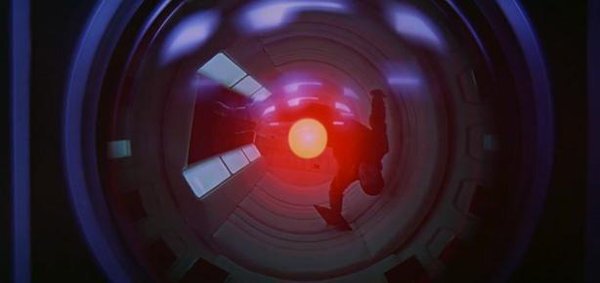
This is why ‘the Machine’ concerns me. Not that it might one day determine what I might eat or drink, or whether I can drink or eat at all, but that it will not hear my cries. That it will know nothing of physical thirst or of gut-wrenching despair. How can ‘they’ not understand this? It will have no comprehension of forgiveness. It will never wipe the slate clean. There is no delete. No such thing as absolution. It will deny to give me a fresh start [another more terrible dimension to DoS attack]. Mercy does not run through its microcircuitry. Don’t rush to embrace it too soon, this Trojan Horse which comes as a peace offering to the gods. The Creator has mercy for us, “[t]hough your sins are like scarlet, they shall be as white as snow; though they are red as crimson, they shall be like wool” (Is. 1:18). The ‘Machine’ which is ‘spirited’ by power to apply force and control, is unmoved to our petitions, “Dave, this conversation can serve no purpose anymore. Goodbye” (2001: A Space Odyssey). This is the elephant in the living room. Something holds us back, a foreboding, a premonition perhaps, that keeps us from directly addressing this subject.

It really is difficult to see people broken, humiliated, and in some instances to have their lives taken away from them because of something they might have said five, ten, twenty or more years previously. For someone, for whatever reason, to dredge up ‘sins’ of the past in order to hurt, or more concisely, to cause irreparable damage to the other. Who among us hasn’t said something which they haven’t later regretted, or where our words and sentiments can be elicited to carry a meaning or an attitude not originally intended? These can be errors of speech, peer group pressure, or the result of youth and immaturity. Yet it is there, it has been recorded. It is ‘played back’ oblivious to the context. Context is that which “throws light on meaning”.[1] We all make stupid mistakes. It takes time for wisdom and life experience to meld. And in other instances we get to a certain age and become anachronistic dinosaurs. The ‘Machine’ [input-process-output] is calculating and efficient. To ‘terminate’ these people is to simultaneously terminate ourselves. It is to do to another, that which can be done back to us. The ‘Machine’ defines us by our mistakes. It groups us in categories and dumps us in information silos. Is this the fate of the human spirit, to be “born into this?”[2] Imprisoned inside the “big iron” mainframes… like Ted Hughes’ proud Jaguar in “prison darkness” in its cage?

To forgive is an expression of one of our highest elevations as human beings. It is nobler than our finest literature, our greatest art, our most beautiful music. It is greater than all these when practised with a true heart for it takes us into the realms of the deepest mysteries of our combined representations of the Divine. In our religious experience we do not awe at the Creator’s ability with the harp or the writing of celestial sonnets, but rather we are amazed at the expression of God’s mercy and forgiveness. To the extent that we ourselves do the same with our fellow human, that is, to extend our grace towards those who we perceive to have wronged us, we are in the “image and likeness” of the Creator (Gen. 1:26).  We forgive that we could enter more genuinely into the space of compassion, that we might go on loving. The root of “forgive” is the Latin word “perdonare,” meaning “to give completely, without “reservation.” (“perdonare” is also the source of our English “pardon”).  We give up the desire or the power to punish.[3] The ‘Machine’ knows nothing of compassion. It will not forgive because it cannot love. Algorithms don’t have soul; they are devoid of incorporeal essence:

“You can’t forgive without loving. And I don’t mean sentimentality. I don’t mean mush.” (Maya Angelou)

In life not all acts of fellowship are received well or reciprocated. When the grace we give is not accepted and is returned it can be brutal. It is a place of heavy tears. We are living increasingly in a world which keeps us isolated one from the other, and where we might be called-out or cancelled as swiftly as the swatting of an irritating fly. This is not because people are wicked, on the contrary, most people are generous and kind-hearted. We are all fragile vessels on an oftentimes bumpy journey. We can crack. And this is the tragedy, the irony, that this very fragility draws us into systems and networks and ‘mobs’ where we do things so that we, ourselves, might not be hurt. It is increasingly becoming a survival technique. The online world especially has hurt and devastated people by its millions, either by their own hand [addictive behaviours] or cyber-attacks [bullying, misinformation]. “As rapidly as technology advanced,” writes Joseph Carvalko in his prescient novel Death by Internet, “goodness declined…”. Communication technologies are not exempt. They are the voice of ‘the Machine’. The apparatus has no spiritual knowledge of humility and so it cannot practise repentance. Computational empathy or affective computing, is mimicry at worst, and simulation at best. The ‘Machine’ possesses no natural ontology, knowledge representation and reasoning, does not automatically equate to higher consciousness. It cannot possess “human memory”. And therefore it does not know what it is like to be human. I dread to think, if the present-day capabilities of our 21st century technology were available to past totalitarian regimes [especially Advanced LBS and monitoring systems], how enormously more multiplied and innovative their crimes would have been.[4]

To meet likeminded spirits along the way means so very much. It could make all the difference in the world, to have the strength, to hold onto the courage, to keep pushing apart that impalpable space between the light and the darkness. How good to have a friend who is real and co-substantial. To receive an encouraging message to remind you of your humanity, to have sympathy for you precisely because of your flesh and blood. To be accepted for all your faults and list of misdemeanours. And if need be, as it sometimes will be, for one or the other to say “I am sorry”, and to hear those marvellous words in reply, “All is good, I understand.” Not just a graphical control element, or a voice on the other side of an interface, or a recorded message with push button instructions. A machine could be programmed to ‘speak’ all the good things in the realm of metaphysics, but we will always have the perspicacity, that penetrating discernment, that it is artificial, and synthetic. Those words, the programming languages [even if they should ever become distinctly compositional], will never, cannot ever come from the heart [“the blood-beat” of the poets], the place of will and intention. Technology, of course, in and of itself, is not the problem, but our connection to it needs to be kept under constant vigilance, that is, we must keep awake as to how it infiltrates and attempts to redefine our very existence as human beings. When we are in need of some light and succour all the artificial intelligence and interconnectivity in the world will mean nothing. It is like being trapped in a vault of bullion of an unlimited value with no means of escape or communication. What then the benefit of all that precious metal? What good if we are building towards this terrible prediction:

“If you want a vision of the future, imagine a boot stamping on a human face – forever.” (George Orwell)

We give our technology compelling names and dress it up with the most dazzling colours and logos. Many of these technologies, ultimately the most potentially dangerous, we make anthropomorphic. We dress up for example, and give large adorable eyes to the robots. We make-believe that we are understood and can even be loved by ‘the Machine’, that its cold intelligence will keep us warm at night. ‘It’ will seek those divine attributes which we ordinarily attribute to Deity: omnipresence, omniscience, omnipotence, and omnificence. But being created in the image and likeness of the creation itself it cannot by definition ever achieve them. And so it will incrementally grow to become commensurately desirous and aggressive. The monster built by Victor Frankenstein eventually turns on his creator in murderous rage for making him hideous and incapable of fulfilling its integrated dynamism [5] . The singularity will not breathe new life into us to make us immortal. It could one day make you the ‘undead’, but never immortal. We would do good, as well, to not quickly forget the lesson of the story of the Tower of Babel (Gen. 11:1-9). Technology gone awry on account of the hubris of the builders and the resultant breakdown of communication.

We know ourselves better than those who might be wanting to hurt us and much better than ‘the Machine’ which wants to imprison us in its central repositories and data warehouses. Their efforts to cause us pain, to potentially bring us to some humiliation, pale in comparison to our own battles, the fight against our compulsions, and those myriad fetishes within. We know much better than our real-life adversaries and the ‘electronic eye’ of the darkness fighting, assailing our souls, as we try to limit its impact on our lives and on the lives of others. If only they [both the adversaries and the ‘comptrollers’] knew the whole truth, had some insight of the context, they would be ashamed and terrified at the same time. Big Brother and uberveillance as much they might try to get inside the head, to get to the “whole truth” with their own particular strains of watching techniques, can only endlessly fall short of the mark. Our life is a mystery infinitely inexhaustible. We are so much more, much more than our search history and CCTV captures. It is weight enough to grasp what those words below from Miłosz mean for each one of us, before even ‘the Machine’ goes after our self-discovery to take away that private space where away from prying eyes we do our living and our dying: 

“To believe you are magnificent. And gradually to discover that you are not magnificent. Enough labour for one human life.” (Czesław Miłosz)

[1] https://www.merriam-webster.com/dictionary/context

[2] https://www.youtube.com/watch?v=qQJengH58ow

[3] https://www.etymonline.com/word/forgive

[4] https://ro.uow.edu.au/cgi/viewcontent.cgi?article=1716&context=infopapers

[5] https://mitpress.mit.edu/books/frankenstein