
On the hidden beauty of brokenness and the art of kintsugi
/The Lord is close to the broken-hearted / and saves those who are crushed in spirit. (Ps. 34:18)
To approach the Other in conversation is to welcome his expression, in which at each instant he overflows the idea a thought would carry away from it. It is therefore to receive from the Other beyond the capacity of the I, which means exactly: to have the idea of infinity. But this also means: to be taught. (Emmanuel Levinas, Totality and Infinity: An Essay on Exteriority)
Let me go there with you. (Yiannis Ritsos, Moonlight Sonata)
I have been overwhelmingly encouraged not only by your response to my recent small essays on a theme, but more so by your own stories of resilience and your practise of the compassionate-love. By this term, I have simply meant the charism of forgiveness, the concern for the well-being and flourishing of the “Other” (Levinas), and an acknowledgement of our fragile and oftentimes contradictory natures. I was especially struck by your experiences and rich insights into the trauma of being “ghosted” by a beloved friend. Though I was not necessarily surprised, given that our lives are deeply interwoven with one another, the volume and integrity of your response had an intense effect on me.
What do I mean, and why was I so moved when I read your words, and later to be also told by Katina of the large number of visitors to this particular post, On the Grief of Losing the Love of a Beautiful Friend, had brought to it. To begin with, the two great things were further reinforced for me. First, that we are all much more alike than we are different. And second, that the ongoing silence of a friend can be one of the deepest pains that we will experience. It is good to know we are not alone, that we all belong to that greater community of like-minded souls who delight in shared joys and suffer through similar sorrows.
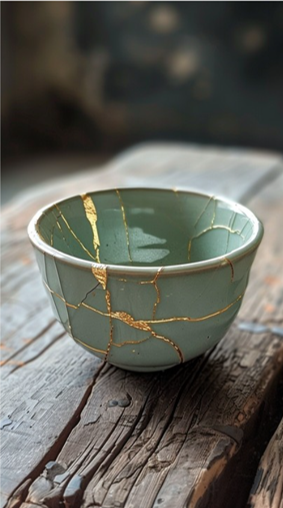
All our stories are unique. They exist within their own context. Every experience of loss brings its own consequence, and it carries its own particular weight. But why does this grief steadfastly refuse to completely go away? Be patient, for in time its brutal sting will be numbed. Yet, it will linger. It will never completely die, for the simple reason that love itself cannot ever be exhausted. For love is much stronger than the sting. This is the irony, our humanity itself. The more human and humane we are, the more we will hurt. And much as we might wish to avoid this grief, for, as we have agreed, it can hurt more than that throbbing pain down to the bones, it is our restorative kintsugi. It is the art of our healing, of bringing the broken pieces back into the whole and transforming them into something even more beautiful than before.
Kintsugi translates to “golden joinery”. It is a traditional Japanese art form that repairs broken ceramics by using a formula made of lacquer mixed with powdered gold, or other coinage metals, to mend the cracks. It is important to keep in mind that these materials themselves might appear to be messy at the start, in the same way to the block-in of a traditional painting. The noble philosophy that underpins this craft is that it understands both the breakage and repair not as something to hide, but rather as part of an object’s history. The beauty that results will rest in the very imperfection itself. I have also come to increasingly look at kintsugi as a metaphor for the mended scars that we carry in the context of healing—Ithacan and more compelling to look at than before.
In a long story that I have in some place written, I have placed these words below in the mouth of my resolute protagonist, Monk Sebastian Kazan:
I have wondered what it would be like, and how wonderful beyond the conception of words, to have in the one room towards the closure of one’s life, all of your adversaries. To reveal to each and every one of these souls that without their presence, the puzzle would not be complete. I say to myself, even during the excruciating hours, I would not be who I am today without you. To embrace these adversaries tightly and to whisper into their ear which too has been aching: “We were in search of our identity. I have always loved you.”
Each day becomes more precious when we try our best to make someone else’s life a little brighter. And the ‘tyranny’ of this universal and proven compassion? Because for some reason there are those times that we hold back, knowing too well how easy it really is—a postcard; a letter; three words in an email (“All is good”); a bouquet of flowers. The recognition, as I have somewhere else read, that we are all on our way to our individual extinction. When we are gone our “species” (our unique and unrepeatable individuality) will never again appear on this earth. And surely this is something worth remembering and acting upon with a healing grace.
I understand. I really do understand. This theology is not for the ivory tower. It was brought to life in the deserts of Egypt under a blazing sun and watered from the aquifer bones of anchorites hallowed and hollowed like the rocks.