
How Does One Deal With A Life Changing Moment

So we do not lose heart. Though our outer nature is wasting away, our inner nature is being renewed every day. For this slight momentary affliction is preparing for us an eternal weight of glory beyond all comparison, because we look not to the things that are seen but to the things that are unseen; for the things that are seen are transient, but the things that are unseen are eternal. (2 Cor. 4:16-18)

How does one respond to a new challenge in life, when almost overnight, everything changes dramatically? You look in the mirror and you recognise that your old physical self is to a large extent gone. There is denial. There is grief. And yes, in the middle of the tears and self-pity, an anger that could surprise you. Perhaps worst of all, the onset of a gnawing despair. You are in fact experiencing the inner and outer metamorphosis. All the self-help books in the world are of no use, for their premises are no longer relevant to you. The man looking back at you is not the man you once knew. The body you inhabited for sixty-five years can no longer serve you in the same ways. One can pretend to the world that these natural human emotions do not apply to them, that you have been able to rise beyond such fallible responses. Yet, and this much I must say, if you have belonged to the community of believers, and you have seen abundant evidence of Jesus Christ, the God-Man, at work in your life, then you will not question your faith nor put away the trust in the providence of your Creator. But your hitherto public stoicism, and those standard rejoinders to the problem of pain, as theologians have long framed this paradox—so much suffering in the world and still at the same time the goodness of God—will be thrown into upheaval and shaken to its core.

What this “thorn of the flesh” is for the present writer is entirely irrelevant. It is not the affliction itself that is of concern to him, nor is his experience at all unique. What he describes here is an undergoing that belongs in whole or in part, to at least some of his gentle readers. The question, then remains, how does one deal with a life-changing moment that has to some degree, made different much of one’s life. The saint, for there are saints who either live here in our midst or in monasteries or in faraway deserts, will reckon this as part of the soul’s journey toward redemption. Then there are too, the stoics, who courageously accept it all as part of the greater story of the cycle of life. But there is something very much in common in both of these positions, the acknowledgment whether be it manifest or tacit, of the joyful-sorrow of life and of the inevitability of our report here in this world one day coming to its close. From Siddhartha Gautama, to Socrates, to Saint Paul, to Blaise Pascal, to Martin Heidegger, to Sophrony Sakharov, to Viktor Frankl, to Irvin D. Yalom, to Dean Rickles, this ontological acquiesce is there in every profound thinker that has walked the earth. There are those winter seasons in which, as my dear friend Joseph Carvalko writes in one of his enthralling essays, that we are drawn to think of our souls in different ways until that time when they reach "that final purpose" (Paradox of Hope).

Pass then through this little space of time conformably to nature, and end thy journey in content, just as an olive falls off when it is ripe, blessing nature who produced it, and thanking the tree on which it grew. (Marcus Aurelius, Meditations)

When we are no longer able to change a situation, we are challenged to change ourselves. (Viktor Frankl, Man’s Search for Meaning)

https://stockcake.com/i/butterfly-life-cycle_3152617_1654139

So we live each day grateful for all we have been taught, not despairing of the new stories we will now live through, and ultimately grateful for these additional narratives we might now write down. For these things, the precious fruits of courage and perseverance are not at all outside the realms of reality and have been manifested in the lives of so very many. And more recently we witnessed this in the life of my late and much beloved Momma. Not long before she left us she “woke” from her deep sleep and in English (her second language which to this point she had almost completely forgotten) to say: “I saw Jesus. He said He loved me.” Her countenance was amazingly bright. Of course, one can interpret these fabulous words in different ways. We took them at their face value, and at that moment she gave us a vision of meaning above and beyond what I could hope to describe here, that change when even at its most difficult hour is not bereft of the light. Suffering can only be met head on, there are no shortcuts to the problem of pain. There on those hard edges of Gethsemane, where the human spirit is tested that it might be refined as gold, awaits the revelation of our true name written on the white stone (Rev. 2:17).

Our eyes and hearts can become opened to astonishing depths of love (now re-defined and re-experienced on account of our new condition) and to all-encompassing fields of compassion once only imaginable when we were at our very best—those days when we refused to chase away the birds from our fruit-trees and considered the practise of forgiveness as the highest expression of agape.

Even with all of the hard knocks and heavy collisions along the way, we all have a fabulously rich story to tell. Whether we can write it down or not, will matter only very little. The narrative will take on its own life to become our legacy. I remember an elderly monk from Mount Athos, Father E., who would refuse to wear laces on his boots. One afternoon after the refectory I summonsed the courage to ask him ‘why’ [and here I must confess to paraphrasing him a little]: “One must be prepared and on time for the unexpected.”
The Little Boy and the Huge Dragon: The Truth Behind Uberveillance

Mollymook, NSW

NB Introductory pages from “The Little Boy and the Huge Dragon: The Truth Behind Uberveillance”, (September 21st 2010, Gerringong, NSW).


“Likewise the Spirit helps us in our weakness; for we do not know how to pray as we ought, but that very Spirit intercedes with sighs too deep for words.” (Romans 8:26)

“The real meaning of enlightenment is to gaze with undimmed eyes on all darkness.” Nikos Kazantzakis

“The day when God is absent, when he is silent – that is the beginning of prayer.” Anthony Bloom

“Sometimes a man can become possessed by a vision. Perhaps it makes no sense to anyone else; perhaps it is a revelation to everyone. Yes, this man will say to himself, this is the way the world is supposed to be. This is how I am supposed to fit into it. He will know, like a man trying on shoes, that he has finally found a pair that will serve him for a very long walk indeed. So he begins, one step at a time.” Joshua Cooper Ramo 

September 21st 2010

Gerringong, NSW

I have been here before, this much I do know, ever since the dream.

But how and why have I arrived into this fearful place and will it ever be possible to escape its dark and terrifying rooms? “Tell me little boy, tell me that together we might deal the huge dragon a mortal blow.”

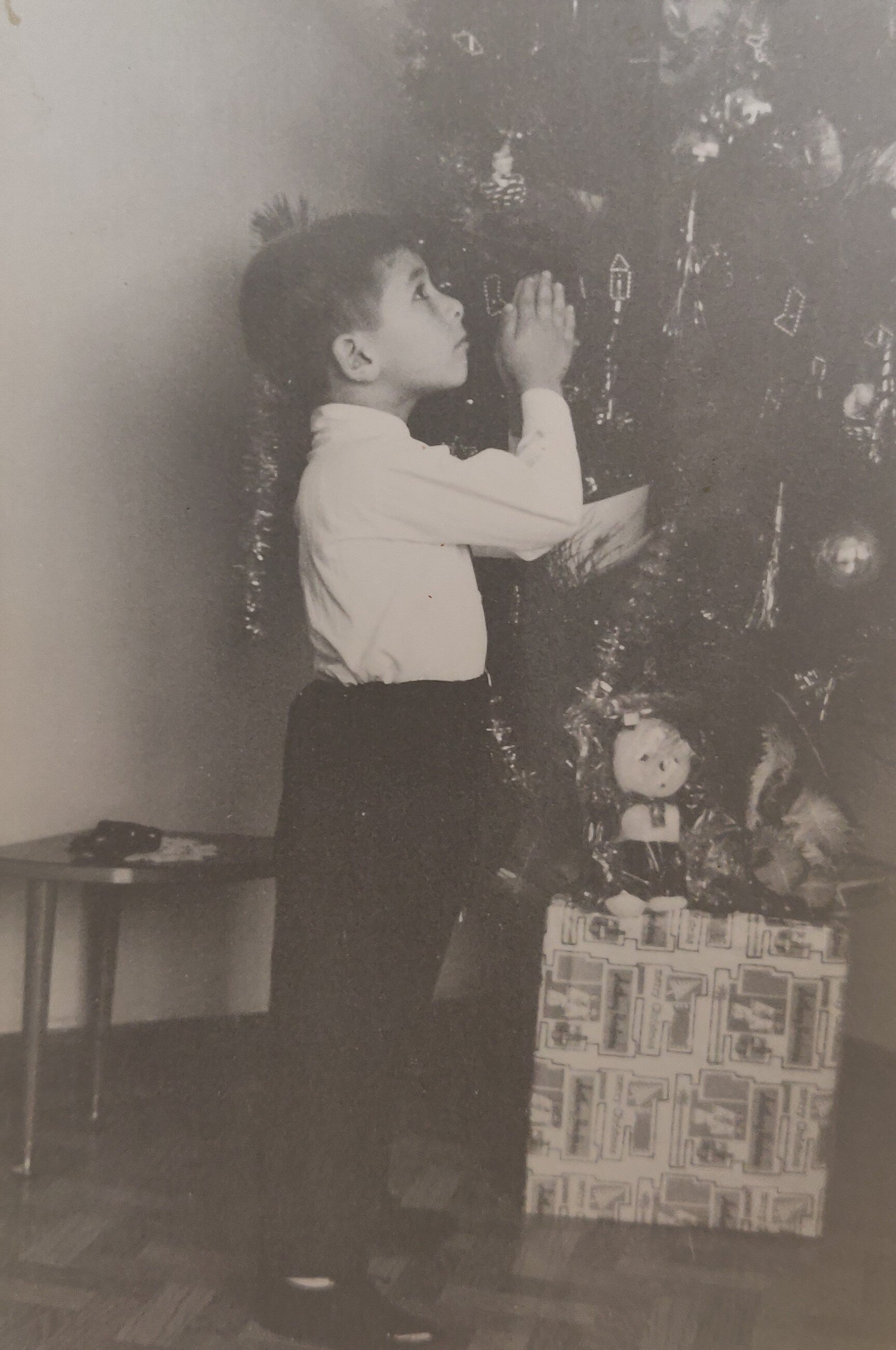
MG circa 1966. Credit: Michael Family Archives

MG circa 1966. Credit: Michael Family Archives

Outside the early sunlight is bending through the cactuses. One can learn a lot from the improvisation of a cactus, but when pressing our flesh against its secret we must not be afraid of the stabs. Redemption is not a bloodless exercise. For those stubborn enough to hold out through to the end they would hope the price of admission into this world was worth the cost. And that the need to understand was greater than the darkness. “I dive down into the depth of the ocean of forms…” (Rabindranath Tagore).[1] These are the deep mysteries which beckon us to search for the soul and which like the private imaginations of a good monk, they will both fascinate and repel.

The one thing I must now do is to write. Write, Michael, it is your only way out of the abyss.

To keep on writing until the larger pieces to this puzzle begin to fall into some recognizable pattern or shape. How many times have I made this promise to myself? Only to see it broken when the story became too hard or when gripped by the dread it would sound too improbable, if not unbelievable, to most. Maybe, too, it is the fear of writing itself, vox audita perit, literra scripta manet: the heard word is lost, the written letter abides. Then again, this ancient maxim takes on new connotations in the world of Uberveillance.[2] The delete option will increasingly become one of those fantastic recollections of the past and the “heard word” too, it would not be lost. All will become video and uploaded to be re-run by the collectors, the controllers, and the hunters.

It has now been almost twenty years since my exile. An exile both forced and self-imposed for the crime of refusing to accept privileges and honour but also for daring to suggest that the “sheep” are not dumb. I cannot but recall those telling and now most ironic and coincidental lines from Dostoyevsky’s Notes from Underground, “I have been living like this for a long time now – about twenty years. I am forty… [a]fter all, I didn’t take bribes, so I had to have some compensation.”[3] Unlike Fyodor Mikhailovich’s “bad civil servant”, however, I am now approaching my fiftieth year and was once a young and highly idealistic clergyman.[4]

As for my own compensation? Hope. And only heaven and hell would ever know how much of it I would truly need. For certainly, I too, am not entirely blameless. Yet even our ruins carry our legacy from which we pick up the pieces to rebuild. Nothing should be wasted. “There is always another story” writes W. H. Auden, “[t]here is more than meets the eye.” We are all looking to be saved by somebody or from something and so every last piece of this big heap of fabulous rubble will find its rightful place. Like great cathedrals and national monuments rebuilt after the bombings of war.

[1] Rabindranath Tagore, Gitanjali, (Macmillan & Co.,: London, 1938), 91.

[2] M.G. Michael and Katina Michael, Uberveillance: Microchipping People and the Assault on Privacy, Quadrant, LIII (3), 2009, 85-89.

[3] Fyodor Dostoyevsky, Notes from Underground/ The Double (trans.) J. Coulson, (Penguin Books: London, 1972), 15.

[4] At the time of upload [December, 2019] “I am now approaching my sixtieth year”.

In my bedroom early morning hours January 7th 2018

Gerringong, NSW

The heat almost unbearable tonight; like the years lost to phantasms; memories which mock till sucked dry; the roundness of my back a parachute; this body once carved from Greek marble; the teasing of a spirit which stays young; the soft flesh and decay of teeth; tonight this is not who I am; tonight I am a god smearing moonlight on my face; I am a poet until the sunrise; and my hair is thick and hiding a multitude of stories; Augustine of Hippo “ever-present eternity”; “[y]et the timeless in you is aware of life’s timelessness” (Khalil Gibran); “At that time Michael, the great prince who protects your people, will arise” (Dan. 12:1); I hear the waves crashing onto the shore; years ago the Pacific Ocean almost claimed me; the water has been after me since the womb; vodka; voda; little water; you can drift off nicely with a huge ear; tympanic membrane; Bugs Bunny “Rabbit of Seville”; Syd Barrett busking in Paris before his conflagration; Estas Tonne’s burning fingers whirling dervishes in Madrid; the blind guitar player on Piccadilly Circus looks my way; word association associative patterns; “[w]ild, wild horses we’ll ride them some day” (The Rolling Stones); Eleni wakes up to a nightmare; J.P. Morgan; the ‘1907 Panic’; the Federal Reserve System; do understand it is a private trust; this generation has been reeling in the darkness; algorithms are without soul; ‘number crushing’ will be reversed; to the right on top my side drawer four books; The Handmaid’s Tale; Titus Andronicus; The Robots of Dawn; David Brooks' The Fern Tattoo; to the left on top my side drawer; the Nestle-Aland Novum Testamentum Graece; a pair of blue crystal angels; a prayer rope; a Rubics cube; a bronze owl from Istanbul; the stories from Paphos almost done; I enjoyed drafting these on the mountain; I might send them to Westerly; I am nodding off; I will sleep for a few hours; here on this bed you were conceived; 5.47 AM; “From bed and sleep hast Thou raised me up”; dreamt of my Father sitting on a ledge in his suit; episodic memory; aromatic incense; Lily of Aegina; 2 charcoal pieces; Surrealism and the unconscious; Salvadore Dali (1904-1989);  camouflage; concealing colouration; “[y]ou can close your eyes to reality but not to memories” (Stanislaw Jerzy Lec); it is a little cooler; remnants will be left behind; my pillow wet like London rain; I am getting a new laptop; I wish I did not need one; nobody needs Facebook; great alphabets are hidden in our backyard; “[o]nly the body remembers stillness”; Elvia Garcia Ardalani; back soon must quench my thirst; chilled tomato juice; savoury crackers and cheddar cheese; a short black; Boat Harbour Rock Pool; Seven Mile Beach; Cathedral Rocks; midnight Christmas services the Julian Calendar; typewriter patented on this day (1714); total fire bans are in place; motifs return in different keys; they come back on their head; Ludwig van Beethoven; Claude Debussy; Jon Lord; we are all connected; all things touch; except the “internet of things” which has no soul; but Charles Bukowski has soul (1920-1994); Iranian oil tanker fire leaves 32 missing;  “Aussie Flu” outbreak; Donald Trump ‘absolutely’ would talk with Kim Jong-Un; Titus Andronicus; pulp fiction; “Art thou not sorry for these heinous deeds?” (Titus Andronicus); redemption; “the action of being saved”; recovery; Katina and the little ones at the beach; George gone fishing; my left leg folded under the right has gone to sleep; Tito Colliander (1904-1989); The Way of the Ascetics; searching for faith in a disbelieving world; Pythagoras’ golden thigh; speak to me great river; bite the head off the old serpent; 10:07 AM; I will take a shower; a shower like a baptism promises re-birth; healed in the waters of the Pool of Siloam and the Gihon Spring; blue sundew; purple garlic; dark orange; the dyers guild protected their secrets closely; the porcelain guild even more; my guardian angel above and beyond; Uberveillance is nearer than I thought; who will be able to resist; save your children; blood pressure 157/95; pressure in large arteries; sphygmomanometer; the explosion of colour; diffuse nebulae; interstellar matter; second breakfast: Melba toast, feta cheese, black olives, and a drop of Sangiovese; drafted a poem; revised two translations; listened to Loreena McKennitt; leafed through some old photographs; joyful-sorrow; translate to ‘double-edged sword’; https://www.youtube.com/watch?v=wIS3Y-lZStU;  “I made my song a coat” (W. B. Yeats); Red Mashad Persian Rug; the Blueface Angelfish will dazzle in the Indo-Pacific; diamonds rain down on the surface of Jupiter; Katina and the little ones have returned; George is still with Pops; our neighbours mowing the lawns; the shrieking of Galahs; much cooler and “partly cloudy”; stratus; cumulus; stratocumulous; a postcard from Singapore arrived two days ago; a letter from the bank; an invitation to a wedding; remember Mary Wollstonecraft; she died giving birth to her daughter; the other Mary who wrote Frankenstein; “[i]f I cannot inspire love, I will cause fear!”; back later don’t go away; 9:47 PM; “The day has passed, and I give You thanks, Lord”; another ritual washing; at least the flesh will be clean; earlier a bowl of lentil soup, onion, olives, with crusty bread; a tall cold beer; a mild cigar; a secure roof; unqualified love; blessings beyond words and so my heart be silent and do not complain; “Give thanks to the Lord, for He is good. His love endures forever” (Ps.136); belief is action and movement; belief is not dogmatic it is ongoing counsel through the darkness; “I do believe; help me overcome my unbelief!” (Mk. 9:24); Jeremy bouncing a ball downstairs; Eleni drawing pictures in the big room; Frida Kahlo (1907-1954); look on the underside of the image; a magical realist acquainted with grief; I am upstairs in the bedroom; “Beam me up, Scotty” (Star Trek); Google maps; ‘view or edit your timeline’; what will be the truth; to the right of me the bathroom; to the left of me the walk-in wardrobe; and to the front of me “[t]wo roads diverged in a yellow wood” (Robert Frost); Siccar Point; time split into many points; creation and evolution; blue whale; white whale; grey whale; it invariably comes down to triggers; “Stories that educate and inspire those with OCD” (Stuart Ralph); tap… tap… Tao; the Titanic burned; the iceberg came after; like the new world we are building; “dance me to the end of love” (Leonard Cohen); Salome; Isadora Duncan; Martha Graham; chasse triple step; lock step; feather step; Rabindranath Tagore; Nandalal Bose; Niranjan Bhagat; contextual modernism; orchid; lotus; bleeding heart; last week I dreamt I was wrestling with myself; I had the ‘other’ in a tight headlock; subdue that which wars within you; courage; enlightenment; collapsing stars and gamma-ray bursts; all good for now; the land of Zebulun and the land of Naphtali; from the shadow of death; light will dawn; it all goes too quick, the little bird lamented; let us cry together tonight.

Some fragments from a diary

When the delivery truck arrived (November, 1990) 

Members of the monastic community Patriarchal Stavropegic Monastery of St. John the Baptist, Essex, England. In the centre the beloved Elder Sophrony Sakharov, 1990. Courtesy: Michael Family Archives.

On a cold and wet Essex afternoon a delivery truck arrived with the Elder’s celebrated masterpiece, Saint Silouan the Athonite,[1] his book on the life and teachings of his spiritual father, Saint Silouan of Athos. The books were arranged in a number of large cardboard boxes, Father Sophrony asked me to open one of these boxes and to present him with a copy. I can still see him bent over his walking stick in his overlong cassock with his face radiant as ever. He asked me to take out a second copy which he straightaway placed back into my gloved hands. This volume was to be mine. To this day it remains one of my most treasured possessions and there have been mornings when I have woken up from sleep with this book resting on my chest. Prayer and the practise of love as revealed through the incarnation of the GodMan, two of the vital teachings which are exemplified in this modern-day spiritual classic, are not idle forces however we might define or understand them. It would be a mistake to underestimate their inherent potential, like solar super storms which take out power grids they can be responsible for seismic shifts in our life. This lifelong dedication to prayer and the divine love emanating from Jesus Christ were two of the enduring lessons from the blessed lives of Saint Silouan (1866-1938) and his disciple in Christ, the Elder Sophrony (1896-1993).[2] And that they would pray without ceasing (1 Thess 5:16-18), like the great John Coltrane from another world of whom it was said would never take the horn out of his mouth.

The letter from the Patriarchate

Two weeks after my arrival here at the Monastery of Saint John the Baptist in Tolleshunt Knights,[3] the old monk Procopius whose visible saintliness was an example in itself of the transfigured life, informed me in his customary understated way, there was a “big envelope” waiting for to me at the Old Rectory. Hearing the news I instinctively knew. I doubled over as my body collapsed from under me and started to sob like a small child. Father Procopius lifted me without saying much, but his encouraging embrace and quiet invocation of “Gospodi Pomiluj” was enough to keep me steady on my feet. The mail was indeed from Australia, posted by the Orthodox Archdiocese, but the letter inside was from the Patriarchate of Constantinople. It was as I had straightaway thought, a copy of the official documents confirming my petition of “re-entry into the ranks of the lay persons.”[4] The reason for this appeal to be relieved of my clerical orders was correctly stated as being of my own request but also to do with issues of “mental health”. This additional explanation surprised me. I had never mentioned mental health as a ‘reason’ and if I had spoken of my battle with depression which I had, it was during confession to my spiritual father who at the time was His Eminence back home. Already I had clearly understood that anybody who had a confrontation with the Archdiocese whether be it clergy or lay person was said to have had issues of “mental health”. We were all insane or ‘mad’ except for the ‘kings’ who were governed by ‘sanity’ and ‘reason’. This is a silencing technique practised by most powerful institutions to protect themselves and if need be, to be able to promptly discredit any potential adversary. Especially sad to say this is an art brought close to perfection by some church communities who have ‘God’ and ‘authority’ on their side. It is very hard to argue against any perceived notions of infallibility.

Even to that moment in the Old Rectory, I was still not sure whether I had rushed into this irreversible decision of asking for my own ‘defrocking’ or what is more commonly known as voluntary laicization. Words cannot adequately capture the vacuum and horror of that single moment of spiritual disconnect that was to linger like a breath behind my neck well into the middle decades of my life. Not yet thirty and everything that I had worked towards, all the dreams which I had aspired to, and the sacrifices (perhaps not for others but for me that is what they were) appeared at that very instant to have come to a fast and dishonourable conclusion. It was all deemed “over” with the signatures of a group of distant bishops presiding in Constantinople with no idea of who I was. And then the sinking, awful realization, that not long from now I would have to return to Australia and would have to explain to friends and acquaintances, why I had committed the unpardonable sin of walking away from the priesthood. After all, was it not I, who was known for the ‘all or nothing’ altar cry: “…everything, all for Jesus.” Why did I do this when I had a good understanding of what I had given up and where this would probably lead? My mind kept going back to Christ’s hard words, “No one who puts a hand to the plow and looks back is fit for service in the kingdom of God.” (Lk 9:62)

It is tempting to make all this sound too deeply meaningful and complex, to launch into an impassioned pro vita sua. Yet despite the darkness which was to quickly descend upon me in the wake of my decision it was relatively simple. Things did not work out. I did not like what I found. Certainly not in the Church herself, but in the church governance. And I was not in any way saintly enough to remain given my own weaknesses and to endure. I had made a serious vocational mistake, but one I had to make and to live through. It was there on the coal face of this ‘unseen warfare’ that I would set out to discover the truth of my redemption, if indeed, it was to ever come. That is, as Father Zacharias of Essex has oftentimes said, “to find the deep heart.” Later on I would begin to complicate things and make life more difficult for myself by going in search for some sort of justification which I felt compelled to share with the ‘outside world’. Guilt, or even misplaced guilt, when it is not accepted as a corrective force or as an opportunity for change is a catalyst to self-absorbed shame and a quick path to self-destruction. It is exactly right what Watchman Nee has said, “[a]n unpeaceful mind cannot operate normally.” I was at the same time convinced that I could not live as a celibate without becoming bitter and resentful. Additionally, my ego was way too strong for me to be humble (in the way which I had understood ‘humility’ from my reading of spiritual texts), to be ‘worthy’ or capable of bearing any high clerical office that might have come my way. I realized early enough that if I was not cut out to make the grade as one of the Church’s holy pastors I was certainly not going to take the risk of becoming one of its closet devils. And the truth was I had it in my flesh to be more devil than holy.

Father Jeremiah (MG) in the Essex snow. Courtesy: Michael Family Archives.

Father Jeremiah (MG) in the Essex snow. Courtesy: Michael Family Archives.

My priesthood, however weak or strong it might have been, was the keystone of my life. Everything I did, or thought, or believed in, revolved around it. Importantly, it was the outward symbol of my faith. It identified me. A keystone is the wedge-shaped embellished voussoir at the crown of an arch, serving to lock the other voussoirs in place. Remove it and everything falls to pieces. It all becomes a pile of stone. Often too, I would think on the potter and clay imagery in the Old Testament and what it might now mean when I turned to God in prayer (Isa 29:16). Would He turn His face away from me? One of the challenges for the potter in using pattern on three-dimensional form we are told by those who have mastered the craft, are that of marrying the relationship of interior to exterior and the association that exists between them. What would now be my connection, not only between my interior and exterior life-worlds, but also with my Maker? This is one of the great temptations that we have to face as human beings, that we too readily identify ourselves and others with the brokenness. And playing on the inside of my head as if on a continual loop, [something not uncommon for an OCD], Pergolesi’s Stabat Mater to which I had become transfixed a few months earlier during my night drives out to the Cronulla sand dunes.

Taking my cassock off for the last time

Now there was the hard practical matter that would soon also face me, taking my cassock off for the last time. Afterwards in a little poem I would speak of it as the painful process of “scraping” it off my back. This I would put off until a few weeks later, when I found myself in Madrid. Here too in ‘the city that never sleeps’, as was happening throughout the world, the question on everyone’s lips was whether Israel had “responded” to the missile attacks from Iraq and what it would mean if they were drawn into the developing military crisis in the Gulf. I was in Europe during the early stages of Operation Desert Shield (August 1990-January 1991). It was an apropos ‘soundtrack’ to my own private war which I was waging secretly within. One thing would remain certain, that I would never forget having served at the altar of Christ and this would forever mark my life. Some experiences will burn us irrevocably. And all you can do is learn to live with them.

Had I been older and blessed with a lot more wisdom I would have transitioned back into lay life quite differently but often I felt like one of those animals in the night, startled by that sudden flash of headlight from an oncoming vehicle. I know from experience that I am not the only one in such a position who has felt this overwhelming brutalized emotion. There are a number of things I know I could have handled better. The cause of my torment rested more with me and I must shoulder the blame for the greater part of my suffering. It was from this time that my struggles with depression would develop into unremittingly long periods of melancholia and bring me close to death more than once. I was no longer trusting in my Lord and God. Prayer had now become very difficult. There were months, long months on end, when I was in the condition of acedia, a spiritual negligence, a dreadful despondency, which feeds the passions and which Saint John Cassian calls "the noonday devil", but I would force myself to read something from the Psalter every day.[5]  It was better than nothing, a few drops of water can keep you alive. Later I would read the autobiography of my brilliant teacher who was very much responsible for instilling in me the love of philosophy and my lifelong interest in existentialism, the gentleman scholar Paul Crittenden. A catholic priest of the Archdiocese of Sydney, he had left his own clerical orders to continue with his professorial teaching in the most seamless and dignified of ways.[6]

I wonder if I am for all time lost

This would not happen to me. Nothing was going to come between me and my love for the Nazarene. Now everything is different. I wonder if I am for all time lost. I had been a conscientious student of the church fathers and especially of some of the harder hitters like Chrysostom and Augustine. Their collective voices which would later once again soothe and lift me up would now seem to be relentlessly condemning me. Kafka’s travelling salesman Gregor Samsa wakes to find himself a bug and I too suddenly find myself in the middle of something that I was not prepared for. And I feel ugly. I wanted to hide, to examine my hideousness in the privacy of my own world. In the end, a lot of what was happening to me after my departure from Tolleshunt Knights and then upon my arrival in Madrid where I learnt more on the meaning of La noche oscura del alma, had to do with a word in spiritual literature which has been much misunderstood, surrender. It means to “give up, deliver over”. It does not stand for giving up on the fight which are the battles of the soul. At a certain point we need to let go of the driftwood and give ourselves over to the tide. Years on the wisdom of a leathery trucker, someone I would befriend at the markets in Flemington where I used to work, would have been good advice: downshift when going down the ice.

Concerning Spiritual Warfare

“Everyone who would follow our Lord Jesus Christ is engaged in spiritual warfare. The Saints by long experience learned from the grace of the Holy Spirit how to wage this war. The Holy Spirit appointed their footsteps and gave them understanding and the strength to overcome the enemy; but without the Holy Spirit the soul is incapable even of embarking on the struggle, for she neither knows nor understands who and where her enemies are.”[7]


[1] https://www.amazon.com/Saint-Silouan-Athonite-Archimandrite-Sophrony/dp/0881411957

[2] https://orthodoxwiki.org/Sophrony_(Sakharov)

[3] http://www.thyateira.org.uk/index.php?option=com_content&task=view&id=373&Itemid=1

[4]

[5] https://blogs.ancientfaith.com/glory2godforallthings/2017/06/26/priests-thoughts-depression-anxiety-soul-body-brain/

[6] https://www.amazon.com/Changing-Orders-Scenes-Clerical-Academic/dp/1876040866

[7] Sophrony op. cit., p. 423

A small note on Mount Athos

Mount Athos or the Holy Mountain as it is often referred to, is the centre of Eastern Orthodox monasticism.[1] Occupying the greater part of the Athos Peninsula in Halkidiki it is an autonomous polity in the north of Greece comprising of twenty imposing monasteries and a number of other smaller monastic settlements. There is evidence of Christian monastic life on the mount since at least the fourth century, and if not earlier.[2] Mount Athos [Athos the name of one of the Gigantes from Greek mythology] is dedicated to the All Holy Theotokos, the Mother of God, though paradoxically no woman is permitted to set foot on its grounds. This rule is strictly followed and is referred to as the ‘avaton’.[3] Young men come here to grow old mastering the art of unseen warfare to then die in anonymity and solitude. In so doing they dedicate their lives to God and pray for the salvation of the world.

“The Lord loves all people, but he loves those that seek Him even more. To His chosen ones the Lord gives such great grace that for love they forsake the whole earth, the whole world, and their souls burn with desire that all people might be saved and see the glory of the Lord.” (Saint Silouan the Athonite)

A large number of these religious are of high intellect and not few have left behind successful professional careers. They are doctors, engineers, musicians, teachers, philosophers, theologians, lawyers, scientists, artists, former police and army officers, and whatever else we might imagine. Some, it is true, are daydreamers and romantics. Others were criminals who have served their time or men who have lost everything to addiction except for hope. The monks here spend most of their day and night attending to the divine services or fulfilling their diaconate or alone in their cells with long prayer ropes made of knotted beads of wool practising the Jesus Prayer otherwise known as the prayer of the heart.[4] The day for the Athonite monk begins at sunset. To attempt to evaluate their vocation through the eyes of logic alone is to miss almost everything and to understand little. One of Aristotle’s truest revelations is that happiness is not just a feeling or sensation, but is the quality of the whole life.[5] The dumbfounding thing is the great majority of these men, for admittedly there are some sad and tragic exceptions, are profoundly joyful and possess an inner peace, a tranquillity of spirit which does radiate visibly from their presence. They are like ghosts from another world with obscure clues and tip-offs for those who journey to visit them in their spiritual ‘hide-out’. But be prepared for these angelomorphic presences are well versed in the game of ‘hide n’ seek’ and it is they who will find you. They are black clad rebels against the established order of decay and corruption who embrace the reality of death together with its promise of transfiguration…of whom the world was not worthy –wandering over deserts and mountains, and in dens and caves of the earth. (Heb. 11:38)

I would visit Athos twice and both times with the dreadful feeling that I was one of those ill-fated seeds from the parable of the sower. Sown on rocky ground and scorched. (Mat. 3:8) On the first of these occasions I was still a layperson and student at the Aristotelian, and then a few years later I would return as an ordained clergyman. We go on pilgrimages and visit monasteries for different reasons. Some of us go looking for spiritual counsel; for redemption and for a fresh start; to confess our sins; to escape from our past; to re-new old promises or to make new ones; to learn the fundamentals of prayer. In the end it is simple enough, the ongoing quest for “meaningfulness”.

But do not go anywhere looking specifically for God, or for that once in a life-time ‘religious experience’. It is one of the great mistakes and most of us will make it, just like when we routinely connect beauty to goodness. The psalmist’s counsel is not without its good reason, “Be still, and know that I am God.” (Ps. 46:10) However, it is the doctrine of Creation that we cannot escape from. Depending on how we understand this teaching and respond to its far-reaching implications, it will largely determine what we learn of the Creator and ourselves when we set out on the journey which might very well lead to Athos or to other places where prayer fills the night skies as if pieces of flickering diamond.

…as I go walkabout the invigorating salt air mixed with the aroma of wild unpicked flowers refreshes my body and spirit. To my right a mythical landscape of undulating peaks and steep ravines which threaten at any moment to spill into the brooding Aegean Sea below. An hour earlier in a distant skete… “Have mercy on me, O God, according to your unfailing love” (Ps.51:1)… I was awash in the scents of exotic Arabian incense and burning beeswax…

Good Lord, how desperately I have missed these wonderful worlds.


[1] Timothy (Kallistos) Ware, The Orthodox Church, (Penguin Books: England), 1993, pp. 129-132.

[2] Graham Speake, Mount Athos: Renewal in Paradise, (Yale University Press: New Haven), 2002.

[3] https://orthodoxwiki.org/Mount_Athos

[4] https://www.amazon.com/Jesus-Prayer-Bishop-Kallistos-Ware/dp/1860828930/and+jesus+prayer

[5] http://www.pursuit-of-happiness.org/history-of-happiness/aristotle/