
Questions that we can only answer under the firelight

“If it is possible, as far as it depends on you, live at peace with everyone.” (Rom. 12:18)

“For others, in spite of myself, from myself.” (Emmanuel Levinas) 

I recently received one of those beautiful letters from a friend that lifts your spirits and reminds you not only of the vital importance of friendship, but also that the world contains far more tender-hearted people than we might imagine. The letter, an email in truth, was sent to encourage me during this season of my journey. These wonderful words rich in compassion were to be understood as a sign of love and affection from a gentle and discerning soul. I reflected on this letter for some time and I have turned to it often, and to others of a similar humanity. What strikes me above all with such compassionate expressions of solidarity is something all of our true friends have in common, and this is not only the depth and elevation of their souls, but also their practice of giving others the “benefit of the doubt.” What is the benefit of the doubt? And what does it mean in the context of friendship but also in our broader communion with other people, or in other words, the Levinasian “Other”.

These oftentimes, life-giving words “the benefit of the doubt,” are, unless I am mistaken, a direct evolution from the legal principle “of reasonable doubt.” As flawed human beings ourselves we are severely limited to the truth, and could possess only a skewed perspective on reality. To give the benefit of the doubt will not rarely mean to dramatically change a life, to affect generations, and to even save a soul. It is to accept in ‘good faith’ that the other’s intentions were not malevolent or intended to cause harm, that whatever actions we might have misread as wrong were unintended or yes, even a mistake from a place of a momentary weakness or lapse of judgement. It is, of course, a lot easier for older souls to practise this precious charity on account of their familiarity of the human condition with all of its fragilities and contradictions. And the fact, that they too, have been the recipients of this grace, and are now paying it forward. One of the more significant reasons why this grace is withheld is its closeness to the ideal of forgiveness. Ordinarily, it can be difficult to distinguish between the two, though forgiveness is typically much harder, since it involves a reciprocal movement of humility and self-knowledge.

The benefit of the doubt might also challenge our own ethics, forcing us to confront uncomfortable truths about ourselves. This could in some instances prove frightening. We may come to believe that we are capable of what ‘bad’ we might suppose in others, and so we see in the other only that which we could perceive within ourselves. If we do not trust, we may begin to doubt our own capacity to be trustworthy. These are difficult questions that we can only answer under the firelight. What then are the enduring profits of presuming innocence and granting a second chance? In short, it can save a fellow human being from a lifetime of anxiety and anguish, and in some instances, as I have already written, literally save a life. An action of grace once seeded can bring delight to those who come after us and establish new friendships and communities of love; an action made in ‘bad faith’ can create enmities that once established will normally also replicate into the future. I must confess, despite my age and experience, I still cannot fully understand how someone can willingly punish another for a perceived wrong, knowing full well that in the end no good can ever come of it.

“As the Searcher of hearts, the Lord knows that men are liable to very frequent trespass, and that, having fallen, they often rise up again; therefore He has given us the commandment to frequently forgive trespasses, and He Himself is the first to fulfill His holy word. As soon as you say from your whole heart, ‘I repent,’ you will be immediately forgiven.” (St. John of Kronstadt)
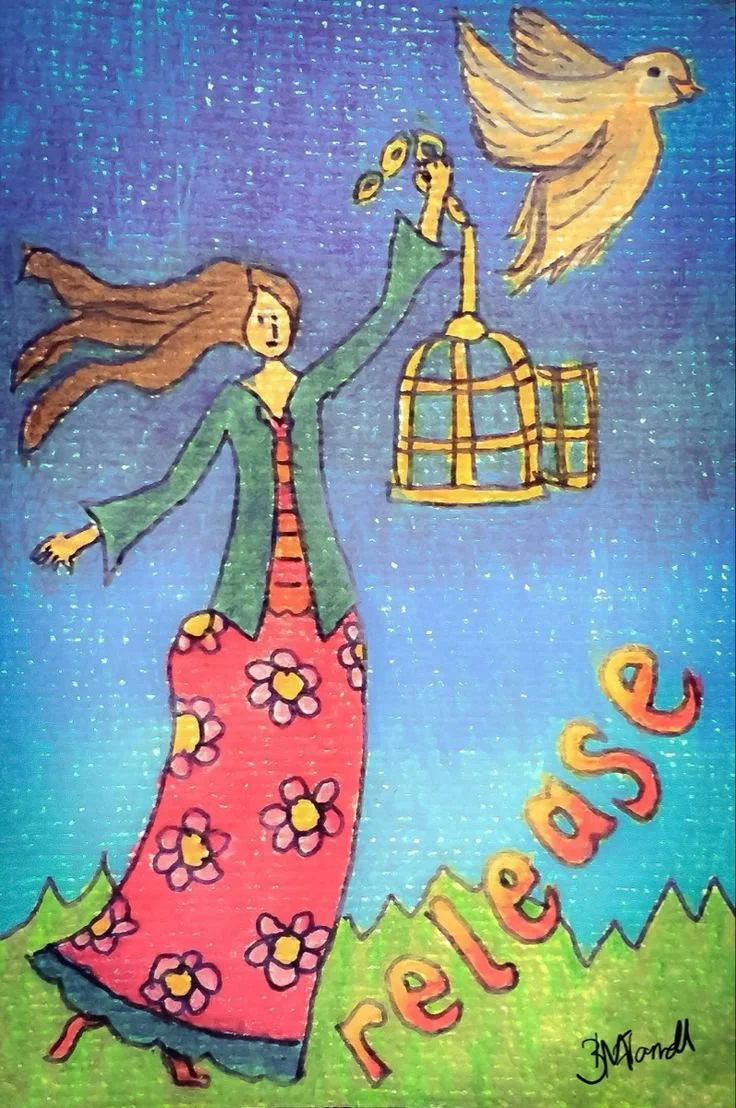
https://pin.it/3pKNx83Fk | Faith hope Love art

My own heart is a long way from perfect. I will stray and have strayed from my creed, the one I still dare to preach. I am still learning “the good” (the agathon), praying that as the days pass, I remove as many barriers as I can in the pursuit of this virtue. People are inherently compassionate and charitable, this too I have found, when you thirst and ask for a cup of water, by far the majority will offer you that cup. And if we might remember this truth, giving the benefit of the doubt, not forgetting how delightful it could be both to the one and to the other, the offering of this noble gift becomes much harder to withhold. If you could allow me one further point, especially for my younger readers, this does not mean to be naive to the darker aspects of the human condition. In time, you will come to recognise these landscapes of brokenness, and through them you will enter those deeper places where the harvest is more bountiful still, for you will be asked to practise even harder things. This is the road of Gethsemane, the journey into the profound mystery and movement of love and forgiveness. One of the greatest things we can do in this life, is to give hope to the “Other” and to release them from their anguish that they might not only flourish, but that they themselves will soon enough pay it forward. Invariably, it will also bring out the best in ourselves, we will come nearer to our true name. Yes, I am more and more returning to old places and familiar spaces, but it is in truth all I know that could be of any use.

On the many different faces of loss

Loss makes us feel incomplete

Loss makes us feel incomplete, for some time it can change us. How we feel about ourselves, and how we might present to others. There is a contraction to our perception. That is, how we might see and understand things. We instinctively put limits on our prospects. We don’t like the feeling of something “gone missing”. It’s like that uncomfortable feeling we get when we see a coffee table or a chair without one of its legs. Sometimes it can simply come down to symmetry and ballast.

Why do we feel the impact of loss so acutely

What is loss? “[t]he fact or process of losing something or someone”. It is etymologically related to the Old English los for ‘destruction’. This is what it can feel like at its worst, to have been broken apart. In the Old Norse los was used for the “breaking up the ranks of an army”. In divers ways we could feel ‘lessened’ or ‘inferior’. Made weaker by our loss. Consider a marriage which breaks down with one partner walking out on the other. This can cause for one of the partners to feel a loss of dignity and self-confidence. When a young person fails an examination, they might question their intelligence, again suffering a loss of self-belief. Our personalities are diminished, we believe or otherwise convince ourselves. Others might during a moment of cruelty make sure to convey to us, that we have lost some of our shine. We are made to feel humbled before our peers and friends. Nobody for instance, wants to hear these dreadful words which can stay with us a lifetime, “I have lost respect for you.” The hurt compounded immeasurably if it happens that it is undeserved. 

On the question of loss and its many faces

Every moment of our lives we are losing something. Our brain cells die in the thousands per second. As we age our hair falls out. We lose our teeth, our eyesight dims, and so too our vigour. We can feel ‘destruction’ going on about in our own body. And then to discern its evident dent on the bodies and minds of our older loved ones. We lose them too, and people comfort us, they “share in our loss”. Then the hours and days that we ourselves have left remaining on the earth, these, too, are lost. The question is then, how do we cope with loss and what are the different types of ‘loss’? Sometimes we are at a “loss for words”; or are made to “lose face”; we can “lose our peace”; we “lose our memory”; or “lose hope” and even “lose our mind”. People also “lose their self-belief” and can also “lose their faith”. We have all of us, lost things. Lost something. It can be natural or forcible. And our response to loss can reveal us to the world. It tests us. Loss can denude us. “Every one of us is losing something precious to us. Lost opportunities, lost possibilities, feelings we can never get back again. That’s part of what it means to be alive.” (Haruki Murakami)

What can we give to people who have suffered loss

How do we respond to others who are experiencing loss? The first thing is not to patronize. Nobody likes to feel they are being talked down to. The best way is to begin with: “I might not know exactly what you are feeling right now, but I, too, have experienced loss.” Almost always there is common ground to be found in another’s loss. It is best to remain silent for a while, and only to listen. Oftentimes we can help replace that which has been lost, a replacement toy or a new pet for a child, or a favourite book or a pair of reading glasses. But other times the loss is heartbreaking and enduring. The loss of a loved one. This is irreplaceable. This movement of charity towards the other will require the marvellous charisms of empathy and compassion. Each situation will require a different approach for there are many different types of losses, and each of these will be felt differently. If someone is grieving allow them to grieve, do not be tempted to tell them ‘how’ to grieve. Severe psychological or mental pain is personal and some things cannot be “fixed”. It is good that you are there. Empathy and compassion, to have ‘feeling’ for and to ‘co-suffer’ with the other, will open up our hearts to the anguish of the other’s loss. So we listen, we try to walk in the other’s shoes. We do not turn away. Sometimes we might even be as the ‘good shepherd’ to go after the ‘lost sheep’ (Lk. 15:3-7). “Loss” could become a mission of seeking out the wounded. 

Do not feel harried or be too quick to replace what is lost 

Sometimes we might panic and hurry to replace what is lost without too much thought or proper consideration for the outcomes. This rush to replace what has been lost, that is, to quickly fill the vacuum, can introduce other more hurting and lasting losses. It can lead from one mistake to another. Like an amateur painter who in trying to remove one smudge will inadvertently create a dozen more. If something is taken from us which, for example, we reckon to be rightly ours, we  could be tempted to retaliate without thinking through the consequences. A more discerning response could yield the better result. Bad choices can only lead to further experiences of loss and disappointment. The rush to find a new partner, for instance, which is not uncommon, can lead to further loss of self-esteem and heartache. I like very much how Ann Voskamp has put it, “[i]n our rushing, bulls in china shops, we break our own lives.” So wait, let us pull back for a season, re-organize ourselves to ‘count our losses’. Then we can during our quiet time make those new plans in moving forward. For those who belong to believing communities, it is prayer which will inspire the next movement.

How loss can oftentimes be good for us 

We are too often conditioned even from our earliest times to the reckoning that ‘loss’ is unavoidably bad for us. “Loss of playtime” let’s say, and later to be upgraded to “loss of privileges”. It then becomes a conditioning exercise, behave and things will be restored, with the result being, reflection time or alternatives can be overtly discouraged. This in itself could be the bigger loss. When I have experienced loss, whether that could be status or health, that is, loss on a personal level, I accept the early days will be hard. Then I tell myself, this has been for the good, because I have acquired new knowledge to do with resilience and a deeper faith in those things, I hold to be true. I am still alive and new words and definitions have been gifted to me. I can now grow further into my potential. It can soften my heart. It can break it. This makes it easier for revelation to enter deeper into its folds. Loss, too, could be good for us in this way, upon realizing that something is “missing” we might be as the woman who having ten silver coins loses one, to then “light a lamp, sweep the house and search carefully until she finds it” (Lk. 15:8-10). 

A telling Old Testament story

Joseph’s “long coat of many colours” (Gen. 37:3) brought him into conflict with his older brothers for it reinforced to them that he was their father’s, Jacob, favourite son. On account of their envy they conspired to sell him into slavery after having initially planned to kill him! The story is one of the most well-known from the Old Testament. Joseph owing to his prophetic gift ultimately rose to a high position in the land of Egypt, indeed to the highest most official position next to the Pharaoh. There came a time of reconciliation which shocked his brothers, but Joseph cognisant to the divine providence of God understood that ‘evil’ [and in this case a terrible loss of homeland, trust, and family] is not always what we might assume it to be: “But Joseph said to them, “Don’t be afraid. Am I in the place of God? You intended to harm me, but God intended it for good to accomplish what is now being done, the saving of many lives” (Gen. 50:18-21).

When the loss seems to us too unbearable

There are those losses which will seem too unbearable to us. Here, too, there is a way through this aching. We know this, for not few have been to such fiery places after even the most dreadful of losses, have been scorched, and returned to share their testimony. But we will have to ultimately work through this labyrinth and come to terms with it, for ourselves. This is the hardest truth, “[w]hat is to give light must endure burning” (Viktor Frankl). Bitterness and anger are normal human reactions. Yet we should be especially weary that these emotions do not keep too long in the heart which is our ‘spiritual organ’ and functions in an analogous way to the eye, filtering darkness and light. Change following loss can, and does hurt, and it will often hurt a lot, but it can make all the difference. It is temperature shock which hardens steel. It is intense heat which changes molecular structure. Franz Kafka who was fascinated with ‘transformation’ considered “patience” very high on the list of virtues. So endurance, once more, becomes the big key. It took Christ an eternity to reveal his blinding glory to his creation, “where his face shone like the sun” at his Transfiguration (Matt. 17:1f.). Allow for time and grace to make the necessary changes, similarly to hitherto unknown colours, created with the passing of the years on natural landscapes. “When all else is lost,” wrote the epigrammatic Christian N. Bovee, “the future still remains.” I know, too well, sometimes it can be like breaking your knuckles on steel. Some pain will not go away, but with time it will be lessened. But keep steadfast, day by day. Ultimately, that is the greatest secret. And we, all of us, know this to be true. 

Sometimes, too, we just need to lose things

Sometimes, too, we just need to lose things. ‘Stuff’ which is weighing us down, or causing us harm. Toxic relationships, for example. Addictions. Bad habits. Phobias. Things which are possible to overcome. These types of losses should never frighten us, but on the contrary, they should fill us with the most wonderful of all the expectations, lit., “an awaiting”. Like the very eager, but controlled trombones, in Shostakovich’s 9th Symphony. Or the terminal buds of lotus roots in pools which will bud when the temperature is just right.